

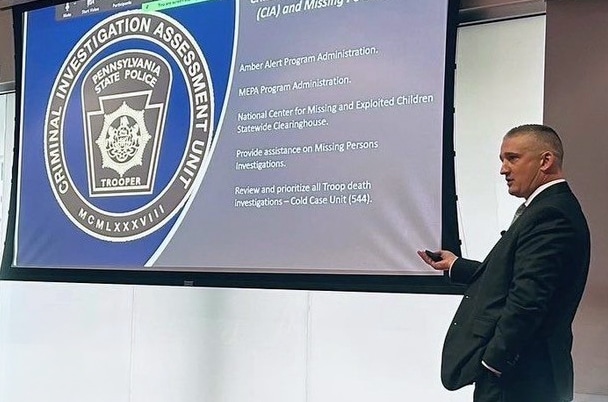
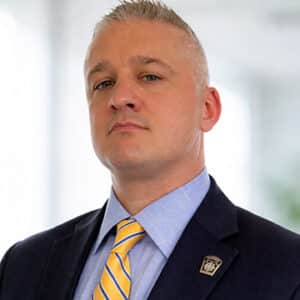
"Everything starts with compassion." For Corporal Todd McCurdy, Pennsylvania’s AMBER Alert Coordinator and supervisor of the State Police's Criminal Investigation Assessment and Missing Person units, this is more than a motto—it’s the foundation of his work. Meeting victims on their worst days, McCurdy understands the heavy toll of abduction cases. In this Q&A, he discusses his path to this demanding role, clarifies common misconceptions about the alerting process, and offers no-nonsense advice for his fellow coordinators.
Could you share a bit about your current role, the region you serve, and where you grew up?
I supervise the Pennsylvania State Police Criminal Investigation Assessment (CIA) Unit and the Missing Person Unit, which includes serving as the state's AMBER Alert Coordinator. My statewide unit provides criminal investigative analysis support for violent crimes. CIA Unit members serve on all Major Case Activations throughout Pennsylvania, assisting with homicides, kidnappings, sexual assaults, and any other complex crimes that benefit from our analysis. We also administer the Missing Endangered Person Advisory System, Pennsylvania’s alerting system for missing persons who do not meet AMBER Alert criteria.
I grew up in Lancaster, Pennsylvania, and began my career with the State Police in 2005. Before this assignment, I primarily worked as a criminal investigator in Lancaster and Chester counties in south-central and southeastern Pennsylvania.
What career path led you to your current position as an AMBER Alert Coordinator and Missing Persons Clearinghouse Manager?
I became a criminal investigator in 2009, and my training and experience have always focused on resolving violent crimes, particularly child abuse and homicide investigations. In 2016, I transitioned to a unit supervisor and Major Case Team supervisor. During that time, I was exposed to several long-term missing person investigations involving suspicious circumstances. These cases tax both investigators and agencies because they are incredibly difficult to resolve.
The challenging nature of these cases pushed me to become more proficient. Then, in 2020, I was directly involved in investigating the abduction of a female in Lancaster County. My role in that case solidified the dedication I have to this work today.
In your experience, what essential skills and personal characteristics make someone effective in this demanding role?
Everything starts with compassion. In police work, we handle numerous calls for service daily. But the average citizen will only be a victim of a violent crime once. We encounter these people on their absolute worst day, and we owe them everything we have to offer.
Varying skills are essential to this role, but they all branch from that foundation of compassion. Pennsylvania has a team of eight AMBER Alert designees. Each brings a unique skillset to the table, which makes us stronger together, but our shared compassion for victims is what drives us to be our best.
What do you believe is the biggest public misconception about the process of issuing AMBER Alerts or missing child advisories?
The biggest misconception is the belief in a mandatory waiting period before an alert can be issued. When we teach AMBER Alert procedures and missing person investigations in Pennsylvania, we are very clear: Just call us. Don’t wait, don’t hesitate, and don’t guess. Call us right away, and we will work through the incident together.
My team encourages all law enforcement and civilians to engage immediately when a child goes missing. These cases often begin under unknown circumstances, which is to be expected. Let us assist from the outset to reach a successful conclusion as efficiently as possible. Even if an alert isn't ultimately issued, my team is trained and ready to help move the investigation forward.
The nature of this work can be heavy. What keeps you motivated and focused on the mission day in and day out?
My unit is tasked with the cases that victims and their families never truly recover from. Each time the phone rings, it’s a new opportunity to attempt to bring resolution to those victims. We owe them everything we have. That mindset drives me and my team to show up every day, prepared for whatever case presents itself.
What advice would you offer to your counterparts across the country, or to someone brand new to this field?
Become proficient. Strive to fully understand the alerting process and the research surrounding child abductions. You can’t do the job of an AMBER Alert Coordinator in half measures. You have to be all in, and you have to want it. This work is not for everyone, and that’s okay.
Finally, lean on your resources, your peers, and your supporting agencies. This work cannot be done on an island. There are people all around you ready and willing to help. Take advantage of that, and your AMBER Alert program will be more successful for it.
Connect with Corporal McCurdy through the Portal.