

Inside Missouri State Highway Patrol Troop F's AMBER Alert Leadership Team
Eleven minutes. That's how long it took a Troop F trooper to spot a stolen vehicle at a convenience store, arrest the driver, and pull a child out of the back seat safe. Minutes earlier, an AMBER Alert had gone out: a non-custodial father, wanted for killing the child's mother, was on the run with his son. By the time backup arrived, it was already over.
Ask three different members of Troop F’s leadership team about that case, and three different vantage points come back—the operations director who watched the request move through channels, the lieutenant weighing whether the facts met the legal threshold, the coordinator trusting that the alert reached exactly the people who needed to see it. It’s the case each of them reaches for first when asked what this work looks like when it succeeds.
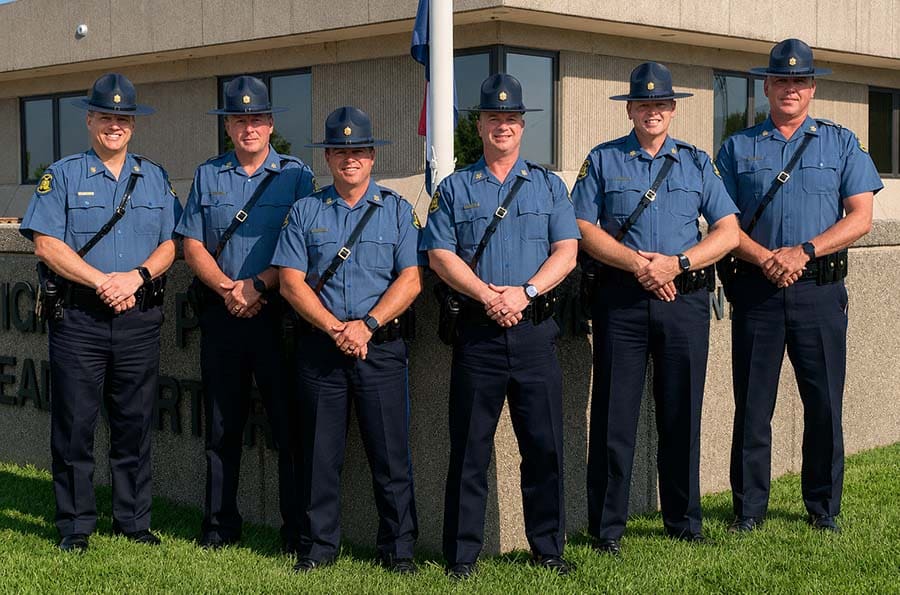
That overlap says something about how this team operates. Missouri State Highway Patrol's Troop F covers the state's central region—Jefferson City, Columbia, the Lake of the Ozarks—through a command structure built on military service, small-town policing, and decades inside the Patrol. Captain Jason Crites and five lieutenants each run a different piece of Troop F's operations while sharing one high-stakes responsibility: deciding, often within minutes, whether a missing child meets the statutory threshold for a statewide AMBER Alert.
Ask any of them what the public gets wrong, and the answer comes back almost word for word: people assume an alert should go out for every missing child. It doesn’t. The criteria are deliberately narrow—evidence of abduction, evidence of imminent danger—and cases that fall short are routed instead to Missouri’s Endangered Person Advisory system. It’s a distinction the team spends real energy explaining, and worth stating plainly before their individual stories begin.
Capt. Jason N. Crites, Badge #32
Missouri Statewide AMBER Alert Coordinator & Troop F Commander
Crites grew up in Portageville, in Missouri’s southeast bootheel, and served four years in the U.S. Marine Corps before joining the Highway Patrol in 1998. He's held nearly every rank between Troops F and E—corporal, sergeant, lieutenant —and ran the Patrol’s Research and Development Division before returning to Troop F as commander and statewide AMBER Alert Coordinator, a dual role that puts him in charge of both central-region operations and every alert-activation decision in the state.
The pull toward the job started next door. “An MSHP trooper moved in next door and let me ride along during his shifts,” he says. “Seeing him take decisive action during criminal encounters and help stranded motorists inspired me. I looked up to him as a mentor.” After the Marine Corps, becoming a trooper felt like the natural next step.
As coordinator, Crites is the one drawing the line the public most often misunderstands. “We maintain very strict criteria for these activations,” he says, but a missing child who doesn’t meet AMBER Alert parameters isn’t simply left uncovered. Missouri's Endangered Person Advisory exists precisely for those cases.
The case Crites points to as a defining success is a different one: a child abducted in central Missouri, where the reporting agency moved fast with a vehicle description, plate number, and direction of travel. Troop F targeted the alert to that corridor; a motorist spotted the car on the interstate; and because a saturation detail happened to be working nearby, a trooper made the stop and recovered the child within minutes.
“Knowing that a child has been successfully recovered makes the entire grind of maintaining and improving the system completely worth the effort. As a parent, I cannot imagine the fear of having a child abducted.” — Capt. Jason N. Crites
The job's weight doesn't disappear at the end of a shift. Crites manages it with a small ritual: “A personal coping mechanism I developed when I was younger is watching a movie after a critical incident or stressful day. It allows me to temporarily disconnect so I can return to duty with a clear mind.” His advice to newer Coordinators is practical rather than sentimental—master the criteria, tighten your transmission process, and never work without backup. “Having six qualified staff members allows us to consult one another on complicated requests to ensure we make the right call.”
Lt. Joseph D. Davidson, Badge #66
District 4 Operations Director
Davidson grew up in Kahoka, in Missouri’s far northeast corner, and spent seven years in local law enforcement—three as a detention officer, four as a Clark County deputy—before joining the Highway Patrol in 2004. He spent his first two decades in Troop B, rising to corporal and sergeant, before a promotion to lieutenant in August 2024 moved his family to Jefferson City. He now runs District 4 operations, supervising three zones along Interstate 70 and commercial vehicle enforcement, while also serving as motor equipment manager, Honor Guard coordinator, awards coordinator, and property control administrator.
His grandfather was a law enforcement officer, and watching that career shaped his own. “By the time I was in high school, I knew I wanted to follow in his footsteps,” he says.
Davidson's read on the public’s biggest misunderstanding goes a step further than most: it’s not just that people expect an alert for every missing child—many also assume an alert failed simply because they didn’t personally receive it. In most cases, that's a matter of geography, not system failure; alerts are targeted to the area where the child is believed to be.
His own defining case unfolded on Interstate 70, not at a convenience store. FLOCK license-plate cameras flagged the suspect vehicle, and rapid coordination between radio operators and road troopers turned that lead into a safe recovery within minutes—a case that shows how much depends on technology and dispatch working in sync, not just a trooper’s instincts in the moment.
Davidson’s role is largely support—keeping troopers and clerical staff equipped and functioning—and that’s where his motivation comes from: “Knowing that they depend on me every day to get them what they need keeps me highly motivated.” Outside of work, it’s family: 18 years married to his wife, Haley, three kids, weekends at the Lake of the Ozarks, golf, pickleball, and lawn care.
“Seek help when you need it; it is a sign of strength, not weakness … do your best not to let your career become your entire identity.” — Lt. Joseph D. Davidson
Lt. Chris S. Daniels, Badge #55
District Lieutenant & Public Order Unit Assistant Platoon Leader
Daniels grew up in Richmond, Missouri, and graduated from Missouri Western State University before joining the Missouri State Water Patrol in 2000, working the Lake of the Ozarks as a patrol officer. When the Water Patrol merged into the Highway Patrol in 2011, he became a trooper without leaving the Lake, working up to corporal and sergeant before a 2022 promotion to lieutenant. He now manages four road zones within Troop F, supervises radio and maintenance staff, coordinates the University of Missouri football detail, serves as an assistant platoon leader for the Public Order Unit, and acts as the Exposure Control Plan coordinator.
His path into the field was simple and direct: “Upon completing college, I had a simple, direct desire to work in a public service field where I could actively help people and improve the community I live in.” He names integrity, clear communication, critical thinking, and decisiveness as the traits the job demands—and describes the daily balancing act at the center of alert decisions as “a high-stakes balancing act of gathering and verifying facts against established criteria while managing the extreme urgency required to issue a timely alert.” He’s one of several on the team who point to the Interstate 70 recovery described above as the case that stays with him.
What keeps him going is uncomplicated: “Having the distinct knowledge that the work I perform actually matters to people and makes a tangible difference in our communities.” Off duty, he protects time with his family deliberately, calling it essential to not “take the burdens of the job home with you.”
Lt. James E. Lowary, Badge #91
District Lieutenant & Public Order Unit Coordinator
Lowary grew up in Quincy, Illinois, and attended Missouri Southern College in Joplin before the Missouri State Water Patrol hired him in 2000 at the Lake of the Ozarks. He moved into the Highway Patrol in 2004, first assigned to Audrain County, then serving across Camden, Miller, and Cole counties as a corporal and sergeant before making lieutenant in 2023. He now oversees Troop F’s marine zones and the Lake of the Ozarks road zones, coordinates the Public Order Unit, and serves as the troop’s drug test officer.
Lowary’s draw to the work is rooted in protecting people who can’t protect themselves: “I have always felt drawn to protecting vulnerable individuals who cannot advocate for themselves … law enforcement offers a powerful platform to hold offenders accountable while helping impacted families rebuild their lives.” He describes integrity and “a rock-solid moral compass” as non-negotiable, since “children depend entirely on law enforcement to advocate for them.” Like several of his colleagues, the case he returns to is the interstate recovery of the boy abducted by his non-custodial father—a reminder, he says, that “every second is critical, yet all actions must remain tethered to verified facts.”
Outside the uniform, Lowary's life runs on a different clock entirely: a farm with horses and cattle, a wife and daughter who compete in barrel racing, and time spent deer hunting.
“It is essential to focus on interests outside the patrol, so work does not interfere with family life.” — Lt. James E. Lowary
Lt. Casey Utterback, Badge #103
District I Commander & Assistant Patrol ALERT Coordinator
Utterback grew up in a small central Missouri town and joined the Missouri Army National Guard in 1997 before earning an Associate of Arts degree and completing a 470-hour police academy. After three years in municipal policing, he joined the Highway Patrol in 2002, working up through corporal and master sergeant in Troop A out of Kansas City before a promotion to lieutenant brought him to Troop F in 2021. He now commands District I, overseeing Motor Vehicle Inspection, Driver Examination, the Chaplain program, and the SWAT team, in addition to his role as assistant Patrol ALERT Coordinator.
“I knew by high school that I wanted to pursue both the military and law enforcement,” he says, describing an empathetic nature and a drive to serve that predates his career. He points to communication and emotional intelligence—paired with “a solid moral compass and core integrity”—as the foundation of effective leadership in the role.
The hardest part of his job isn’t any single case; it’s the whiplash between them. “The toughest challenge is rapidly shifting gears between radically different tasks within a span of minutes—such as transitioning from tedious administrative paperwork directly to supervising a high-speed vehicle pursuit or managing an officer-involved shooting scene.”
His defining case happened in the Kansas City area: a vehicle stolen with a child inside while the mother ran into a store. The AMBER Alert triggered a multi-jurisdictional pursuit—local, county, and state agencies working together—that ended with a tire-spike, a short foot chase, an arrest, and the child safely back with her mother.
Utterback manages the job’s weight by accepting its limits: “certain outcomes are completely beyond your control, regardless of how much effort you expend.” He protects time for physical fitness and family—sporting events, holidays, family dinners.
“Life is short, so make a conscious effort to make it enjoyable for yourself and those around you.” — Lt. Casey Utterback
Lt. Morgan B. Patterson, Badge #88
Administrative Services Director & Assistant Troop F SWAT Director
Patterson is a Jefferson City native who attended the State Technical College of Missouri and joined the Highway Patrol in 2010 as part of the 92nd Recruit Class. He worked the road in Osage and Gasconade counties before being promoted to corporal, then sergeant in Cole County, then spent a tour instructing at the Patrol’s Academy before making lieutenant in 2023. He now serves as Troop F’s administrative services director and assistant director of Troop F SWAT.
“I witnessed firsthand how dedicated law enforcement officers could change lives,” he says of his path into the field, describing a lasting sense of responsibility “to stand up for those who cannot protect themselves.” He names integrity and communication as the two pillars of emergency response—the first ensuring decisions are based on accurate data, the second keeping field officers, agencies, and the public aligned during a crisis.
The case Patterson points to isn’t a clean rescue—it’s one that almost didn’t happen. A request initially fell short of AMBER Alert criteria, and the team made the harder call: deny it and tell the detective exactly what evidence was missing. Once the agency came back with what was needed, the alert went out immediately. A trooper spotted the vehicle, made a brief pursuit, and recovered the children unharmed. It’s a story less about speed than restraint—proof that getting the criteria right, even when it means saying no first, is what makes the system work.
Patterson’s motivation is close to home: a husband and father of three young boys, he says they’re “a daily reminder of exactly why this work is so important.” He recharges by coaching their sports teams, calling it “a healthy, positive outlet outside of the uniform.”
“Never attempt to make critical, life-altering decisions in isolation … build a cohesive team that communicates openly and trusts one another.” — Lt. Morgan B. Patterson
Six Paths, One Clock
Six different paths into the job, six different corners of Troop F's territory—but the same math shows up in every conversation: children can’t wait, the criteria can’t bend, and no single person carries that weight alone. That's the case this team keeps making, one alert at a time.
Connect with the Missouri State Highway Patrol Troop F's AMBER Alert Leadership Team through the Portal.