

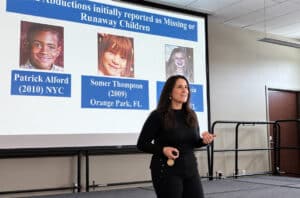

New York State Police Senior Investigator Victoria Martuscello has built a career around one idea: behind every case is a child and a family.
Every missing child case is urgent, she says. Not every one is an AMBER Alert. For Martuscello, a Senior Investigator and AMBER Alert Coordinator with the New York State Police (NYSP), that distinction shapes how she approaches the work and what she tells colleagues who are new to it. "If an AMBER Alert is not the right tool, that should never end the conversation," she says. "The next question should be, 'What else can we do?'"

From the Classroom to the Intelligence Center
Martuscello is a Senior Investigator and AMBER Alert Coordinator with the New York State Police. She supervises the Investigative Support Unit at the New York State Police Intelligence Center. The unit supports investigations across the state, provides investigative and intelligence support to law enforcement agencies throughout New York, and oversees several statewide programs and resources, including missing and exploited children investigations, AMBER Alerts, Abducted Adult Alerts, and Blue Alerts.
A native of Troy, she has lived in New York's Capital Region her whole life. Before policing, she was a teacher. She also spent many years coaching youth sports. Working with children and families was part of her life before she ever wore a badge.
After joining the State Police, she became increasingly involved in investigative support and in cases involving missing and exploited children. Her responsibilities grew to include coordinating resources for missing child investigations, working with the state's Missing Persons Clearinghouse, and supporting AMBER Alert activations and other statewide alerting efforts. "Looking back, there is a clear connection between where I started and where I am now," she says. "A large part of my career has always centered around children and helping protect them."
The work, she adds, can be among the hardest in law enforcement, and the most meaningful, "because the work can have such a direct impact on a child and their family."
Calm, Clear, and Compassionate
Asked what makes someone effective in this role, Martuscello starts with composure. Cases move quickly and emotions run high, so investigators have to "separate that emotion from the facts, evaluate the information you have, and make sound decisions."
She also stresses communication, since Coordinators work with investigators, analysts, command staff, families, and outside partners. Judgment, attention to detail, adaptability, and compassion round out her list. Sometimes "a very small piece of information can become incredibly important."
Above all, she says, it takes a willingness to work as a team. "No single person or agency has every resource or every answer, and some of the best outcomes come from people putting egos aside, sharing information, and working toward the same goal."
Protecting the Integrity of the Alert
The AMBER Alert system works best when the public understands what an activation means: a child is believed to be in imminent danger, and the information shared may help locate them. Use the alerts too broadly, Martuscello warns, and people may start tuning them out or disabling notifications.
When a case doesn't meet AMBER Alert criteria, the response doesn't slow down. Investigators can turn to Missing Child Alerts, social media, intelligence sharing, analytical resources, law enforcement notifications, license plate reader information, and traditional media. "The balance comes from matching the response to the facts of the case," she says.
Her biggest daily challenge is the volume of information. Tips, social media, other agencies, and multiple investigative systems can flood in within hours. The task is determining "what is credible, what is actionable, and where resources should be focused," without letting speed compromise accuracy. She relies on established procedures, close communication with the investigating agency and partners, and continual reassessment as the case develops.
Lessons from Charlotte Sena
Martuscello was part of the NYSP team during the 2023 search for 9-year-old Charlotte Sena, who disappeared from Moreau Lake State Park in Saratoga County on September 30 and was found safe two days later. She was serving as an Investigator and Assistant AMBER Alert Coordinator at the time. The case drew national attention and an extraordinary multiagency response. (Read our "Frontlines" story on the case.)
For Martuscello, it reinforced the value of staying grounded in facts despite intense public pressure. Law enforcement has to make decisions "based on verified information, not outside pressure," she says, and consistent criteria keep decision-making objective in emotional moments. The case also showed how effective agencies can be when they share information quickly. "Public trust is incredibly important," she says. "We want the public to understand that when an AMBER Alert is issued, there is a specific reason for it."
Motivation and Balance
What keeps Martuscello going is the direct impact of the work and the people around her. That includes her own investigator, other investigators and analysts at the Intelligence Center, Missing Persons Clearinghouse personnel, local agencies, and federal partners. Sometimes the role is highly visible. Other times it is "one phone call, one lead, one analytical product, or connecting an investigator with the right resource." All of it matters.
Away from work, family is how she recharges. She and her husband have four young children, and a schedule full of sports and activities keeps her grounded. She has learned to give every case everything while working it, but recognizes that "carrying every case home with you is not sustainable."
Advice for Colleagues
Her advice for counterparts nationwide and for newcomers is to build relationships before you need them. Learn the criteria, understand the purpose behind them, and be able to explain why an alert or resource is or isn't appropriate. Ask questions, verify information, keep the investigating agency informed, and don't hesitate to reach out to someone with more experience.
"Most importantly, never lose sight of the fact that behind every case is a child and a family," she says. "Keeping that at the center of the work helps guide everything else."
Connect with Victoria Martuscello through the Portal.