

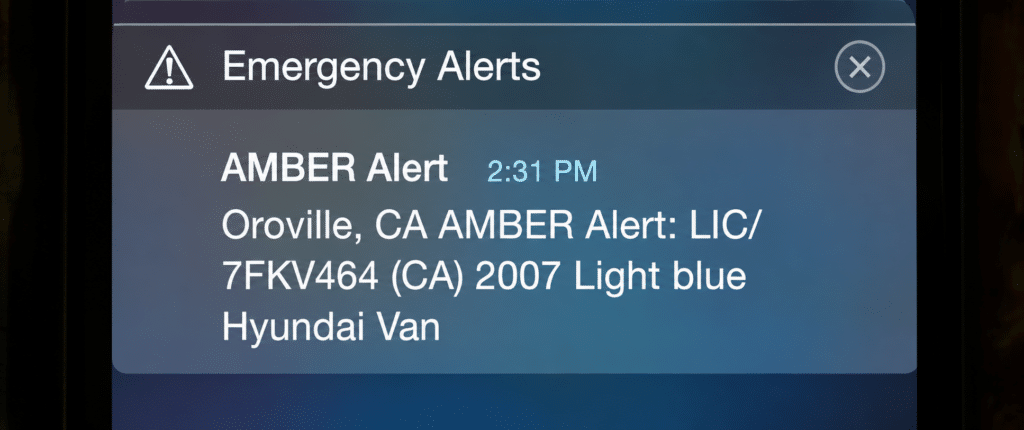
 The Butte County Sheriff’s Office in California issued an AMBER Alert for 3 children on June 14, 2014. Nine minutes later the children were recovered safely and the suspect was in custody. A citizen saw the Wireless Emergency Alert (WEA) on his cell phone and looked up and saw the suspect’s blue van.
“I can’t believe right when the AMBER Alert came is right when I see the van. That was right within 5 seconds,” Gurinder Jhutty told a reporter. “My gut told me ‘Let’s go back and check it out.’ That’s when I came back and I looked at the license plate and that’s when I started calling 911 and I saw 3 kids in the back. That’s when I started following him.”
Matthew Kline allegedly took his 3-year-old daughter, 18-month-old son and an unrelated 4-year-old girl earlier in the morning. The AMBER Alert cautioned citizens to not approach the suspect because authorities believed he was carrying firearms.
Sergeant Jason Hail has spent 19 years with the Butte County Sheriff’s Office and this was the first AMBER Alert for him and the agency. The sheriff’s office immediately set up a command post and a call center. Officers had an idea where the suspect was heading but did not know at the time the alert would go to all the cell phones in the area.
“I was very surprised and relieved how quickly it was resolved,” said Hail. “I was impressed and it renewed my faith by showing that people really do care and will take appropriate action.”
He also credits the AMBER Alert training he had received in the past for the positive outcome. “I learned that in order to have a smooth operation, it would be beneficial to have all of the involved parties’ information and the circumstances written down, including officer safety information and if there is an arrest warrant active or in the process,” added Hail. “We were flooded with calls in our dispatch center. I learned we need to have a sufficient amount of people on duty to handle calls from the public and assign tasks to individuals to handle the media, make contact with the National Center for Missing & Exploited Children (NCMEC) and other logistics.”
California Highway Patrol Captain Jay Bart has been California’s AMBER Alert Coordinator for the past 2 years. He said it was an easy decision to realize this case was eligible for an AMBER Alert. “The children were in imminent danger because the suspect was violent and mentally unstable,” said Bart. “He was also in possession of stolen firearms and had made threats toward the children and their mother.”
The highway patrol uses a step-by-step process to initiate a chain of notifications to try and recover children during an AMBER Alert, including:
- The Emergency Alert System was activated.
- Changeable Message Signs were activated to display the suspect vehicle’s information on the national and state highway systems.
- The suspect vehicle’s information was entered into the California Highway Patrol License Plate Reader database.
- The California Lottery was contacted to display the AMBER Alert information on their display systems.
- A message was posted to the California Office of Emergency Services’ Emergency Digital Information System website and it was also sent to all law enforcement agencies in California, including off-duty highway patrol officers.
- NCMEC was contacted to request the WEA activation and other secondary notifications.
- A flyer with information and pictures was sent to law enforcement, first responders, medical facilities, media outlets and missing persons’ organizations.
“I firmly believe our protocols aided in the success of this AMBER Alert. We are all aware time is a critical factor in cases where missing and abducted children are involved,” said Bart. “I was ecstatic to learn the suspect was apprehended in a very short time frame.”
NCMEC believes this AMBER Alert had the fastest resolution of any alert involving WEA. “This case really shows what a game changer it is to have AMBER Alerts come directly to cell phones in the targeted area,” said Robert Hoever, NCMEC’s Director of Special Programs in the Missing Children Division. “Nearly everyone is carrying a phone and we just need one person to be in the right place at the right time.”
Hail has this advice for those who have yet to issue an AMBER Alert: “I believe the most important part is to have enough staff in place to handle calls from the public,” he said. “Have individuals in place and assign those individuals responsibilities as you would with any other critical incident.”
Preparation, protocols and new technology made this AMBER Alert a case study on what works to recover abducted children.
“Factoring in the time it takes to gather information, approve the alert and activate the emergency alert system, the suspect was arrested and the victims were safely recovered in less than one hour from the activation,” concluded Bart.