



By Denise Gee Peacock
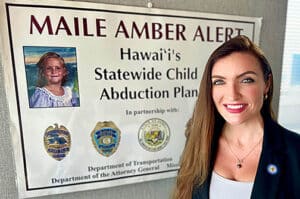
Nearly 3,000 miles and three time zones away, Hawaii's AMBER Alert Coordinator Amanda Leonard faced a daunting task: A 6-year-old Big Island girl named Violet was missing, and the best hope of finding her was in Arizona.
The parental custodial-interference case did not meet Hawaii’s strict criteria for issuing a MAILE AMBER Alert, so Leonard expected her options in Arizona would be similarly limited to a be-on-the-lookout (BOLO) bulletin shared with law enforcement. What she didn’t expect was an opportunity that would change the trajectory of the search—and set a precedent for a brand-new alerting tool.
The Backstory
After Violet was reported missing July 16, 2025, investigators learned her noncustodial mother, Sarah C., had flown with her from Kona to Phoenix Sky Harbor International Airport. After that, the trail went cold.
By Tuesday, July 22, one fact was clear: Sarah had no legal authority to take Violet to the mainland. Investigators were increasingly concerned about the child’s safety.
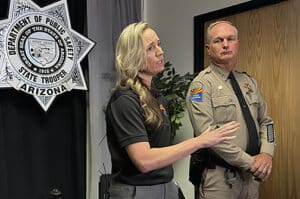
To locate her Arizona counterpart, Leonard turned to the AMBERAdvocate.org Partner Portal, maintained by the AMBER Alert Training & Technical Assistance Program of the National Criminal Justice Training Center (NCJTC). Her call reached the Arizona Department of Public Safety (DPS) Duty Office just as DPS Alerts Coordinator Kelsey Commisso* was finishing her shift.
Leonard explained the situation. Hawaii was not requesting an AMBER Alert extension—no formal alert had been issued—but asked Arizona to circulate a BOLO to law enforcement. The FBI and Hawaii Police Department were already coordinating with Arizona investigators. And if Arizona had other ideas, she was open to them.
A New Option Emerges
From home, Commisso continued following the case as new details came in—and began to consider another possibility. Arizona had enacted the Turquoise Alert less than two weeks earlier. It had never been used. Could this case qualify?
There was already confusion about the new alert. Some assumed, based on its name, that it was limited to Indigenous missing persons. While that had been its original intent, the statute broadened during the legislative process to include all missing and endangered individuals under 65, while also recognizing the disproportionate impact of missing and murdered Indigenous people (MMIP).
The alert stems from “Emily’s Law,” Arizona House Bill 2281, created in memory of 14-year-old Emily Pike, a San Carlos Apache Tribal member found murdered after being reported missing in early 2025. The law was signed in May 2025 by Governor Katie Hobbs to improve responses to disappearances, particularly those involving Indigenous people.
Using the alert for a non-Native child—from as far away as Hawaii—would likely raise questions. But the criteria appeared to fit. Commisso called her supervisor, Sgt. Kim Love-Ness. They agreed: The case met the criteria and could be activated at Hawaii’s request.

Arizona's Turquoise Alert Criteria
The Arizona Department of Public Safety may issue a Turquoise Alert if the following criteria are met:
- The missing person is under age 65.
- Law enforcement has exhausted available local resources.
- Law enforcement believes the person is in danger or otherwise in peril.
- The disappearance involves unexplained or suspicious circumstances and is not solely a runaway situation (unless aggregating factors indicate danger).
- Public dissemination of information could assist in safe recovery.
“We saw this as a chance to find Violet,” Commisso says, “and to educate the public about who the alert is actually intended for.”
A Sleepless Call
After a restless night, Commisso called Leonard early the next morning—unaware it was 4:29 a.m. in Hawaii.
Leonard was awake. She hadn’t slept either.
The opportunity was real, but the decision belonged to Hawaii investigators. “It’s our alert,” Commisso explains, “but it’s their missing child case.”
Leonard relayed the option to Hawaii Police Department command staff and the FBI. There was no guarantee they would proceed.
“Just because an alert exists doesn’t mean activating it is the right call,” Commisso says. “An alert has to help, not hinder, an investigation.”
Hawaii ultimately agreed. Local leads were exhausted, and urgency was mounting. From that point on, Commisso and Leonard were in near-constant contact, navigating parallel chains of command across multiple time zones.
Their camaraderie wasn’t accidental. Both had attended the National AMBER Alert and AMBER Alert in Indian Country Symposium in Washington, D.C., earlier that year.
“Being connected through the NCJTC builds instant rapport,” Leonard says.
Arizona’s Turquoise Alert had gone live just six days before Violet was reported missing. Being its first activation carried weight. “It would be a huge responsibility,” Leonard recalls thinking, “one full of public scrutiny and media intensity.”
First Turquoise Alert Unfolds
On Wednesday, July 23, Hawaii Police Department leadership, working closely with the FBI, approved activation of Arizona’s Turquoise Alert.
“This is exactly what the Turquoise Alert is meant for—cases that don’t meet AMBER Alert criteria but demand urgency,” Commisso says. For example, Arizona had not issued an AMBER Alert since 2023. The threshold is intentionally high to avoid public desensitization. The gray space between “AMBER Alert” and “nothing at all” is where many cases fall—and where this alert was designed to operate.
Even before final approval, coordination was underway. Hawaii officials submitted documentation demonstrating the case met Arizona’s criteria. Leadership within Arizona’s DPS Counter Terrorism Information Center (Fusion Center), the Governor’s Office, public information offices in both states, transportation divisions, dispatch centers, and child abduction response teams were notified.
At 7:01 p.m. Arizona time, the Turquoise Alert was sent to more than 10 million cell phones statewide. Minutes later, media outlets were notified.
“Everything appeared to be working,” Commisso recalls. “Now we just needed the alert to help find Violet.”
She went to bed that night with her two cell phones within reach. Five hours later, one of them lit up.
Violet was safe. A public tip led law enforcement to a women’s shelter in Cottonwood, Arizona, where at approximately 12:45 a.m., officers were able to locate the girl and her mother.
We deeply respect the efforts of Governor Hobbs to provide critically needed public safety assistance for the 22 Tribes in Arizona. The new Turquoise Alert, also known as ‘Emily's Law,’ will advance safety in Arizona not only within Tribal communities, but through the State of Arizona. Over the years, Tribal communities have faced the crisis of missing and murdered Indigenous persons without advanced emergency systems in place and we see the Turquoise Alert as a proactive step in the right direction.

Sarah C. was taken into custody without incident on a felony custodial-interference warrant. Violet was soon reunited with her custodial father.
After the Adrenaline
“When I got the text that she’d been found, I teared up,” Commisso says. “There was such relief. The adrenaline lasted for days.”
“It’s euphoric,” Leonard adds. “You’re happy for the child, the left-behind parent, and everyone who helped bring them home.”
Commisso and Leonard had been in constant contact through the formation and dissemination of the Turquoise Alert and realized by now they shared a unique bond with each other.
In the hours that followed came media questions, public scrutiny, and continued education about what the Turquoise Alert is—and is not. But in that moment, none of it outweighed the outcome: The system had worked.
Arizona’s first Turquoise Alert did more than help locate a missing child. It defined a new tool in real time, clarified its purpose, and demonstrated what can happen when two states—separated by thousands of miles and three time zones—trust each other enough to act. In the gray space between “AMBER Alert” and “nothing at all,” a precedent had been set—and a child was home.
*Editor's Note: As of press time, Commisso was recently named Supervisor within the Arizona Counter Terrorism Information Center, where she continues to oversee its emergency alerting program.
Meet the Press: Three Tips for Alert Coordinators
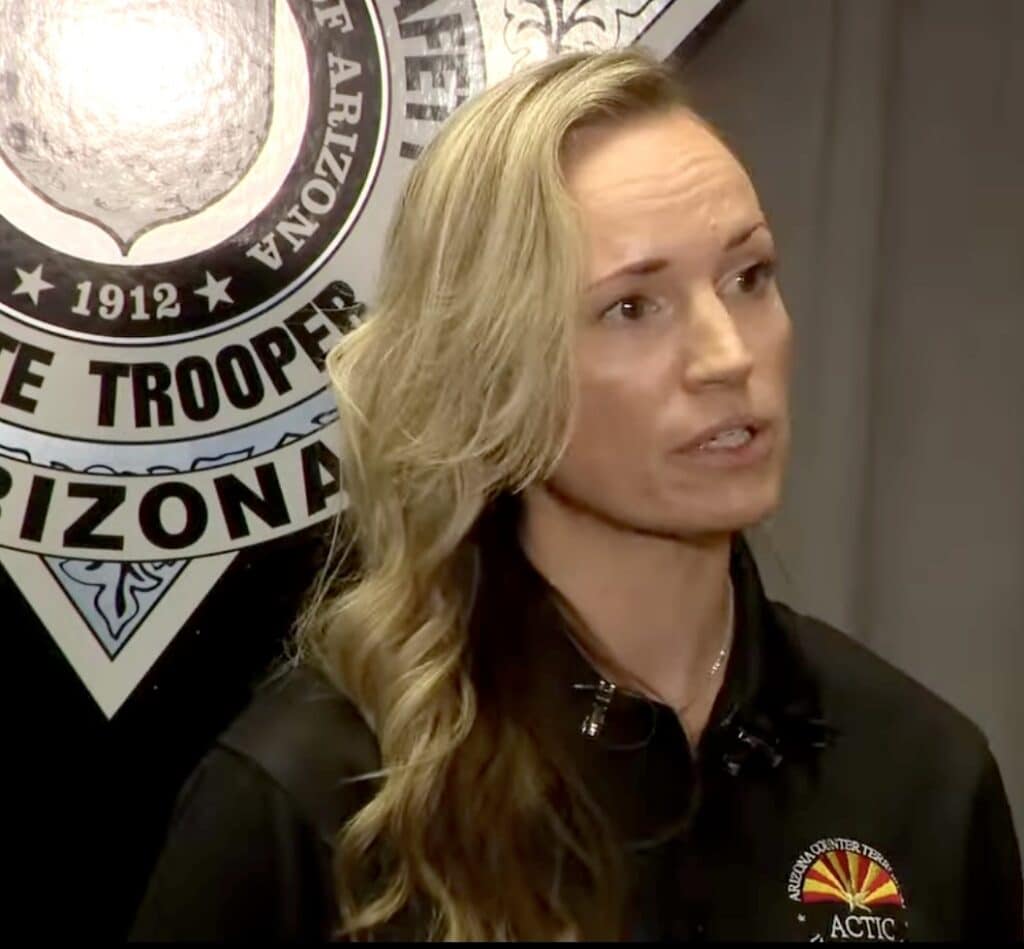
When Arizona DPS Alerts Coordinator Kelsey Commisso stepped to the podium, it was her first live media event of that magnitude. “It was a room full of major news outlets—microphones on, cameras rolling, bright lights, rapid-fire questions,” she recalls. “Rather than relying on rigid scripting, I focused on staying grounded, present, and intentional.” Here is her advice from that day.
- Pause First. Listen Fully. Actively listen to what is being asked—not what you think is being asked—and take a breath before answering. Pausing prevents speculation and over-sharing.
- Be Human—But Stay Rooted in Truth. Balance professionalism with
relatability. Authenticity builds trust when grounded in facts. - Protect the Investigation Without Shutting Out the Public. Transparency and investigative integrity are not mutually exclusive. Defer case-specific details when necessary while communicating with empathy and clarity.
