


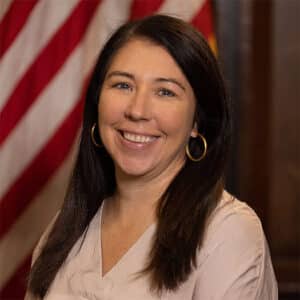
"In that moment, I knew I wanted to dedicate my life to helping protect children like him, and I decided I wanted to become a police officer." For Assistant Special Agent in Charge Lisa Vorrasi, Georgia's AMBER Alert Coordinator, a childhood memory of a missing child flyer forged a 20-year career in law enforcement. Juggling intelligence operations at the Georgia Bureau of Investigation with the urgency of missing child investigations, Vorrasi knows that success requires preparation, resilience, and strong alliances. In this Q&A, she shares her strategies for managing high-stakes crises, the vital importance of building partnerships before disaster strikes, and how she finds joy off the clock.
What inspired you to dedicate your career to law enforcement and protecting vulnerable children?
Growing up in Wisconsin, a seemingly small event profoundly impacted the direction of my life. One day after school, I found a flyer in the mail with an image of a young boy about my age. My parents explained he had been kidnapped, and the flyers were distributed to help find him. I remember crying in my room for hours, thinking of that happy boy in the picture who was now scared and separated from his family. Even though I had never met him, the pain was very real. In that moment, I knew I wanted to dedicate my life to protecting children like him, and I decided to become a police officer.
What is the most significant challenge you encounter in your daily work, and how do you navigate it?
Serving as the Georgia AMBER Alert Coordinator represents only a portion of my responsibilities. I am also a supervisor at the GBI’s Georgia Information Sharing and Analysis Center, one of 80 intelligence fusion centers across the United States. I also supervise the Georgia Bureau of Investigation's Information Sharing and Analysis Center, one of about 80 intelligence fusion centers in the U.S. I help oversee a nearly 65-person unit providing criminal and counterterrorism intelligence to our partners. Working in metro Atlanta brings unique challenges, including a massive, diverse population and a sheer volume of complex investigations.
However, my most significant daily challenge is prioritizing tasks. Because of the nature of our work, emerging issues of varying urgency constantly arise. Navigating this requires continuous reprioritization, focusing on "what is important now"—even as that changes by the minute. It requires flexibility, organization, and learning to give myself and others grace.
The nature of this work can be heavy. What keeps you motivated and focused on the mission?
Law enforcement officers are often present on the worst day of someone’s life. For a long career, you must stay grounded in the positive impact you're making rather than dwelling on the sadness. One of the most rewarding aspects is the sense of righteous conviction when victims of horrific crimes receive justice. Holding predators accountable is a powerful motivator, but recognizing small wins—like helping a victim access service, getting a confession, or just listening to someone—is equally vital.
Some days are harder than others, but we are making a difference, one child at a time. If we improve even one life, it is worth the setbacks. Sometimes, getting through tough days comes down to a decent cup of coffee, a good night’s sleep, and a lot of laughter.
How do you manage stress and find joy outside of work?
A great blessing has been my involvement with Special Olympics Georgia's Law Enforcement Torch Run. For 16 years, it has provided a deep source of joy and purpose. The athletes bring incredible positivity, and being part of that community has been life-changing. I also organize Hockey Fun Day, a fundraiser combining my love of ice hockey with my passion for the Special Olympics.
Additionally, my 10-year-old son, Nolan, and I are unified partners on a soccer team, North Fulton United. Stepping onto the field on Sunday afternoons makes the stress of the week fade away.
Recently, I was honored to participate in the 2025 Special Olympics World Winter Games in Turin, Italy. I joined 80 law enforcement officers worldwide to run the Flame of Hope across northern Italy before the opening ceremony. It was a powerful reminder of this movement's global impact. I also recharge by traveling, playing hockey, coaching two Atlanta Ice Lynx girls' youth hockey teams, and spending time with my family and animals.
What advice would you offer to your counterparts across the country or someone brand new to this field?
I have been with the GBI for 20 years, but I have only served as the AMBER Alert Coordinator for the past three years. My biggest lesson is the importance of building relationships with law enforcement partners before a critical incident occurs. The side of the road, in the pouring rain, in the middle of the night, is not the time to establish those connections.
Child abduction investigations evolve rapidly, and every second matters. Knowing you can call a trusted partner directly in the middle of the night makes a tremendous difference. I am especially grateful for the partnerships among AMBER Alert Coordinators and Missing Children Clearinghouse Managers across the country, particularly in Region 2. They are an invaluable resource. Stay engaged, communicate regularly, attend training, and exchange ideas.
Biography
Assistant Special Agent in Charge Lisa Vorrasi of the GBI is assigned to the state’s Fusion Center, the Georgia Information Sharing and Analysis Center. A 20-year veteran of the GBI, she serves as Georgia's AMBER Alert Coordinator and Child Abduction Response Team Commander. She previously served as an ASAC at the Atlanta Regional Office and as an agent for the Atlanta-Carolinas High Intensity Drug Trafficking Area and the Atlanta Regional Office.
Vorrasi holds a bachelor’s degree from the University of Dayton and a master’s degree from Georgia State University. She initiated the GBI’s involvement in the Special Olympics Georgia Law Enforcement Torch Run in 2010 and continues to serve as the agency coordinator and is the Co-Assistant Director for the Special Olympics Georgia Law Enforcement Torch Run Executive Council. Additionally, Vorrasi serves as the long-standing secretary on the executive board of the DeKalb County Chiefs' Association.
Connect with Lisa Vorassi through the Portal.