

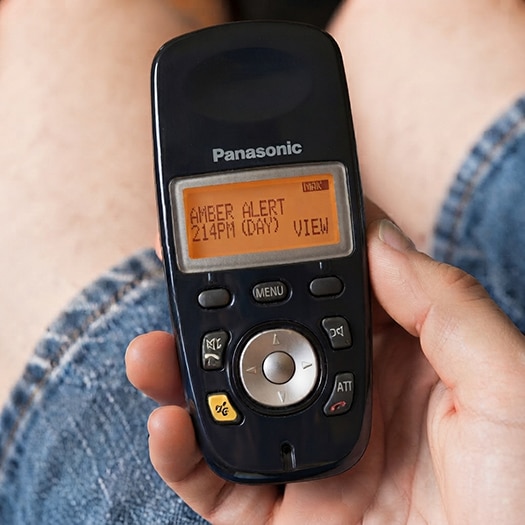
 In Buckeye Lake, Ohio, the phone rang at the home of Terry and Laurence Noblick. Laurence picked up the phone after reading “AMBER Alert” on the caller ID. He was surprised when the person on the other end of the line said he was collecting money for the AMBER Alert Plan.
“That is rather strange to get an AMBER Alert phone call and a gentleman asking for money,” Laurence told a local reporter.
The call was even stranger because the Ohio AMBER Alert Plan does not solicit donations. Ohio Department of Public Safety Captain Rob Jackson is the Ohio AMBER Alert Coordinator, and he thinks the call is the newest twist on an old scam.
“There have been scams around for years where telephone solicitors tried to collect money and claimed association with police departments or fire departments, so it did not surprise me the scam artists would try and capitalize on AMBER Alert,” said Jackson. “It seems nothing is out of bounds for these types of scam artists.”

Some schemes take the plan designed to protect children and use it to put children in danger. Last April in Las Vegas, NV, a man showed up at the door of Annette Rosada and asked for a picture and personal information about her 7-year-old son.
The man said he was with “AMBER Alert Protection Services” and claimed the mother requested to have her son fingerprinted. He said the information was needed in case her son ever disappeared. Rosada refused the request, but the man said he would return the next day and then left with two other people.

“That night, all kinds of things went through my head,” Rosada told a reporter. “We do not know why they want all this information. It could be to sell the information. It could be anything. That drives me crazy.”
The Las Vegas police were contacted and began searching for a car with an Oklahoma license plate. Nevada AMBER Alert Coordinator Stephanie Parker was appalled when she heard someone was using the AMBER Alert to gather personal information about children. She thinks there are many reasons these people tried to obtain this information, and the people may have also been casing homes for a robbery.
“I think it is scary,” said Parker. “I think it is alarming and people need to report any type of suspicious activity like this. If you did not ask someone to come to your house, then something is wrong, and people need to contact the authorities.”
What happened in Las Vegas also happened in Patton Township, PA. In August, a woman claiming she worked for “AMBER Alert” approached several people in the same neighborhood, saying she needed DNA from hair samples and pictures of their children “in case of an emergency.”
In October, a woman was knocking on doors in Franklin City, KY, claiming she was with the “AMBER Alert System.” The woman was attempting to sell insurance and child identification kits and told one mother, “I heard you had a newborn in your house.” The mother refused to let the woman come in to get more information about the child.
The silver lining to these scams is that AMBER Alert Coordinators are using them to educate the public. “Immediately seize upon the opportunity to get a news release out and use it as another chance to educate the public about your program and what they can expect to see during a real AMBER Alert,” advised Jackson. “The more public awareness of the branding of your programs, the better off you are in fending off these types of attacks from scammers.”
Jackson said the Ohio media got the word out quickly about the scam and the reports brought an end to the phone calls.
“I think AMBER Alert Coordinators should on a regular basis educate their communities what AMBER Alert actually is—that it is a tool for law enforcement—not businesses,” added Parker.
The Nevada AMBER Alert Coordinator has also gone after legitimate businesses that use the AMBER Alert to market and seek customers. “We had companies claiming to be part of the AMBER Alert Program,” said Parker. “They would take addresses and visit homes. It is important for them to understand the harm in providing misleading information.”
She said AMBER Alert coordinators need to be vigilant to find out what is being said about the AMBER Alert and who is claiming to be associated with the AMBER Alert Program. “The AMBER Alert is a tool, it is not a product,” said Parker.