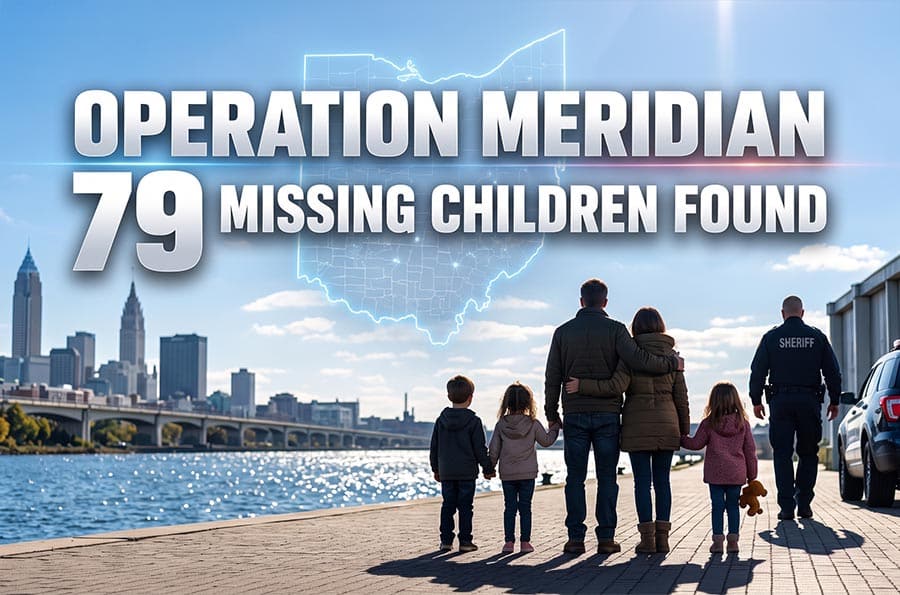
Operation Meridian, which recently wrapped up across Ohio, shows what federal fugitive task force resources can do when applied to missing and endangered children. In August, the U.S. Marshals Service worked closely with local, state, and federal partners to find 79 missing children between the ages of 6 and 17. Many of them were at serious risk, including from suspected human trafficking, abuse, and neglect.
One key lesson was the value of applying fugitive-tracking methods to the search for hidden children. Investigators used the same intelligence-gathering and surveillance techniques they would use on violent offenders, and followed leads across jurisdictions. In Toledo, for example, officers tracked a 16-year-old girl into Michigan, where they found her with an adult man.
Partnerships between agencies also made a difference. Investigators worked directly with the U.S. Department of Housing and Urban Development (HUD) to follow leads tied to federally assisted properties. That connection gave law enforcement access to residential data and tenant networks they would not otherwise have had, and it paid off in Columbus, where a 13-year-old girl was found hidden in a basement crawlspace beneath a closet floor.
Once the children were found, law enforcement partnered with local family service organizations right away. Recovered children received prompt medical evaluations and evidence-based, crisis-responsive care.
Taken together, the results suggest a workable model for finding endangered children: use fugitive-tracking strategies, draw on non-traditional federal partners like HUD, and connect children to social services immediately after recovery.
Key Findings
Applying fugitive task force intelligence-gathering techniques to missing child cases can significantly enhance the ability to track targets across multiple jurisdictions.
Partnering with federal housing authorities can provide critical intelligence and direct access to residential networks where endangered youth may be concealed.
Conducting thorough physical searches of targeted residences is essential, as suspects may utilize hidden architectural features to conceal missing children.
Coordinating immediately with family service professionals ensures that recovered children receive rapid medical evaluations and crisis-responsive care upon extraction.
Sources
KCBY (Sep 8, 2026): US Marshals find 79 missing children in Columbus, Cleveland, Akron, Toledo, Ohio, Georgia (Link)
U.S. Marshals Service (Sep 8, 2026): Operation Meridian Concludes: 79 Reported Missing Children Found (Link)
CBS Pittsburgh (Sep 8, 2026): 79 missing children found in Ohio during law enforcement push (Link)
A child reported missing to police in Mesa, Arizona, was safely recovered at an encampment in Olympia, Washington. The operation combined information from the National Center for Missing & Exploited Children (NCMEC), investigative follow-up, a ground search, and arrangements for care after recovery.
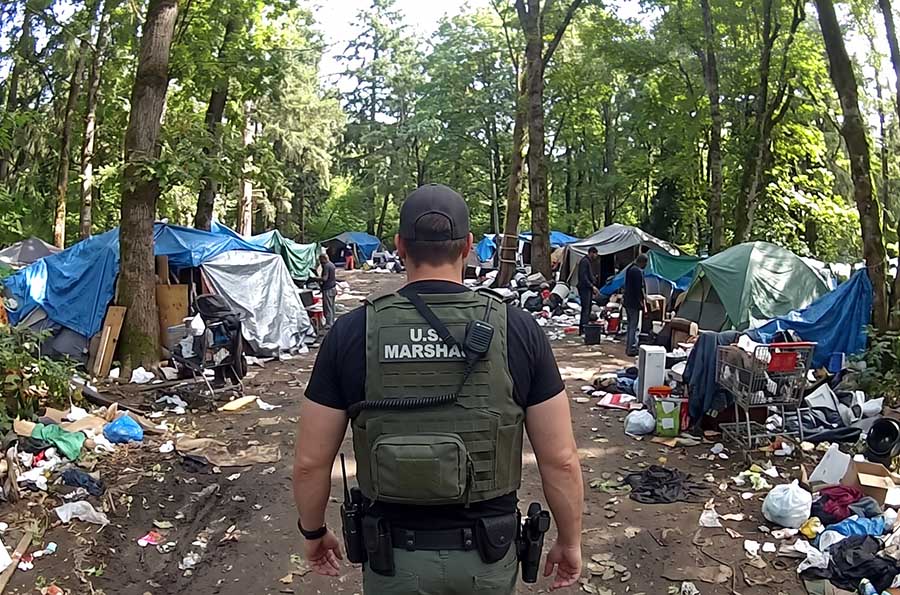
On June 18, NCMEC informed the U.S. Marshals Service that the child might be experiencing sex trafficking in Washington. A deputy assigned to missing children investigations developed a lead pointing to the 3200 block of Martin Way East. The location was a 20-acre encampment known as “The Jungle.”
The search took place over two days. Deputy U.S. Marshal Thorin Fash told The Olympian that work began Wednesday and concluded Thursday. Body-camera images shared with the newspaper documented personnel at the camp on both days. Washington State Department of Corrections personnel assisted through their task force role.
Direct inquiries extended to nearby businesses. A worker told KIRO 7 that marshals showed him the girl’s photograph, provided her name, and left a business card while asking whether he had seen her. This account documents a canvassing method: pairing identifying information with a way to contact investigators.
After locating the child, authorities transferred her to Olympia police and the Washington State Department of Children, Youth and Families for treatment and victim assistance. Olympia police provided a safe place at their offices while marshals contacted agencies to help her.
The documented sequence offers operational lessons: act on information shared across state lines, develop a specific search location, conduct personal inquiries, sustain the search, and connect recovery with protective care.
The child’s age and details of her disappearance were withheld to protect her identity. Public reporting did not establish that trafficking or abduction had occurred. The confirmed outcome was a safe recovery supported by coordinated investigative work.
Key Findings
U.S. Marshals searched over two days with assistance from Washington corrections personnel.
Nearby business inquiries used the child’s photograph, name, and investigator contact information.
Once the child was found, Olympia police provided a safe location while arrangements for assistance were made.
Sources
U.S. Marshals Service (June 26, 2026): U.S. Marshals Safely Recover Missing/Endangered Juvenile (Link)
KIRO 7 (June 27, 2026): Child reported missing out of Arizona found in Olympia’s ‘Jungle’ encampment (Link)
The Olympian (June 30, 2026): It took 2 days to find missing girl at Olympia’s ‘Jungle,’ federal official says (Link)
"The U.S. Marshals (USMS) can do everything to find missing kids that they do to find fugitives. ... The Marshals are the best at finding people who don’t want to be found," says Bill Boldin, Retired USMS Inspector & Former Coordinator of the National Missing Child Program
By Jody Garlock
Bill Boldin is one of those people who always knew what he wanted to do in life. At age 15, he became a youth cadet for the Canton, Ohio, Police Department, where he learned about law enforcement, experienced different types of training, and volunteered at events. That early stint solidified his desire to work in law enforcement and ultimately led to a more than 30-year career, much of it spent with the U.S. Marshals Service (USMS).
What he didn't anticipate was that the same relentless pursuit that defined his fugitive work would lead him to one of the most meaningful chapters of his career. In 2015, after passage of a federal law that allows the Marshals to assist local agencies in missing children investigations, Boldin was tasked with developing a program for the USMS Northern District of Ohio. "Over the next six or so years, more than 250 missing children were found in Northern Ohio, and they still lead the nation in recoveries to this day," says Boldin, who went on to become the national coordinator for the USMS National Missing Child Program.
We talked with Boldin, who retired from the USMS in late 2025, about his career and about the Marshals' role in helping find missing juveniles — a function that may not be widely known even a decade later.
How is it that the Marshals became involved in missing children investigations?
The 2015 JVTA [Justice for Victims of Trafficking Act] provided USMS the statutory authority to assist with missing juvenile cases. Prior to that, the child had to be with a registered sex offender or fugitive. The USMS can do everything to find missing kids that they do to find fugitives — that's actually how they got into the business. The Marshals are the best at finding people who don't want to be found. The vast majority of missing juveniles are high-risk runaways who are actively trying to not be found by parents, social services, or the police, or they are with age-inappropriate adults who are trying to hide them.
Talk a bit about that — children who have run away from home and the importance of finding them.
In the past, repeat runaways were considered habitual and not many departments put forth the effort to find them. That has really changed. We realize that there is no shortage of adults waiting to take advantage of every kid out there who's a runaway. It's impossible for them to stay a runaway without some adult 'help.' It's not just that it leads to trafficking and sexual abuse, it's all levels — retail theft rings, drugs. It's rare, if ever, that we recover a runaway and there isn't all kinds of criminal activity occurring in the same place.
What makes the Marshals a good fit for investigating missing children cases?
The same skill set used to hunt down fugitives is the same used to find missing kids. It's a combination of deep-diving into a person's digital presence and old-fashioned police work — getting off your butt and knocking on doors. You're not going to find fugitives or missing kids while sitting behind your desk. When we're out looking for a missing kid, we get such a positive response from the community.
What should law enforcement understand about the USMS involvement in missing children cases?
There are two main points. First, the child must have been reported missing prior to their 18th birthday. USMS can't work missing adults but can work the case as long as they were a juvenile when they went missing. Second, there must be a request or approval from the originating law enforcement agency. USMS can't take direct requests from the public.
It's been more than 10 years since the JVTA law passed. Are people aware of it and what it allows?
For years it wasn't really known to local law enforcement that the Marshals could help, but it's becoming more known. It was definitely a goal of the agency to try to get the word out. USMS has legal authority, but zero congressional funding for the Missing Child Program. As a result, different offices in different parts of the country have varying degrees of ability to assist with the program. Not all have sufficient manpower.
Do you have a success story to share with us?
One specifically involved an AMBER Alert. A subject in southern Ohio assaulted and attempted to murder his ex-wife and abducted three young children. He was extremely violent and a danger to the children. Hours later, phone pings placed him in Cleveland, but then the phone was shut off. It was a densely populated urban area with apartment buildings, and the subject had no known connections to the area. While searching for his vehicle, an AMBER Alert tip reported a possible sighting in that area. Based on that tip, we had a much smaller area to search. When the subject was located, he ran. He was caught but refused to say where the children were. A door-to-door search in the building found them alone in a vacant apartment.
What are you doing now that you've retired from the USMS?
I'm working part-time as a detective with the Dalton, Ohio, Police Department and am assisting other agencies with long-term missing child cases. I'm still a committee member and actively involved with the National Missing and Unidentified Persons Conference [part of the National Criminal Justice Training Center of Fox Valley Technical College]. I'm also a member of the Ohio Missing Persons Investigative Network run by the Ohio Attorney General's Office. Police work gets in your blood — it's in your system. You'll see an AMBER Alert, and it's everything to not get in your car and go. So I'm still staying involved. I'm looking for my next adventure.
Seeking USMS Assistance?
Contacting a local U.S. Marshals Service office is typically the easiest and fastest way to seek potential support from USMS in a missing and endangered child case. Other options include emailing [email protected] and requesting assistance form USM-641.
*583 missing children were located or recovered with assistance from the U.S. Marshals, according to fiscal year 2025 data. In that same period, the USMS received 823 requests from law enforcement for assistance in missing child cases. USMS located or recovered more than 4,561 missing children since 2015, when it received enhanced authority. Of those recovered, 61% were found within seven days.
The Tribal Warrant Fairness Act (H.R. 7490) marks a critical shift in missing child recovery. Historically, jurisdictional gaps prevented the U.S. Marshals Service (USMS) from executing Tribal warrants, often stalling investigations. This bill grants the USMS authority to assist Tribes directly, mirroring their support for state agencies where 61% of children are recovered within seven days. By integrating Tribal law enforcement into the Fugitive Apprehension Task Force, the act ensures rapid, multi-agency response. This coordination is vital for cases like Emily Pike's, where delays across reservation lines can be fatal. The legislation was referred to the House Committee on the Judiciary Action on February 11.