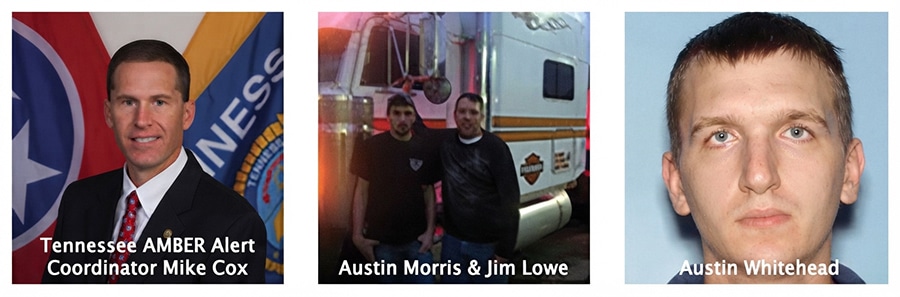
 A suspect accused of assaulting his wife and snatching their 2-year-old son was no match for a trio of truckers and highway patrol troopers who responded to an AMBER Alert in Tennessee. On January 9, 2013, 23-year-old Austin Whitehead allegedly got into a violent fight with his wife and then took their son with him in his Pontiac Grand Am.
The Houston County Sheriff's Office wanted to issue an AMBER Alert because of the assault and because Whitehead had allegedly threatened suicide. Tennessee AMBER Alert Coordinator Mike Cox said there was no question the alert met the state's criteria.
“We thought he was a danger to the child because of his possible mental state and the injuries to his wife,” said Cox.
The Tennessee Bureau of Investigation (TBI) oversees the statewide AMBER Alert program. Cox was assigned to be the state AMBER Alert coordinator in September 2012, and this was the third time he helped initiate an alert. “You can practice all day long, but you know it is different when it is real,” he said. “Every time I lie down at night I think, ‘I hope I made the right decision and did the right thing.’”
After all the information was gathered the alert went out at 1:20 p.m. to law enforcement, media, transportation, state lottery, and the National Weather Service. The alert can go out statewide or to three individual regions. Because authorities believed Whitehead was traveling to Covington, Georgia, Cox decided to send the alert to only the middle and eastern regions.
Moments after truck driver Jim Lowe saw the AMBER Alert on the electronic highway signs, he spotted the Pontiac Grand Am about 170 miles from the reported abduction. He used his radio to notify the trucks ahead of him and three truckers started to box the suspect in and slow him down.
“It is pretty wild,” noted Cox. “In almost 22 years of law enforcement I have never seen anything like it.”
Tennessee Highway Patrol dispatchers notified troopers, and they arrested Whitehead and safely recovered the young boy from the car. The AMBER Alert was cancelled less than two hours after it was issued.
“I am just glad that little kid is safe at home tonight in his own bed,” Lowe told a reporter. “I guess that is just where God meant for me to be.”
Tennessee has had five AMBER Alerts since Cox became the coordinator, and he said he is grateful for everyone who got the program up and running before he started. “I have a child of my own and it makes me feel good,” he said. “It is about as fulfilling as anything we can do in law enforcement. Nothing is more important than children.”