

Law enforcement officials in Ontario, Canada, received an angry and threatening message after an AMBER Alert was issued for a missing 11-year-old. The child was found safe, but an expletive-filled message was sent to the Niagara Police Department’s social media inbox which took issue with the 4 a.m. alert. The department also received many messages of support in response to those who were angered by being awakened from the alert.

A woman wearing a nurse's uniform walked into a hospital in Trois-Rivières, Quebec on May 26, 2014, and left with a baby who was born 16 hours earlier. The woman was not the mother of little Victoria McMahon and she drove away with the newborn in a red car with a sign that said "Baby on Board."

The hospital's security guards found a picture of the woman and staff members and patients provided details to municipal police about the suspect and her vehicle. Quebec AMBER Alert Coordinator Jean-Charles Benoit was contacted and he quickly determined the situation met the criteria for an AMBER Alert.
Quebec Provincial Police Sergeant Martine Asselin was at home when she got the call that an AMBER Alert was about to be issued. Asselin is the public information officer for her agency and she knew she needed to be ready to answer questions for the media. "The biggest challenge is to get the alert out as quickly as possible," said Asselin. "We have to be fast but the information has to be good."
This was the 10th AMBER Alert issued by the Quebec Provincial Police and every child from previous alerts had been recovered safely. Flyers with information about the latest alert went out to law enforcement, media, social media, transportation and other AMBER Alert partners.
"You have to be ready before it happens," said Asselin. "You have to have a protocol so everyone knows what to do."
They were trained and ready but everyone knew what was at stake. "Everyone is touched by this type of call," said Asselin. "It is their job but no one is immune to the emotions of a child needing help."
Charlène Plant and three friends saw the alert on Facebook and immediately joined the search. They recognized the suspect as a former neighbor and drove to her apartment and saw her car parked outside. "We just wanted to do something for the night, so we went out to find the car," Plant told a reporter.
They called the police and 50 minutes after the alert went out the baby was recovered safely and the suspect was in custody.
Not surprisingly, Victoria's mother, Mélissa McMahon, thanked everyone on Facebook. "The photo saved our daughter! In less than an hour, the photo was everywhere. You were more than thousands of people who shared the photo of this woman on social media. Know that it was this that saved her, our little Victoria. Every click, every share made the difference."
"The child was recovered safely and returned to her waiting parents within less than three hours," noted Canada AMBER Alert Coordinator Nancy Martin. "It was a proud moment for all involved."
Everyone involved in the Quebec AMBER Alert Program is also a big believer about the impact of social media. "Facebook was the reason this AMBER Alert was a success," said Asselin. "The fact that it went out on social media demonstrates that social media can really help in an AMBER Alert."
The use of social media and the fact it was the first time in recent memory that a child had been abducted from a hospital in Canada drew international attention to the case and the AMBER Alert system. "It was like a movie scenario," said Asselin. "We were very proud of the work by the police and we worked together as a team to use new tools to find a child."
Despite the success, Asselin said her agency will still look for new ways to help find abducted children. "We always can improve," she said. "We need to be sure we are on track and we need to make sure everyone is prepared."
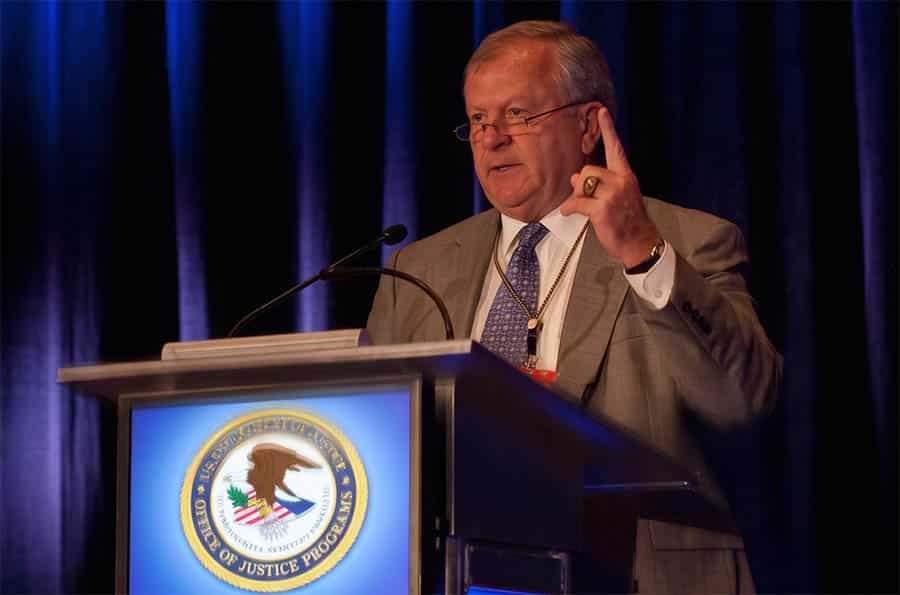
Phil Keith had just retired in 2004 as the police chief of Knoxville, Tennessee, when he was given a monumental task: make sure every state, territory and the District of Columbia have a consistent and effective AMBER Alert program within two years. Many states and communities had a child abduction alert system but the programs varied in size, criteria, and capability.
"One of the driving tenants of the development of the AMBER Alert system was to not decide what level of participation there would be but to make the network seamless and let the local, Tribal, regional, and state governments make the most informed decision best meeting their needs," said Keith. "This strategy is still in place today."
Keith put together a small team of professionals who understood teamwork, a strong work ethic and a "relentless sense of urgency to help recover missing children." The team listened to law enforcement officers who knew what did and did not work. They reached their goal in 18 months and wanted to do more.
"It was very clear the U.S. Department of Justice AMBER Alert Initiative was more than highway signs and messaging," said Keith. "The program had to create a voluntary seamless network of AMBER Alert Plans designed to rescue and recover missing, endangered and abducted children."
The team used best practices on investigations, searches, policies, and technologies to help good AMBER Alert programs become better. Team members invited abduction victims and their families to learn about the strengths and shortfalls they witnessed firsthand. They discovered and developed new ways to recover children like the Child Abduction Response Team, Endangered Missing Advisory, AMBER Alert in Indian Country Initiative and the Southern Border Initiative and using social media, including sending AMBER Alerts through the National Center for Missing & Exploited Children's secondary distribution program.
"This is not to say there were not 'bumps in the road,' bruised feelings or some unintentional temporary derailments, but the bottom line was the focus on protecting children," said Keith. "We pushed the envelope at times to gain acceptance, secure sincere team efforts at all levels of government and were very careful to be inclusive rather than exclusive."
Funding for training has always been difficult to obtain on a federal, state, and local level. Keith had to find ways to teach more people with less money. Instead of bringing hundreds of people to be trained by a few experts, he began sending the experts to train hundreds of AMBER Alert partners where they worked. More than 18,700 people have also been trained through eLearning courses.
Now nearly a decade later, Keith has retired from the AMBER Alert Program. Jim Walters, who has been involved with the AMBER Alert Program since its beginnings, has assumed the position as Director of the AMBER Alert Training & Technical Assistance Program. He credits the team for bringing the AMBER Alert Program to its current level and he believes teamwork will be essential to keep the momentum going.
"We have already seen 'bad guys' let children go once they hear AMBER Alerts have been issued, so we are headed in the right direction," concluded Keith. "However, we have to be ever vigilant in our efforts as there are some really evil people in the world who bring great risk and harm to our children."
Keith's Parting Thoughts on:
Child Abduction Response Team (CART)
These teams are built from the bottom up in most communities and represent the true intent of state, local, and Tribal communities to be prepared to respond to episodes of missing, endangered, or abducted children. This model program should remain the flagship initiative of the U.S. Department of Justice and be expanded into as many communities as possible.
Endangered Missing Advisory
The common recurring question about AMBER Alerts was “what to do if my child does not meet the criteria.” The Endangered Missing Advisory addresses the gap for persons over the age of 17, special needs persons, and addresses a population neglected by most everyone, the “endangered missing and runaways.” Today over 43 states and a number of local communities have adopted a form of the Endangered Missing Advisory Program.
AMBER Alert in Indian Country
This initiative was designed to meet the culturally sensitive needs of life in Tribal communities and the unique challenges Tribal members face every day. We learned early on not to layer another program on the Tribes, but rather utilize existing programs and efforts to compliment the work achieved and give AMBER Alert a true meaning of creating greater capacity and skills to respond to children in crisis among Tribal communities.
The Southern Border Initiative
Our partners on both sides of the border demonstrated their dedication and resolve to make a difference in missing children and after only 18 months we had “Alerta AMBER” throughout Mexico. Many of the officials supported the Alerta AMBER, even though there is a potential grave consequence by organized criminal enterprises not interested in the welfare of children and were most likely involved in the trafficking of children for commercial sexual exploitation.
AMBER Alerts in Social Media
Technology has been a great tool to advance the AMBER Alert messaging. In the coming years use of the social media will become a more localized effort as it should be, as the local communities know best what is needed and the urgency in getting “other eyes” looking for missing children.
Utah Child Abduction Response Team Faces Real Challenges During Mock Abduction
 Minutes before 8 a.m. on September 5, 2013, a child was snatched from a park playground in Riverton, Utah, in front of dozens of people. The people were expecting to play a role in the mock activation for the Utah Child Abduction Response Team (CART) but they had no idea they would be witnesses to a carefully planned abduction.
“One witness looked over and refused to look back,” said Utah CART Coordinator Jessica Farnsworth. “They said, ‘We really didn't see anything.’ People do not go around expecting to witness an abduction.”
For about six months Farnsworth and Co-Coordinator Patty Reed worked to come up with an exercise with as many realistic details as possible that would truly test the team's ability to respond to the challenges that may be encountered during an actual abduction.
They recruited more than 100 neighbors and friends to act out the roles of victim, suspect and witnesses. Some of the participants called in tips and others allowed investigators to come in and search their homes.
“If you do not use your skills then you lose them,” said Farnsworth. “CART members are highly skilled, and we need to make sure they can respond quickly if this happens in real life.”
The Utah CART has about 150 members from 26 local, state and federal agencies with expertise in computers, forensics, search and rescue, crime intelligence analysis and other areas.
The last mock activation was held three years ago to test whether the Utah CART would receive national certification from the U.S. Department of Justice. The Utah CART was started six years ago and is now one of 19 teams in the country with national certification.
The timeline shows that this exercise moved very fast: at 8:26 a.m. CART members respond to the CART activation, with the dispatcher's original report indicating a 9- to 11-year-old girl was grabbed by the wrist and started screaming for help. At 8:45 a.m. a mother calls in and reports her 12-year-old daughter Mckenna was missing. At 9:26 a.m. CART members arrive at the command post near Riverton Chase Park. At 10:04 a.m. the decision is made to issue an AMBER Alert. At 10:13 a.m., instead of activating the official state AMBER Alert system, Twitter is used and tweets start going out with details about the mock victim and suspect, including a description of McKenna Eldredge, 12, and the suspect's vehicle. At 9:53 a.m. a tweet sends out a photo of the abducted child.
The team began canvassing the area and checking for sex offenders when tips came in that a man in his 20's was seen dragging a girl down the canal road. At 11:20 a.m. investigators found the victim's bracelet inside a vehicle near the road and soon found her hoodie on the canal road.
The “victim” was found at 11:51 a.m. and a tweet went out two minutes later announcing the abduction “victim” was located safe at Jordan Parkway while the suspect was still at large. The “suspect,” played by Daniel Stewart, was arrested at 12:15 p.m.
Despite the massive numbers of CART members and the quick recovery, those in the exercise learned they could have done better with more people. “New leads came in but there were not enough investigators to handle them,” said Utah CART Search Coordinator Leo Lucey. “We would have found her 45 minutes earlier with enough resources.”
A debriefing was held a few hours after the exercise to find out what went right, what went wrong and what is needed to improve. Teams are encouraged to hold a debriefing and prepare an “After-Action Report” anytime a CART is activated, even for an exercise.
Here are some examples of the lessons learned: witnesses mistakenly thought the suspect had a hat and was wearing jeans instead of khakis, the location of the printing plotter caused delays for making maps, the victim's family needed hourly updates, and the CART needed more investigators, searchers, radios, and flyers.
The media was invited to take part in the exercise, and reporters and camera crews gave the exercise more authenticity. Members of CARTs in Iowa, Arizona, and Southern and Northern Utah also came to observe.
“You did a good job of getting back and forth with your information,” said Iowa Department of Public Safety (DPS) Special Agent Don Schnitker. “It was important to see when leads come in whether or not it has already been checked.”
“It was very impressive,” said Iowa DPS Special Agent Michael Motsinger. “We have been talking about how far you have come. This will be huge to take back and use as a springboard to go forward.”
“It was really impressive and it is good to know you are not far away if we need help,” said St. George, Utah, Police Captain Kyle Whitehead.
One of the biggest surprises: a real stolen vehicle was discovered by the license plate reader during the exercise.
Despite some missed opportunities, everyone was impressed by what was accomplished in such a short amount of time. “I was blown away that you had found the child so soon,” said Farnsworth.
“You guys put the safety in public safety,” concluded Ken Wallentine, former Chief of Law Enforcement for the Utah Attorney General's Office. “I appreciate your service.”
 On January 12, 2011, AMBER Alert, the most effective tool to save abducted children, teamed up with Facebook, the most successful social network in history, to save abducted children.
AMBER Alert suddenly has lots of new friends. Facebook has begun posting AMBER Alerts that more than 750 million users worldwide—more than 130 million of them in the U.S.—can view.
Facebook worked with the Department of Justice and the National Center for Missing & Exploited Children (NCMEC) to create a main AMBER Alert page and 53 additional pages for the 50 states, Puerto Rico, the U.S. Virgin Islands, and the District of Columbia.
"AMBER Alerts depend on partnerships between public and private entities to get the word out when a child goes missing," said Laurie O. Robinson, Assistant Attorney General of the Office of Justice Programs and National AMBER Alert Coordinator. "Social networking has few boundaries, and now AMBER Alerts will benefit from that nearly limitless reach."
NCMEC posts the initial alerts, updates, and cancellations for each geographical area. Facebook users can sign up to receive the alerts in their area by simply becoming a friend. Those friends can then post the alerts and send them to others.
"We know time is the enemy in the search for abducted children, and people on Facebook will allow the alerts to become viral, not just in local jurisdictions, but across the country and around the world," said Ernie Allen, NCMEC President and CEO. "It is free, and it is going to save lives."
The AMBER Alert sites do not contain any advertising, and Facebook users cannot post comments on the state pages. This plan will ensure that the only information about the AMBER Alert will come from the law enforcement agency that issued the alert. Once the alert is canceled, Facebook removes the post from all sites so users will not search for a child who has already been found.
Facebook also donated more than 25 million advertising impressions to promote the AMBER Alert pages. Just 5 months after the launch, the main AMBER Alert page has over 60,000 friends and nearly 500,000 people view the site each week. The vast majority of the people using the site are from the United States, but it has attracted friends from 18 other countries as far away as India, Turkey, and Malaysia.
"Facebook is more than a social network, it is one of the largest communication platforms," said Chris Sonderby, Facebook Lead Security and Investigations Counsel. "The more people who participate, the better. It is a small step that can make a big difference in the life of a child."
The main page has a link to each of the state pages and has become a community bulletin board for the AMBER Alert Program and efforts to find abducted children. Within minutes after a new post goes up on the main AMBER Alert page, tens of thousands of people can view the site and post comments. Here is a sampling of some of the comments made shortly after the launch:
"It will be amazing what Facebook can do for AMBER Alert. It is national and fast and gives more info than just people and vehicles. We will be asking 'Why did we take so long?'"
"It is the best example of how the Internet can be a useful tool."
"This is right on time. AMERICA unite; find these missing children!!!"
"My heart breaks and my stomach gets knots every time I hear an AMBER Alert. However, when a child is located and saved, the joy is AMAZING! What a great tool to help protect our children and unite us in the fight."
"I cannot wait to start hearing the success stories of children being found through Facebook!"
Col. Steven Flaherty, Virginia State Police Superintendent, spoke at the Facebook/AMBER Alert launch on how his state has already used the social network to find an abducted child. On December 6, 2010, the Roanoke (Virginia) Police Department issued an AMBER Alert for a 12-year-old girl who had been abducted after her mother was murdered. The alert was posted on the Virginia State Police Facebook page, and the story picked up national attention. Five days later, a woman recognized the victim from a television story, and the girl was recovered safely in San Francisco.
"We would have not had as many leads without our Facebook fans," said Flaherty. "Social media enabled law enforcement to reach beyond our borders to find this 12-year-old girl. Her search started with an AMBER Alert and spread because of social media and traditional media. I can only imagine or dream what we can do now."
On January 15, Facebook posted its first AMBER Alert for a 13-year-old Columbus, Missouri, girl. More than 63,000 people viewed the original post, and the girl was found the following day in Jasper, Alabama.
Julie Fisher believes Facebook has the potential to save many children. The Massachusetts mother regularly posts updates on AMBER Alerts across the country. She also encourages others to sign up for the alerts in their own states.
"I just want this to be a safer world for everyone, especially children," said Fisher. "Facebook is a great way to spread the alerts because even if you are not in the area of the alert, a friend, or a friend of a friend may cross their path. What better use of networking is there? Someone may be in the right place at the right time and save a life."
What's on the National AMBER Alert Facebook page:
- Links to state AMBER pages
- Current AMBER Alert news
- AMBER Advocate Editions
- Hundreds of millions of potential people who can help find a missing child
What's on the State AMBER Alert Facebook pages:
- Current active AMBER Alerts automatically issued by NCMEC
- A local network of concerned citizens eager to help in the recovery of a child