
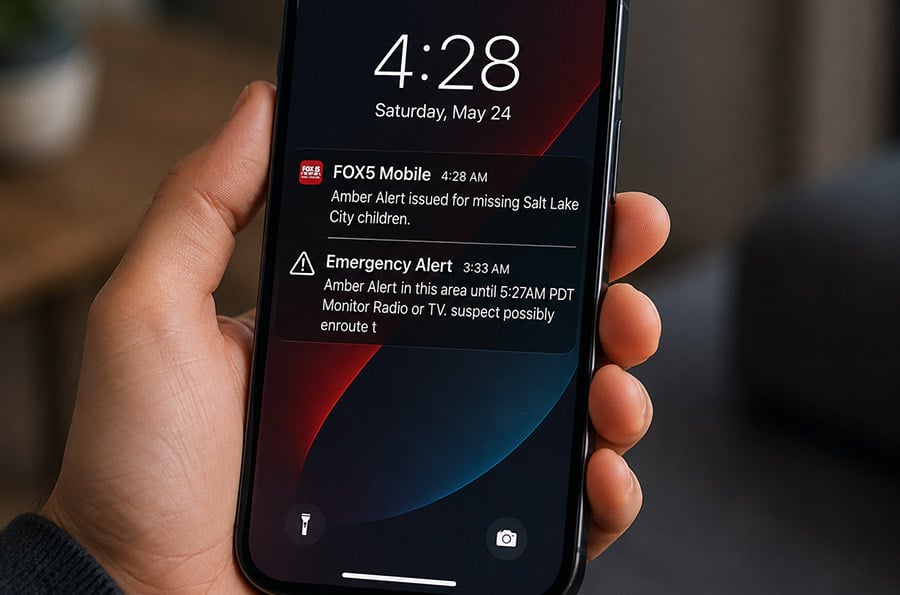
Close-up of phone screen displaying AMBER Alert for 10 month old abducted in North Las Vegas

On March 5, 2026, the North Las Vegas Police Department successfully recovered a 10-month-old infant less than 90 minutes after issuing an AMBER Alert. The abduction stemmed from a domestic violence incident where the suspect, Roderick Duke, experienced an emotional crisis and threatened self-harm. While authorities quickly located the child unharmed by utilizing immediate cell phone tracking, the case highlighted a critical systemic vulnerability regarding public broadcast systems. Nevada Department of Transportation regulations prevented the AMBER Alert from displaying on overhead highway signs due to the absence of a license plate number in the initial police report. This incident demonstrates the intersection of domestic disturbances and abduction, along with the strict data requirements for highway alert activation.

This abduction began with a reported domestic disturbance. The suspect assaulted the child's mother and fled with the infant without using a car seat. Police reports indicated the suspect was in an emotional crisis and made specific threats to harm himself and the child. These immediate threats of violence and self-harm act as primary risk indicators during parental abductions.

A limitation emerged regarding public alert infrastructure. The Nevada Department of Transportation delayed posting the AMBER Alert on overhead freeway signs. State rules require specific vehicle details, including the make, model, color, and exact license plate number, before highway signs can be activated. Because the initial police report lacked the license plate number, the message could not be displayed. Officials state that posting partial vehicle descriptions could lead to public abuse or fatigue of the alert system.

Detectives successfully used cell phone tracking to monitor the suspect's movements immediately after the abduction. Interestingly, while the public AMBER Alert was issued, court documents reveal the suspect had already returned to the initial apartment complex with the baby. Officers found him there and arrested him without incident. This highlights the importance of maintaining a physical police presence at the original crime scene during domestic-related abductions, as offenders experiencing emotional crises may return to familiar locations.

Key Findings

  • The abducted 10-month-old was recovered safely within 90 minutes of the AMBER Alert.

  • Immediate cell phone tracking aided the police in monitoring the suspect.

  • Strict state regulations prevented the AMBER Alert from appearing on highway signs due to a missing license plate number.

  • The suspect returned to the original scene of the domestic dispute, where the arrest occurred without incident.

Sources

  • KTVN (Mar 5, 2026): AMBER Alert cleared for 10-month-old girl in North Las Vegas (Link)

  • FOX5 Las Vegas (Mar 6, 2026): North Las Vegas police say child in AMBER ALERT was found and unharmed, father arrested (Link)

  • FOX5 Las Vegas (Mar 12, 2026): North Las Vegas man accused of kidnapping 10-month-old daughter appointed public defender (Link)

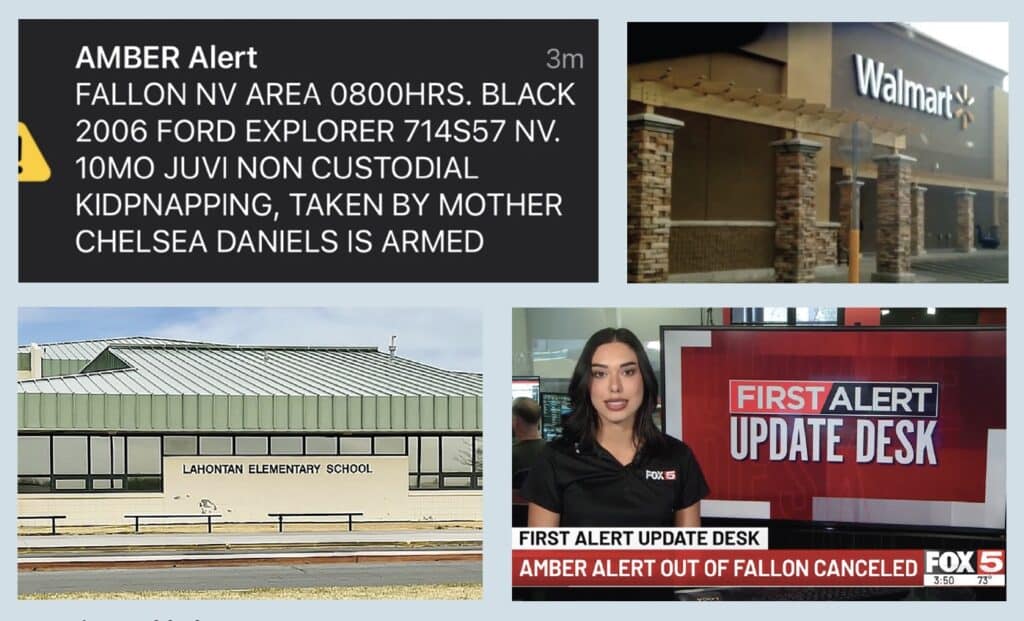
Photo illustration of a blue blanket with a pink heart pillow
In 2023, 59% of AMBER Alerts were for family abduction cases, according to the National Center for Missing & Exploited Children. The abductions tend to occur at transition points, such as when court-ordered exchanges of the child are scheduled to take place. Staff photo illustration.

By Jody Garlock

Engaging the public has always been at the heart of AMBER Alerts. The program, after all, was built on the premise of instantly galvanizing citizens and motorists to serve as an extra set of eyes to help law enforcement safely locate an endangered missing or abducted child. The power of that concept played out literally and figuratively in a case that gripped the quiet county-seat town of Fallon, Nevada.

On March 31, 2025, the Nevada Department of Public Safety issued an AMBER Alert that was disseminated to broadcast media and cellular devices around Washoe County. Ten-month-old Lyric Smitten had been taken by his noncustodial mother, Chelsea Daniels, earlier that day. According to information released by the Churchill County Sheriff’s Office, authorities were advised that Daniels had been distraught after a court removed the boy from her care and custody. She was reported to have a handgun and had threatened to harm herself and her son.

The case solidly met the criteria for activating an AMBER Alert. These criteria included the belief that the child was in imminent danger and there was enough descriptive information for the public to aid in the recovery.

Unlike most AMBER Alerts, this case had an additional layer of urgency: The child was scheduled to undergo heart surgery the following day.

As news of the missing boy quickly spread around Fallon and the other high desert communities of western Nevada, tips to 911 came in. Because the vehicle Daniels was driving was relatively common—a black SUV (specifically a Ford Explorer) with a Nevada license plate— several tips matched a general description.

Although the AMBER Alert provided the license plate number, motorists aren’t always able to capture the exacting details. Officers knew the dire situation required taking all tips seriously, even those where the information matched just a general description of the SUV. One such tip led to a Fallon elementary school being placed on lockdown until authorities confirmed that the vehicle reported on the grounds wasn’t Daniels’.

One particular tip, however, stood out. A caller reported seeing a vehicle matching the description and that was being driven by a woman in an area that aligned with earlier cell phone pings from the mother’s phone. Patrol and investigative units were already in the area and took swift action. They spotted the SUV traveling on a mountain road.

Collage of four images showing the AMBER Alert cell phone message, a Walmart, an elementary school, and a news report
HOW IT UNFOLDED (from left, top to bottom): The AMBER Alert pinged cell phones shortly after 2 p.m. for the Nevada infant taken by his noncustodial mother and believed to be in imminent danger. The last reported siting of the child was at a Walmart. An elementary school was placed on lockdown after a tip matched a general description of the mother’s vehicle there. About an hour after the alert was issued, authorities acting on another tip spotted the vehicle and safely recovered the boy. Local media reported the news, to the relief of residents.

After initially failing to stop, Daniels pulled over the vehicle, heeding the emergency lights and sirens from a sheriff’s deputy’s patrol vehicle. The infant was found safe; emergency medical responders also assessed the child’s health.

Authorities did not release information on the boy’s heart condition or surgery.

The Fallon Police Department took Daniels into custody on various charges, including kidnapping. Fallon authorities noted after the incident that concern about the child’s medical condition played a factor in the case rising to the level of an AMBER Alert.

Similar to how the public responded with tips, local authorities were quick to praise the public for its vigilance that contributed to the safe resolution. Churchill County Sheriff Richard Hickox also credited the multiple agencies and emergency medical responders who were involved. “We are grateful for the citizens who called in with sightings and information,” Hickox posted on Facebook. “The successful resolution of this situation is a prime example of a collaborative effort by many agencies striving toward one goal—and that is the safety of the public.”

Residents greeted news of the child’s safe recovery with similar gratitude. “Thank you to the people who spoke up and reported!” one person wrote on the Churchill County Sheriff’s social media page.

Carri Gordon, AMBER Alert Training & Technical Assistance Program (AATTAP) Liaison for Region 5 (which includes Nevada), considers the case an example of the AMBER Alert system working as it was intended: by engaging the public to prompt a swift recovery. “I’ve activated alerts in the past where the tip came in within six minutes of the Wireless Emergency Alert (WEA) hitting cell phones, and it was from someone directly behind the suspect’s vehicle,” she recalls. “Law enforcement contacted and safely recovered that child in less than 15 minutes of the AMBER Alert going out. It’s literally lifesaving.”

During her 13 years as the state of Washington’s AMBER Alert Coordinator (AAC), Gordon handled more than 100 AMBER Alerts. Although alert activations for noncustodial parent abductions, such as in this case, have always been higher than stranger abductions, she reminds AACs that this doesn’t mean the child is free of danger. “Parents will—and do— harm their own children,” she says, dispelling a common misconception.

Gordon also knows from experience the pressure AACs feel every time an AMBER Alert is issued, even though they aren’t directly investigating the case. “As AACs we monitor our alerts as they go out and monitor the involvement on social media, such as the shares and likes,” she says. “When you see a case with a lot of public involvement—and tips that eventually lead to the location of the child—it makes you aware of how critical and valuable a tool like the AMBER Alert system is.”

Quote icon

Law enforcement relies on the public to be on the lookout for critically endangered missing and abducted children. This case illustrates how critical it is to follow those leads.

Carri Gordon AATTAP Region 5 Liaison and former AMBER Alert Coordinator
Quote image

Blue and white asterisk graphicIn 2023, 59% of AMBER Alerts were for family abduction cases, according to the National Center for Missing & Exploited Children. The abductions tend to occur at transition points, such as when court-ordered exchanges of the child are scheduled to take place.