








By Denise Gee Peacock

National Missing Children’s Day has long been a lodestar for families of missing children—a safe harbor for gathering with child protection professionals who on that day are recognized by the U.S. Department of Justice (DOJ) for being at the top of their game.

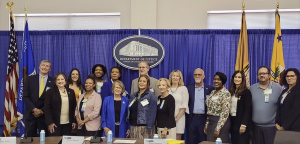
This year that star shone brighter than ever, largely fueled by the unwavering advocacy work of nearly a dozen surviving family members—including parents and siblings—who have endured the nightmare of a missing child, brother, or sister. Their presence at the May 22 commemoration, and related events, was deeply moving—despite the fact that “all of us belong to a club that no one ever wants to belong to,” says parent survivor Ahmad Rivazfar.
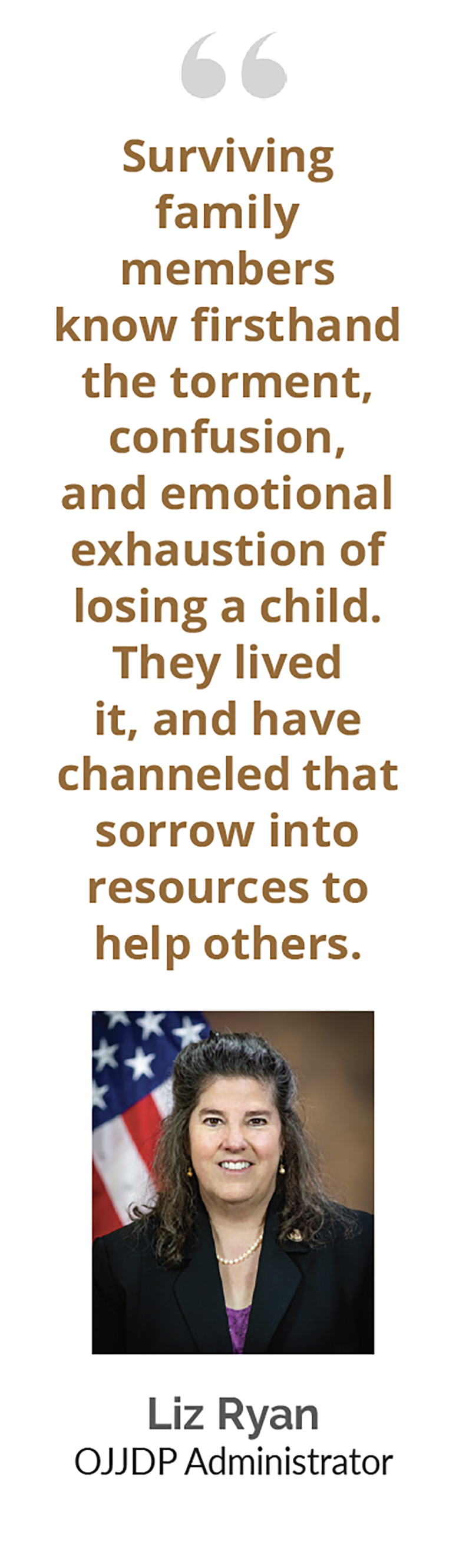
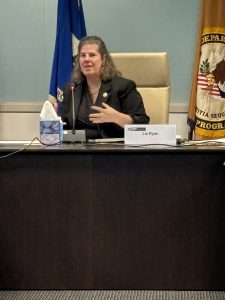
Photograph of OJJDP Administrator Liz Ryan with this quote: “Surviving family members know firsthand the torment, confusion, and emotional exhaustion of losing a child. They lived it, and have channeled that sorrow into resources to help others.”That club’s members include parents and siblings desperate to find their missing loved ones, whose whereabouts remain unknown. They are also families who will forever grieve a child who was abducted, sexually assaulted, and murdered; families of children illegally taken out of the country by an estranged parent; families who have fortunately been reunited with their once-missing child, but now work to become whole again.

These family survivors’ stories were invaluable to discussions during the 2024 National Missing Children’s Day events. The AMBER Alert Training & Technical Assistance Program (AATTAP) and National Criminal Justice Training Center (NCJTC) hosted the family members at the events, with support from the DOJ’s Office of Justice Programs (OJP) and Office of Juvenile Justice and Delinquency Prevention (OJJDP).

The AATTAP-NCJTC team and surviving family members were unified in promoting their work on two updated DOJ resources for parents and families of missing children: When Your Child Is Missing: A Family Survival Guide (released last year) and the forthcoming sibling-focused survival guide, What About Me? Finding Your Path When Your Brother or Sister Is Missing.

Collaboration for a clearer path forward

The day before the National Missing Children’s Day commemoration, surviving family members paid a visit to the Alexandria, Virginia, headquarters of the National Center for Missing & Exploited Children (NCMEC). Afterward they attended a private AATTAP reception recognizing their contributions to ensuring family members across the nation have access to the latest information and resources.

They also previewed video segments from a filming project completed earlier this year, one in which contributors to the forthcoming What About Me? sibling survival guide shared their insights and advice to illuminate its content for readers. The videos will be offered alongside the sibling guide (after its release later this year) on the Family Survival Guide website.

During the National Missing Children’s Day ceremony, the group received thanks for their efforts from U.S. Assistant Attorney General Amy L. Solomon, OJJDP Administrator Liz Ryan, and NCMEC President and CEO Michelle DeLaune—as well as attendee applause—when they were asked to stand for recognition.

They also heard from nationally revered parent-advocate and retired AATTAP-NCJTC Associate Patty Wetterling, who was a featured speaker at the event. Wetterling is the mother of Jacob Wetterling, who was abducted and murdered in 1989. (Read more about her search for him, and her new book, Dear Jacob, here—and an excerpt from her Missing Children’s Day talk below.) Wetterling also helped update the new edition of the Family Survival Guide, released in 2023.

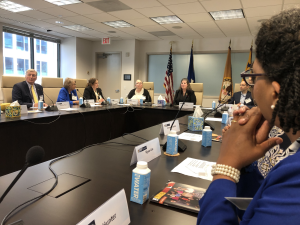
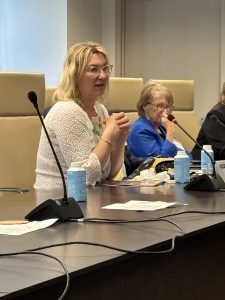
During the session, the family members discussed their experiences with being a part of these survival guide projects, along with their ongoing needs and goals as surviving family members who have experienced a missing child or sibling.
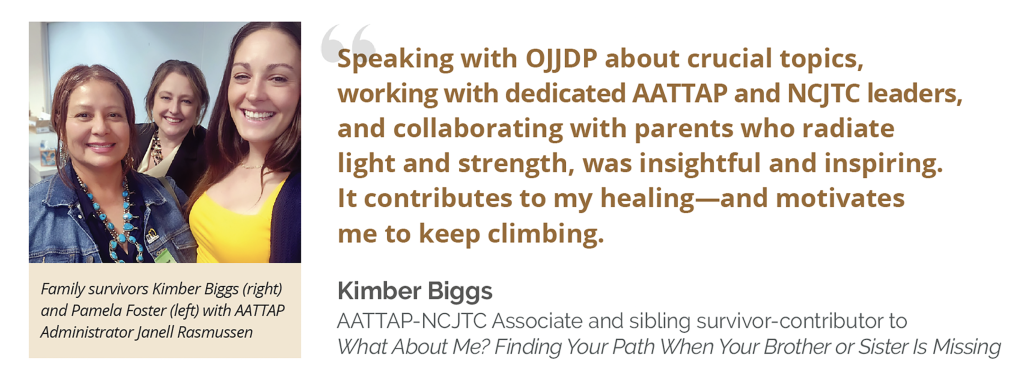
Photo of family survivors Kimber Biggs (right) and Pamela Foster (left) with AATTAP Administrator Janell Rasmussen. Adjacent to the image is this quote from Kimber Biggs, AATTAP-NCJTC Associate and sibling survivor-contributor to the forthcoming resource guide, "What About Me? Finding Your Path When Your Brother or Sister Is Missing“: "Speaking with OJJDP about crucial topics, working with dedicated AATTAP and NCJTC leaders, and collaborating with parents who radiate light and strength, was insightful and inspiring. It contributes to my healing—and motivates me to keep climbing.”

They also offered OJJDP and AATTAP leaders recommendations on ways to best support families and more broadly promote awareness and distribution of critically important resources for families, law enforcement, and child advocates.

Following through on a commitment made by OJJDP Administrator Ryan last year during her impactful meeting with the Family Survival Guide contributors at the conclusion of the Missing Children’s Day ceremony, this year’s event included an inaugural, private Family Roundtable discussion with sibling guide family contributors.

Commemoration highlights

Each year, the DOJ honors agencies, organizations, law enforcement officials, and others whose exemplary and heroic efforts have helped recover missing children and prosecute those who harm them.

“Our commemoration is taking a new format this year,” Ryan explained. “OJJDP decided not only to highlight the tremendous work of those who protect children, but also address the challenges in this work—to learn more about issues involving missing kids, and hold in-depth conversations with youth and families of missing and murdered children and other experts on these topics.”
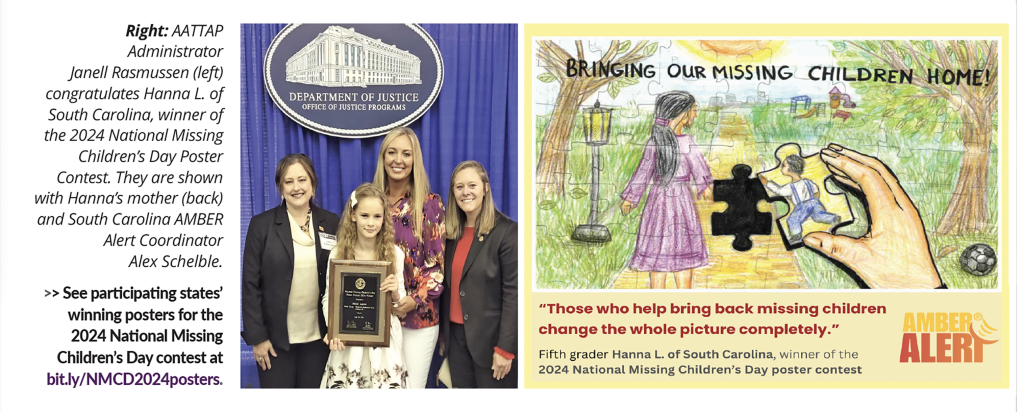
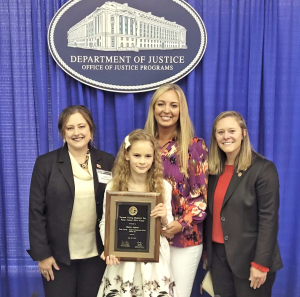
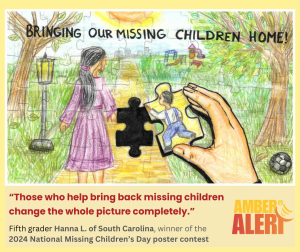
Fifth grader Hannah L. of South Carolina is shown holding a plaque for winning the 2024 National Missing Children's Day poster contest. She is accompanied by her mother, AATTAP Administrator Janell Rasmussen (left) and South Carolina AMBER Alert Coordinator Alex Schelble (right). An embedded link notes: "See participating states’ winning posters for the 2024 National Missing Children’s Day contest at bit.ly/NMCD2024posters." Hanna's winning poster is also shown. It represents children being found as missing pieces of a puzzle, and includes a quote from her: "Those who help bring back missing children change the whole picture completely."

After the commemoration, a cadre of experts, including a youth advocate with lived experience in the foster care system, joined a panel discussion on why so many children and young adults go missing from care. “They will suggest ways to improve collaboration and ensure the well-being of these children,” Ryan said. She next recognized members of the Family Roundtable—parents, siblings and others with a loved one who has gone missing. “Each of them has contributed to two very important [survival] documents.”

When Your Child Is Missing: A Family Survival Guide was announced at the 2023 Missing Children’s Day event. The new fifth edition provides a wider range of missing child situations; gives families instant access to information online; and allows them to hear advice and encouragement from the parents themselves, who speak in powerful videos.

As was the case with the Family Survival Guide, the What About Me? project was developed by AATTAP’s publications team with guidance and oversight from the OJJDP. Both initiatives were stewarded by Helen Connelly, retired FVTC-NCJTC Program Administrator who continues to share her expertise as an Associate employee.

Looking back—and ahead

“As you know thousands of children go missing in the U.S. every year,” Ryan said. “While most are safely recovered, others are found deceased and never identified. Currently there are more than 1,000 children whose remains have been found, but have not been identified. We want to help name them, and return them to their families, communities, and loved ones.”

The OJJDP and NCMEC, with support from the DOJ—and training and technical assistance from the AATTAP and NCJTC—will work with state and local law enforcement agencies to identify these children, Ryan explained, adding, “they deserve no less.”

The forthcoming sibling survival guide, What About Me?, will help a missing child’s siblings understand the emotional turmoil surrounding the crisis as well as the search process. It will offer trusted advice and firsthand insight into what to expect; tips for managing self-care and family dynamics; and guidance on how to deal with law enforcement, the courts, and the media.

Parent-advocate Patty Wetterling to DOJ and NCMEC: ‘You save lives. You saved mine.’
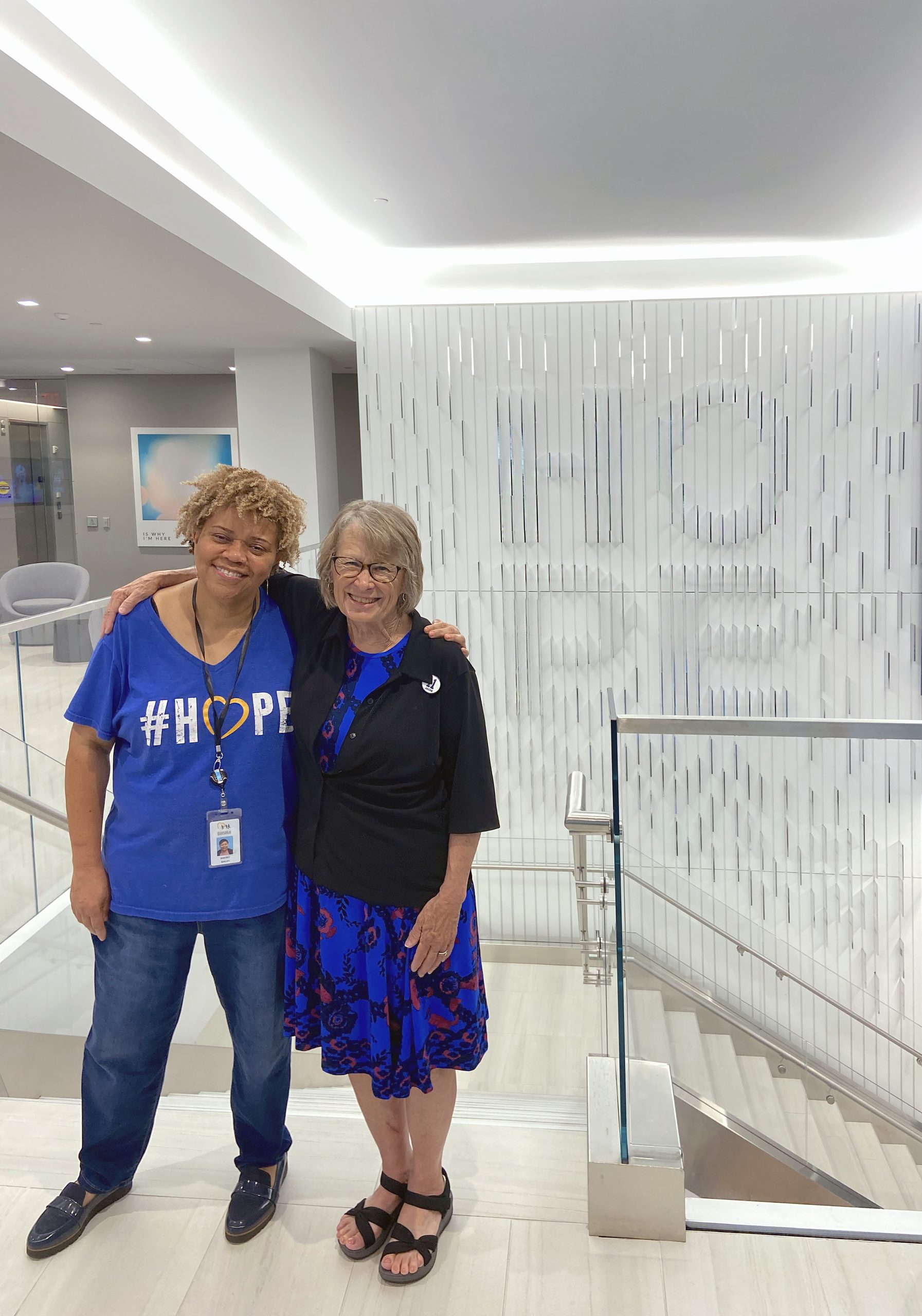
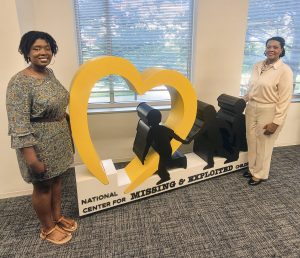
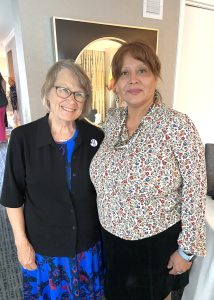
Photo of two women with this caption: Patty Wetterling (right) greets NCMEC’s Director of Special Projects Sherry Bailey during the family survivors’ visit to NCMEC headquarters in Arlington, Virginia.
Patty Wetterling (right) greets NCMEC’s Director of Special Projects Sherry Bailey during the family survivors’ visit to NCMEC headquarters in Arlington, Virginia.

NCMEC President and CEO Michelle DeLaune welcomed parent-advocate Patti Wetterling to speak, recognizing her as “a longtime friend and a personal source of inspiration.”

“Her son, Jacob, who went missing when he was 11 years old, was abducted near their home in Minnesota,” DeLaune said. “Patty has given her life to advocating for her son. She’s raised a beautiful family. And she’s a fierce mother, one who changes this world with every person she speaks to.”

Assistant U.S. Attorney General Amy L. Solomon added, “We’re so honored that you could be with us today, Patty. We’re indebted to you for your years of advocacy on behalf of missing children, and for the work you continue to do to claim a brighter future for our children.”

What follows is an excerpt of Wetterling’s remarks given at this year’s National Missing Children’s Day commemoration.

I want to thank you, Liz Ryan, for meeting with this amazing group. [Wetterling gestures to the family-survivor group attending the ceremony.] I belong over there with you, my heart is with you, and we draw strength from you. I also want to thank everybody at NCMEC and the DOJ. You save lives. You saved mine. 

National Missing Children’s Day is a time to shine a light on a dark topic. When my son, Jacob, was kidnapped, I knew nothing about crimes against children. ‘Who would do that?’ I cried, ‘Who would harm a child?’ It is an unimaginable pain.

After a few days, sleep deprived and depressed, I crawled into bed and pulled the covers over my head, deciding I’m never gonna get out of bed again. It’s too hard. It hurts too much. I can’t do it. But with tears streaming down my face, I suddenly saw Jacob curled up in a ball somewhere saying the same thing. ‘I can’t do this anymore. It’s too hard. They’re never going to find me.’

Screaming, I got up and said, ‘Hold on Jacob, we will find you! But you have to stay strong!’ I got out of bed. That decision to get out of bed was the first of many choices that I had to make.

That was in the early days, and in the 34 years that have followed, I decided I couldn’t live in the darkness. I chose to seek light instead. I chose to fight for the world that Jacob knew and loved—a world that was fair, kind, and safe for kids.

When I was given the phone number for the National Center for Missing & Exploited Children, I learned so much about the problem—how many children were missing and exploited, and what we all needed to do to bring them home. Most kids come home because somebody is aware of their abduction. They look at the pictures. And if they see something unusual about a child, or a child in a bad situation, they trust their instincts and call the police.

We tried to make sure everybody got Jacob’s pictures. We had to mail out pictures back in 1989. We sent them all over. My favorite story was when a couple was traveling from Minnesota to Florida and thought they saw Jacob. They recognized the picture and said, ‘He was with a man who’s very thin, and he didn’t look like he wanted to be with this guy.’ But they didn’t know who to call. So eventually they called the FBI in Minneapolis. When they described the man that this boy was with, the FBI agent knew who they were talking about…and caught up with him in Flagstaff, Arizona. And clearly [the child they found with him] wasn’t Jacob.

But at least one 12-year-old boy got to go home because somebody was aware of the problem. They looked at the pictures and took that extra step of being there for the child. In those 34 years since Jacob was kidnapped, I’ve learned we are stronger when we collectively pool ideas and resources through Team HOPE and the family and sibling survival guides, we support each other and offer assistance to other families walking down this difficult path.

We have to keep missing children in our hearts until we can hold them in our arms again.

We are all the hope for all missing children, as well as all children who are home safe today.

We can never give up hope.

And together, we can, and we will, build a safer world for all of our children.


By Denise Gee Peacock

At the 41st National Missing Children’s Day commemoration May 22, 2024 in Washington, D.C., staff members from the AMBER Alert Training & Technical Assistance Program and National Criminal Justice Training Center accompanied family members of missing children who have helped produce two multimedia resources for the U.S. Department of Justice Office of Justice Programs (OJP) and Office of Juvenile Justice and Delinquency Prevention (OJJDP): When Your Child Is Missing: A Family Survival Guide and the forthcoming What About Me? Finding Your Path When Your Brother or Sister Is Missing.

On the day before the Missing Children’s Day commemoration, the AATTAP-hosted family members paid a visit to the Alexandria, Virginia, headquarters of the National Center for Missing & Exploited Children (NCMEC). Afterward they attended an AATTAP reception recognizing them for their contributions to ensuring family members across the nation have access to the latest information and resources. They also were shown highlights of videos that will be featured on the Family Survival Guide website along with the publication once released. (Stay tuned to The AMBER Advocate for more details.)

Recognition and collaboration for better understanding—and a clear path forward

During the National Missing Children’s Day ceremony, the group received thanks for their efforts from U.S. Assistant Attorney General Amy L. Solomon, OJJDP Administrator Liz Ryan, and NCMEC President and CEO Michelle DeLaune—as well as attendee applause when they were asked to stand for recognition. They also heard from nationally revered parent-advocate and retired AATTAP-NCJTC Associate Patty Wetterling, who was a featured speaker at the event. Patty is the mother of Jacob Wetterling, who was abducted and murdered in 1989. (Read more about her search for him, and her new book, Dear Jacob, here.) Wetterling also helped update the new Family Survival Guide.

Following through on a commitment made by OJJDP Administrator Liz Ryan last year during her impactful meeting with the Family Survival Guide contributors at the conclusion of the Missing Children’s Day ceremony, this year’s event included an inaugural, private Family Roundtable meeting during which both Family Survival Guide and Sibling Guide family members discussed their experiences with being a part of these projects, their ongoing needs and goals as surviving family members who have experienced a missing child or sibling, and offered OJJDP and AATTAP leaders recommendations on ways to best support families and more broadly promulgate awareness and distribution of these and other critically important resources for family, law enforcement, community and child advocates.

“The AATTAP was honored to be invited by Administrator Ryan and other OJJDP leadership to facilitate a discussion with the families of missing and murdered children. We discussed ways to improve law enforcement response, preparedness, family support and protecting children. Bringing the important perspectives of both parents and siblings, they bravely and earnestly offered their personal stories and messages of hope for those facing the same unthinkable situation.”

Janell Rasmussen
Administrator, AMBER Alert Training & Technical Assistance Program

Commemoration highlights

Each year, the Justice Department also honors agencies, organizations, law enforcement officials, and others whose exemplary heroic efforts to help recover missing children and prosecute people who harm them.

“Our commemoration is taking a new format this year,” Ryan said. “OJJDP decided not only to highlight the tremendous work of law enforcement others in efforts to protect children, but also to take this opportunity to address the challenge is in this work— to learn more about issues related to missing kids, and hold in depth conversations with youth and families of missing and murdered children and other experts on these related topics.”

Following the commemoration, a cadre of experts, including a youth advocate with lived experience in the foster care system, participated in a panel discussion on the reasons why so many children and young adults go missing from care.  “They will suggest ways we can improve collaboration and to ensure the health and well-being of these children,” Ryan explained.

Ryan next recognized “members of family roundtable—parents, siblings and other family members with a loved one who has gone missing. They know firsthand the torment, confusion and emotional exhaustion of losing a child,” she said. “They lived it and they have channeled that sorrow into resources to helping others. Each of the family roundtable members here today has contributed to two important guidance documents."

When Your Child Is Missing: A Family Survival Guide was announced at the 2023 Missing Children’s Day event. The new fifth edition provides a wider range of missing child situations; gives families immediate access to information via its online format; and allows them to hear parents’ advice and encouragement from the parents themselves, who speak directly to them through powerful videos.

As was the case with the Family Survival Guide project, the What About Me? project was developed by AATTAP’s publications team with guidance and oversight from the OJJDP. And both projects where shepherded by Helen Connelly, a former program administrator for Fox Valley Technical College (FVTC)—home to AATTAP and the NCJTC.

The new sibling survival guide will help a missing child’s siblings understand both the emotional turmoil surrounding the crisis and the ongoing search for their sibling. It will offer advice and resources; tips on self-care, mental health, and family dynamics; guidance on dealing with law enforcement, the media, and court; first-hand insight on what to expect and how to cope.

“While more than 1,200 children have come home safely as a direct result of AMBER Alerts, we must not forget that while the system is at work, searching for that missing child, that child’s loved ones are scared, frustrated, and mentally isolated. Providing emotional support to these family members is one of our most important jobs.”

Amy L. Solomon
Assistant U.S. Attorney General

Looking back—and ahead

This year marks the 40th anniversary of NCMEC, which has contributed to the safe recovery of more than 400,000 missing children.

Additionally, the OJJDP is celebrating 50th anniversary of the Juvenile Justice and Delinquency Prevention Act. The law that established our office OJJDP has supported youth and families across the nation, providing federal funds owing to states, territories, Tribes, and communities to protect children prevent delinquency and transform juvenile justice systems.”

“As you know thousands of children go missing in the U.S. every year,” Ryan said. “While most are safely recovered, others are found deceased and never identified. Currently there are more than 1,000 children whose remains have been found, but have not been identified. We want to help name them and return them to their families, communities and loved ones.”

The OJJDP and NCMEC, with support from the DOJ—and training and technical assistance from the AATTAP and NCJTC—will work with state and local law enforcement agencies to identify these children, Ryan explained, adding, “they deserve no less.”

“I’m honored to reflect on our shared responsibility of responding to [cases involving] missing children and supporting their loved ones. And it's especially meaningful to be in the company of parents and family members of missing children. Your presence honors your loved one, and helps represent the thousands of families still searching for their children.”

Michelle DeLaune
President and CEO, National Center for Missing & Exploited Children

Wetterling to DOJ & NCMEC: ‘You Save Lives. You Saved Mine.’

NCMEC President and CEO Michelle DeLaune welcomed Patti Wetterling to speak, recognizing her as “a longtime friend and a personal source of inspiration.”

“Her son, Jacob, who went missing when he was 11 years old, was abducted near their home in Minnesota,” she said. “Patty has given her life to advocating for her son. She has raised a beautiful family. She is a fierce mother and has changed this world with every person she speaks to.”

“We're so honored that you could be with us today,” added Attorney General Solomon. “We’re indebted to you for your years of advocacy on behalf of missing children and for the work that you continue to do to claim a brighter future for our children.”

The following is an excerpt of Wetterling’s remarks at the 2024 National Missing Children’s Day event:

I want to thank you, Liz Ryan, for meeting with the group, this amazing group. [She gestures to the families group attending the ceremony.] I belong over there with you, my heart is with you, and we draw strength from you. And I also want to thank everybody at NCMEC and the DOJ. You save lives, you saved mine. 

National Missing Children's Day is an amazing time to shine a light on a dark topic. When my son Jacob was kidnapped, I knew nothing about crimes against children. ‘Who would do that?’ I cried! ‘Who would harm a child?’ It is an unimaginable pain.

After a few days, sleep deprived and depressed, I crawled into bed and pull the covers over my head and decided I'm never gonna get out of bed again. It's too hard. It hurts too much. I can't do it. With tears streaming down my face, I suddenly saw Jacob curled up in a ball somewhere saying the same thing. “I can't do this anymore. It's too hard. They're never going to find me.”

Screaming I got up and said, ‘Hold on Jacob, we will find you! But you have to stay strong!’

I got out of bed. That decision to get out of bed was the first of many choices that we made. And for me, it was in the early days—and 34 years that have followed—I decided I couldn’t live in the darkness, and I chose to seek light. Instead, I chose to fight for the world that Jacob knew and loved—a world that was fair and kind and safe for kids.

When I was given that phone number for the National Center for Missing & Exploited Children, I learned so much about the problem; how many children were missing and exploited and what we all needed to do to bring them home. Most kids come home because somebody is aware of their abduction. They look at the pictures. And if they see something unusual about a child, or a child in a bad situation, they trust their instincts and call the police.

We tried to make sure everybody got Jacob’s pictures. We had to mail pictures out back in 1989. We sent them all over. But my favorite story was when a couple was traveling from Minnesota to Florida, and they thought they saw Jacob. They recognized the picture and said, ‘He was with a man who's very thin and he didn’t look like he wanted to be with this guy.’ But they didn't know who to call. So eventually they called the FBI in Minneapolis. When they described the man that this boy was with the FBI agent knew who they were talking about… they caught up with him in Flagstaff, Arizona. And clearly [the child they found with him] wasn't Jacob.

But one 12-year-old boy got to go home because somebody was aware of the problem. They looked at the pictures and they took that extra step of being there for the child. In those 34 years since Jacob was kidnapped, I've learned that collectively, we are strong when we pool ideas and resources. Through Team HOPE and the family and sibling survival guides. We support each other and offer assistance to other families walking down this difficult path.

When a when a child is missing, it affects the entire world. Classmates, teachers, neighbors, cousins, friends—all have their worlds turned upside down… We have to keep missing children in our hearts until we can hold them in our arms again.

We are all the hope for all missing children, as well as all children who are home safe today. We can never give up hope. And together, we can, and we will, build a safer world for all of our children.
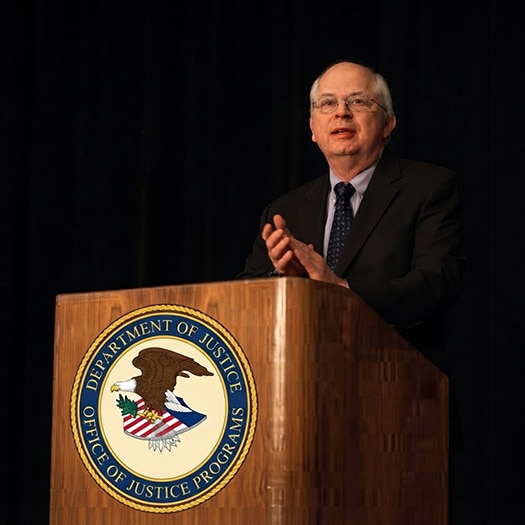
Phil Keith at the 2009 National AMBER Alert Symposium
Phil Keith at the 2009 AMBER Alert Symposium.

Phil Keith had just retired in 2004 as the police chief of Knoxville, Tennessee, when he was given a monumental task: make sure every state, territory and the District of Columbia have a consistent and effective AMBER Alert program within two years. Many states and communities had a child abduction alert system but the programs varied in size, criteria, and capability.

"One of the driving tenants of the development of the AMBER Alert system was to not decide what level of participation there would be but to make the network seamless and let the local, Tribal, regional, and state governments make the most informed decision best meeting their needs," said Keith. "This strategy is still in place today."

Keith put together a small team of professionals who understood teamwork, a strong work ethic and a "relentless sense of urgency to help recover missing children." The team listened to law enforcement officers who knew what did and did not work. They reached their goal in 18 months and wanted to do more.

"It was very clear the U.S. Department of Justice AMBER Alert Initiative was more than highway signs and messaging," said Keith. "The program had to create a voluntary seamless network of AMBER Alert Plans designed to rescue and recover missing, endangered and abducted children."

The team used best practices on investigations, searches, policies, and technologies to help good AMBER Alert programs become better. Team members invited abduction victims and their families to learn about the strengths and shortfalls they witnessed firsthand. They discovered and developed new ways to recover children like the Child Abduction Response Team, Endangered Missing Advisory, AMBER Alert in Indian Country Initiative and the Southern Border Initiative and using social media, including sending AMBER Alerts through the National Center for Missing & Exploited Children's secondary distribution program.

"This is not to say there were not 'bumps in the road,' bruised feelings or some unintentional temporary derailments, but the bottom line was the focus on protecting children," said Keith. "We pushed the envelope at times to gain acceptance, secure sincere team efforts at all levels of government and were very careful to be inclusive rather than exclusive."

Funding for training has always been difficult to obtain on a federal, state, and local level. Keith had to find ways to teach more people with less money. Instead of bringing hundreds of people to be trained by a few experts, he began sending the experts to train hundreds of AMBER Alert partners where they worked. More than 18,700 people have also been trained through eLearning courses.

Now nearly a decade later, Keith has retired from the AMBER Alert Program. Jim Walters, who has been involved with the AMBER Alert Program since its beginnings, has assumed the position as Director of the AMBER Alert Training & Technical Assistance Program. He credits the team for bringing the AMBER Alert Program to its current level and he believes teamwork will be essential to keep the momentum going.

"We have already seen 'bad guys' let children go once they hear AMBER Alerts have been issued, so we are headed in the right direction," concluded Keith. "However, we have to be ever vigilant in our efforts as there are some really evil people in the world who bring great risk and harm to our children."


Keith's Parting Thoughts on:

Child Abduction Response Team (CART)
These teams are built from the bottom up in most communities and represent the true intent of state, local, and Tribal communities to be prepared to respond to episodes of missing, endangered, or abducted children. This model program should remain the flagship initiative of the U.S. Department of Justice and be expanded into as many communities as possible.

Endangered Missing Advisory
The common recurring question about AMBER Alerts was “what to do if my child does not meet the criteria.” The Endangered Missing Advisory addresses the gap for persons over the age of 17, special needs persons, and addresses a population neglected by most everyone, the “endangered missing and runaways.” Today over 43 states and a number of local communities have adopted a form of the Endangered Missing Advisory Program.

AMBER Alert in Indian Country
This initiative was designed to meet the culturally sensitive needs of life in Tribal communities and the unique challenges Tribal members face every day. We learned early on not to layer another program on the Tribes, but rather utilize existing programs and efforts to compliment the work achieved and give AMBER Alert a true meaning of creating greater capacity and skills to respond to children in crisis among Tribal communities.

The Southern Border Initiative
Our partners on both sides of the border demonstrated their dedication and resolve to make a difference in missing children and after only 18 months we had “Alerta AMBER” throughout Mexico. Many of the officials supported the Alerta AMBER, even though there is a potential grave consequence by organized criminal enterprises not interested in the welfare of children and were most likely involved in the trafficking of children for commercial sexual exploitation.

AMBER Alerts in Social Media
Technology has been a great tool to advance the AMBER Alert messaging. In the coming years use of the social media will become a more localized effort as it should be, as the local communities know best what is needed and the urgency in getting “other eyes” looking for missing children.

Ron Laney has spent the past 35 years leading others to do more to protect children. The Associate Administrator of OJJDP's Child Protection Division said being a victim of an abusive childhood gave him the experience and the compassion to know what needed to be done.

Laney was 12 years old when his mother took her four children, left her physically abusive husband, and then struggled to raise them on her own by working at a five-and-dime store. Laney struggled as well and had minor brushes with the law until he was arrested and charged with larceny for stealing from a local business. He spent the next 11 months in reform school.

A police officer took interest in Laney and helped him join the Marines in 1964, six months after he left the school. He served as an infantry platoon sergeant in Vietnam where he was wounded by rocket fire in 1969. Laney honorably served in the Marines until October 30, 1970.

"The Marine Corps gave me the discipline and the drive to make something of myself," said Laney. "That drive and experience taught me to not be afraid to make decisions. When I got out of the Marine Corps, I wanted to do something to help children."

Laney went home to get an education and went to work for the Florida Department of Juvenile Probation. He said his military background was an advantage in working with juveniles and persuading them to do the right thing. He went to work at the U.S. Department of Justice in 1976 and eventually became the coordinator for missing children programs.

In 2002, the AMBER Alert child recovery program that began as a local system in Arlington, Texas, in 1996 became a nationally coordinated effort under the U.S. Department of Justice, and Laney was asked to help put it together. "We had to figure out what we were going to do and how we were going to do it," recalled Laney. "We started developing a training program and a model criteria. The goal was to have a seamless system across the country."

Along the way, Laney has won numerous awards, including a Commendation in the Congressional Record presented on July 24, 2006. In 2002, the American Professional Society on the Abuse of Children created the Ronald C. Laney Distinguished Service Award for individuals who exhibit a lifetime of service to others.

"I think the most satisfying accomplishment is to know we have trained law enforcement and the media to do a better job of bringing missing and abducted children home," said Laney. "Bringing a child home safely is the biggest reward for me."

Laney does not plan to rest on his laurels. He would like to see more states create Child Abduction Response Teams and use the Endangered Missing Advisory to help child abduction cases that do not meet the AMBER Alert criteria. "The AMBER Alert criteria cover only a small percentage of children. Parents were telling me, 'What are you going to do to find my child?'" said Laney. "We are making people qualified to find our missing children. The more we fine tune the tools and resources available, the better off we will be. We want the AMBER Alert Program to be such a deterrent that people will give a second or third thought before taking a child."

Laney has a wife, two sons and is currently caring for two grandchildren. He may be famous for his work with missing children, but he is also well known for his sense of humor, his sunny disposition, and his leadership by example. Laney's lead in protecting children sets an example for all to follow.

Assistant Secretary of Indian Affairs Larry Echo Hawk behind a podium
Assistant Secretary of Indian Affairs Larry Echo Hawk

An unprecedented gathering of more than 175 Tribal representatives from 54 Tribes and 20 states took place in Santa Ana Pueblo, New Mexico, to develop a multiagency approach to protecting Native American children. The National Symposium on Child Protection in Indian Country was held March 9-11, 2010, to confront faltering graduation rates and increased incidents of suicide, rape, child abuse, and abduction.

“We need to stop the rising crime rate, especially against women and children,” said Assistant Secretary of Indian Affairs Larry Echo Hawk, a member of the Pawnee Nation. “The real agenda is to empower tribal governments so they can govern their own people. We need to teach parents about parenting skills so children are safe in their homes.”

The Department of Justice’s Office of Juvenile Justice and Delinquency Prevention sponsored the symposium as part of the AMBER in Indian Country Initiative (AIIC). The initiative was recently expanded to address the following challenges:

  • Abuse, Neglect and Exploitation
  • Runaway and Thrownaway Children
  • Family Violence

AIIC is now offering additional training concerning high-risk runaways, including Native American trackers, bloodhounds and Tribal border issues. “The idea is to create the same level of service and safe return of children in Native American Communities as what is found in any other community,” said AIIC Liaison Jim Walters. “We always wanted a voice for children in Indian Country.”

Gena Tyner-Dawson, Senior Advisor to the Assistant Attorney General for Tribal Affairs, announced that more grants are available to help tribes protect children. “We want to improve public safety, reduce alcohol crimes, create correctional facilities, provide more assistance to sexual assault victims, reach out to victims of elder abuse and prevent juvenile delinquency,” said Tyner-Dawson. “We have one goal: to improve public safety in Tribal communities.”

U.S. Attorney for New Mexico Greg Fouratt encouraged law enforcement leaders to become involved in the lives of children so they will be trusted when a crime is committed. “We have to introduce ourselves to kids before they ever meet a prosecutor, judge or jury,” said Fouratt. “They desperately need our help.”

Native American Children’s Alliance Executive Director Linda Logan shared that she was a victim of child sexual abuse, as was her mother, grandmother and two sisters. She also identified ways to stop Indian children from being abused. “Tribal leaders need to acknowledge family abuse is a problem,” said Logan. “We also need to hold offenders accountable in a way that is fair, swift and sure.”

Under federal law, the maximum penalty for child abuse in Indian Country is one year in jail and a $5,000 fine. “What we are doing now is not working,” said Jerry Wiseman-Foley, a Tribal prosecutor in Oklahoma. “We need to look at our own ways to address what is going on with our people.”

Indian Pueblo Council Chairman Joe Garcia said the problems will not be addressed unless Tribes, states, and the federal government work together. “We cannot do it alone,” said Garcia. “People must work together or we won’t make a dent in the system.”

Representatives from the Native American Community Academy (NACA) and the National Indian Child Welfare Association (NICWA) also participated in the symposium to help in their advocacy work for Tribal communities and children.

Victim Kaelin Glazier, left, and suspect William Frank Simmons, right

Detectives say the AMBER Alert training they received played a pivotal role in making an arrest in an Oregon child homicide case that happened nearly 14 years ago. The Jackson County, Oregon, Sheriff's Office arrested William Frank Simmons on April 7, 2010, for the November 1996 murder of Kaelin Rose Glazier.

Simmons was indicted by a Grand Jury and arrested exactly 2 years after Glazier's remains were found 78 feet from Simmons' home. Once the skeletal remains were found, detectives said they relied on the AMBER Alert training they had just received from the Department of Justice's Office of Justice Programs, Office of Juvenile Justice and Delinquency Prevention (OJJDP) through Fox Valley Technical College.

"We are passionate about AMBER Alert training," said Det. Sgt. Colin Fagan, Jackson County Sheriff's Office. "When we found her remains, we had a better idea of what we needed to do to move the case forward. We knew we had one opportunity to get this right and the AMBER Alert training gave us the awareness and the tools to take the case to the Grand Jury and make an arrest."

Fagan had attended training on how to develop a Child Abduction Response Team (CART) when he saw an age-progressed picture of Kaelin Glazier. The course also included a case study presentation by Sergeant Mark Simpson (Retired) about his investigation into the 1996 abduction and murder of Amber Hagerman, the 9-year-old whose death prompted the creation of the AMBER Alert program.

Fagan and a colleague were impressed by the quality of the training and soon the sheriff's office was sending their detectives and crime analysts to every AMBER Alert course on missing and abducted children offered by the Department of Justice's Office of Justice Programs. The Jackson County Sheriff's Office is also changing its policies and procedures for missing and abducted children.

"The Jackson County Sheriff's Office should be commended for taking what they learned and bringing closure to a tragic murder," said Simpson, "It clearly demonstrates that the effort we put into training is extremely worthwhile."

The Jackson County Sheriff's Department also asked Simpson for advice to help with its newly ramped up investigation into Glazier's death. Simpson was given complete access to the case files so he could train other detectives about lessons learned during the investigation. "We consider Mark a member of the team and we consulted with him to draw from his deep well of experience," said Fagan.

The teamwork paid off when detectives finally had enough evidence to present their findings to the Grand Jury. "They put a lot of effort and sweat equity into the investigation," added Simpson. "I'm proud to have had this unique opportunity to work with these detectives and be associated with them."