
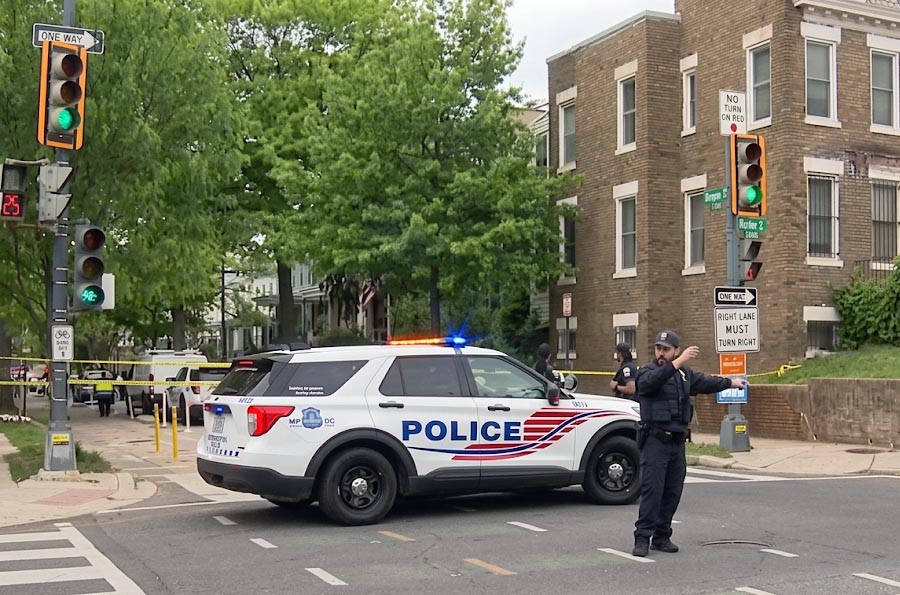
Police officer directing traffic form middle of intersection. Police SUV and crime scene tape block a tree-lined street in front of brownstone brick townhouses.

The response to a fatal shooting in Washington, D.C., demonstrates the critical overlap between homicide investigations and missing child protocols. After 25-year-old Jamillah Gales was killed in a Northwest D.C. alley, Metropolitan Police Department officers discovered her 2-year-old son was missing and issued an AMBER Alert to mobilize community assistance. Within hours, the child was located unharmed in a nearby apartment on the same block, spotted knocking on a window and crying. The suspect, who was inside the apartment with the child, was taken into custody without incident.

Identifying and accounting for associated children and family members is an important part of the initial investigation of a violent crime. In this case, discovering the toddler was missing prompted investigators to initiate missing child protocols and issue an AMBER Alert alongside the homicide investigation.

The child and suspect were found on the same block where the shooting occurred, underscoring the importance of neighborhood canvasses. Door-to-door inquiries and observations of nearby buildings can help law enforcement identify potential witnesses and locate missing individuals.

The child was located after being spotted crying and knocking on a window—a reminder of the importance of watching and listening for signs of a missing child in surrounding structures during canvass operations.

The AMBER Alert sought the public’s assistance in locating the child, extending the request for information beyond law enforcement’s immediate search area.

Key Findings

  • Identifying and accounting for associated children and family members during the initial investigation can accelerate the activation of missing child protocols.
  • Neighborhood canvasses are an important part of the search for a missing child, including inquiries and observations near the crime scene.
  • Visual and auditory cues from surrounding buildings, such as a child crying or knocking on a window, can provide important leads during urban searches.
  • Public alerts can encourage residents to report relevant observations, assisting law enforcement on the ground.

Sources

  • D.C. Metropolitan Police Dept. Report (Apr 22, 2026): MPD Searching for Missing Child after Fatal Shooting (Link)
  • WUSA9 Report (Apr 22, 2026): 2-year-old boy found safe after mother was shot to death in Northwest DC (Link)
  • NBC4 Washington Report (Apr 22, 2026): Child missing after mother killed in DC shooting (Link)

Joseph Nicpon mugshot

The resolution of a Wisconsin AMBER Alert highlights the value of fast interstate communication and electronic monitoring in missing child cases. After an 8-year-old girl disappeared from Wautoma, Wisconsin, investigators learned the suspect—an individual under supervision who had recently cut off his tracking bracelet—was banned from contacting the child and her mother. Recognizing the cross-border flight risk, the Wautoma Police Department and Adams County Sheriff's Office worked closely with the Wisconsin Department of Justice, federal agencies, and the Nebraska State Patrol, whose troopers located the suspect's vehicle on Interstate 80 near Omaha, leading to a safe recovery and peaceful arrest.

Disabling the court-ordered GPS monitor was an immediate red flag that the suspect intended to flee. Recognizing that warning sign allowed local police to escalate their response quickly, pulling in federal and out-of-state agencies during the critical early hours of the search.

Sharing the suspect's vehicle description with the Nebraska State Patrol gave troopers specific identifying information to look for while patrolling major roads. After spotting the Buick Terraza on Interstate 80, troopers stopped it at an exit interchange, and the arrest concluded peacefully. Conducting a traffic stop at an exit interchange can help prevent a high-speed pursuit on an interstate.

By pooling resources across jurisdictions, the case drew on local police, county sheriffs, state justice officials, the U.S. Marshals, and the FBI to track the suspect across state lines and safely recover the child. When someone under supervision violates a no-contact order, fast alerts between agencies can help prevent them from using state borders to evade detection.

Key Findings

  • Disabling electronic tracking devices is a high-priority behavioral indicator that a suspect may flee the jurisdiction.
  • Sending vehicle details directly to highway patrols in neighboring states leads to faster interceptions on major travel corridors.
  • Executing traffic stops at highway exits can help prevent dangerous pursuits.
  • Sharing intelligence across local, state, and federal agencies closes geographic gaps in interstate investigations.

Sources

  • FOX6 Milwaukee (Apr 4, 2026): AMBER Alert canceled: Wisconsin girl found safe, man in custody (Link)
  • Nebraska State Patrol (Apr 4, 2026): Troopers Rescue Missing Wisconsin Girl, Arrest Suspect (Link)