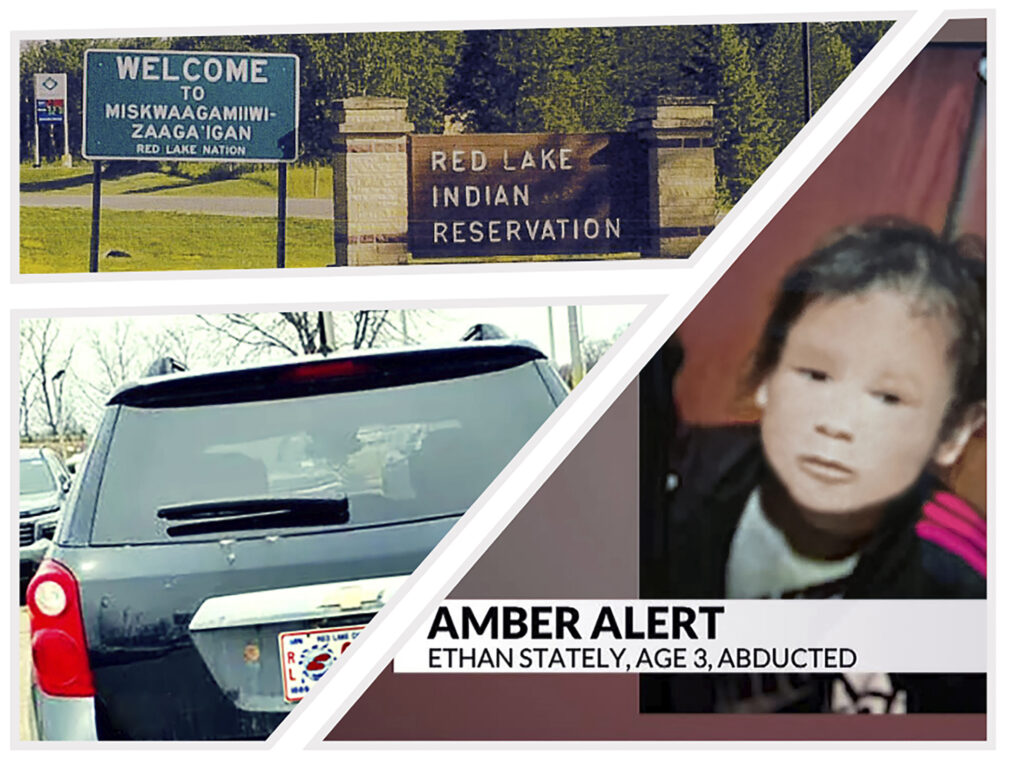
Photo illustration showing Ethan Stately, Red Lake Nation, and type of vehicle he was found in

By Jody Garlock

Red Lake, Minnesota, set on the idyllic shores of one the state’s largest lakes, is typically a tranquil community. But on March 15, 2024, it bore witness to an unfathomable chain of events. The sirens of fire trucks and police cars echoed throughout the Red Lake Nation’s towering pine and birch trees as first responders raced toward a one-story home from which smoke was billowing.

Tragically, emergency responders found two young boys with knife wounds inside the house; both boys died. The area was a crime scene, and agents from the FBI and Minnesota Bureau of Criminal Apprehension (BCA) were among those who joined the investigation.

Red Lake Police authorities would also soon learn that a third child lived at the house. Three-year-old Ethan Stately, authorities realized, was missing and feared to be in danger, taken by his mother (who also was the mother of the two other boys).

Although the Red Lake Department of Public Safety had never before initiated an AMBER Alert, Department Director Kendall Kingbird Sr. and Lieutenant Geoff Pierre sensed how dire the situation was. “We had to get it solved and find our missing boy and mother,” Kingbird says. “And we needed to do that as soon as possible.” The AMBER Alert that followed would be the first one issued for any Minnesota Tribe.

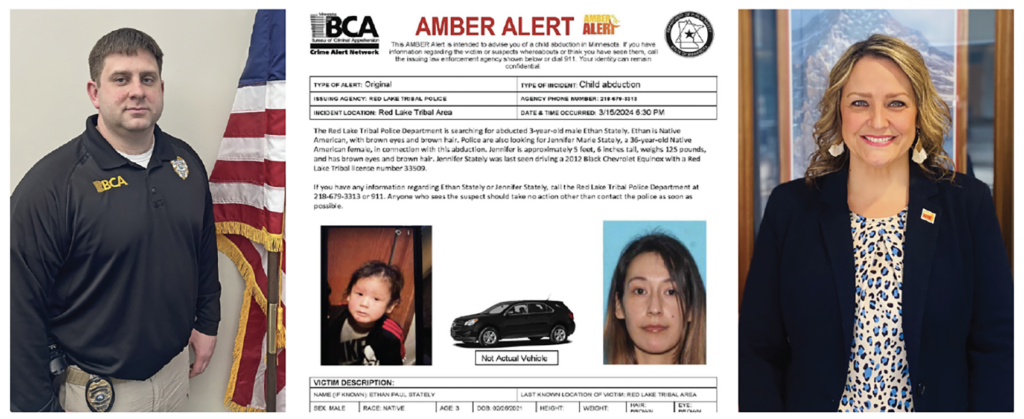
Photos of Ricky Wuori and Janell Twardowski with the Minnesota BCA as well as the AMBER Alert poster for Ethan Stately.
“With this AMBER Alert, we hit all the components,” says Minnesota AMBER Alert Coordinator Janell Twardowski (right), who worked on the case with BCA Assistant Special Agent in Charge Ricky Wuori (left) and others.

The case’s participating law enforcement agencies consider the collaboration a textbook example of an AMBER Alert response. From the beginning, state, Tribal, and federal partners coordinated efforts and shared information. The FBI immediately partnered with the Red Lake public safety department and BCA—responsible for issuing AMBER Alerts in Minnesota—and avoided communication silos to ensure resources were aligned and deployed. And the on-site presence of BCA Assistant Special Agent in Charge Ricky Wuori, alongside FBI agents and Red Lake officers, facilitated rapid decision- making and an efficient, unified response.

The AMBER Alert itself solidly met all of the criteria. There was an abundance of information: the mother’s and child’s photos, a picture of the vehicle, the complete license plate number, and a distinctive Red Lake Nation tag. The alert also provided enough descriptive information to prompt a motorist who had seen the AMBER Alert to call authorities. “He spotted the vehicle, confirmed the license plate, and called 911,” says Janell Twardowski, AMBER Alert Coordinator (AAC) with the BCA’s Operations Center. “With any AMBER Alert, we’re relying on the public to respond, and that’s exactly what happened in this case.”

Less than two hours after the statewide AMBER Alert was issued around 9 p.m., authorities acting on the motorist’s tip pulled over the mother’s vehicle on a Minnesota highway. The toddler was safe inside, but showed signs of neglect. The mother, Jennifer Stately, was arrested and has since been federally charged with various counts of murder, arson, and child neglect. (An indictment alleges that Stately fatally stabbed one of her boys and slashed the other before setting the house on fire and fleeing with Ethan. She has filed an insanity defense.)

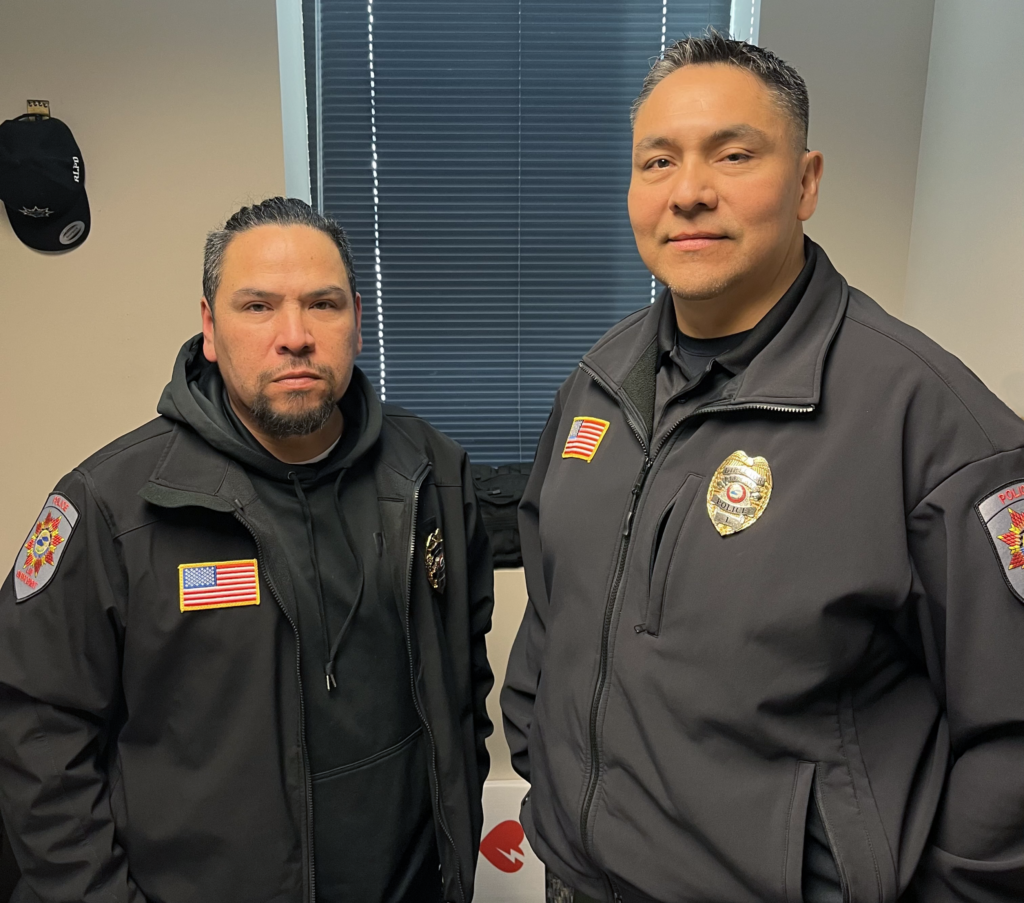
Red Lake Nation Public Safety Director Kendall Kingbird Sr. and Lieutenant Geoff Pierre.
Red Lake Public Safety Director Kendall Kingbird Sr. (on right) and Lieutenant Geoff Pierre led Red Lake’s AMBER Alert case that safely recovered 3-year-old Ethan Stately.

Aerial view of the Red Lake Nation land in Minnesota.

Quote icon

We couldn’t have asked for a quicker response and a better outcome. We’re glad the child was located, and it wouldn’t have been possible without an AMBER Alert.

Kendall Kingbird Sr. Public Safety Director, Red Lake Nation (shown above)

The Red Lake Nation, one of the state’s 11 federally recognized Tribes, has full sovereignty, subject only to the federal government. (It’s one of two Minnesota Tribes exempt from Public Law 280; therefore state courts/government have no jurisdiction.)

The fact that Kingbird and Pierre made the swift decision to initiate the department’s first-ever AMBER Alert stems in part from a trusted relationship with Wuori, who works out of the BCA’s regional office in Bemidji. “They have assisted us with a lot,” Kingbird says.

Wuori credits ongoing communication as key to building trust between agencies. “When you have a good relationship, it’s easier to get things moving,” he says. “It’s constant communication—stopping in and checking on everybody from time to time, not just when you need something.” Tribal investigators regularly meet with BCA agents, and BCA has held training specific to AMBER Alerts. Additionally, over the years, Minnesota’s Tribal communities have received ongoing training and support from the AMBER Alert Training & Technical Assistance Program (AATTAP) and its AMBER Alert in Indian Country initiative, which are funded by the U.S. Department of Justice and supported by the Ashlynne Mike AMBER Alert in Indian Country Act.

As Minnesota’s AAC, Twardowski points to similar relationship-building needed to ensure an AMBER Alert reaches as many people as possible. She credits the state’s media with timely stories and the state’s transportation department with posting roadside alert messages. “As an agency, we are committed to leveraging our partnerships to reach as many Minnesotans as possible,” she says.

In the aftermath of the incident, an outpouring of emotion filled the Red Lake community. A walk of remembrance and candlelight vigil were held to honor the 5- and 6-year-old brothers who died. Yet despite the profound grief, displays of hope and strength emerged. “We’re a tight-knitcommunity,” Kingbird says. For him, the tragedy instilled confidence in the AMBER Alert process. “We couldn’t have asked for a quicker response and a better outcome,” he says. “We’re glad the child was located, and it wouldn’t have been possible without an AMBER Alert.”

Quote icon

In the face of such tragedy, the partnership between local, state, Tribal, and federal agencies proved crucial. Through our combined efforts and the vigilance of the public, we were able to locate a missing child and hold those responsible accountable.

Alvin M. Winston Sr. Special Agent in Charge, FBI Minneapolis
Quote icon

This case is yet another example of how AMBER Alerts save lives. They get critical information out quickly to millions ... [who are] willing to step up to help rescue a child in mortal danger.

Drew Evans BCA Superintendent (in statement from the U.S. Attorney’s Office, District of Minnesota)

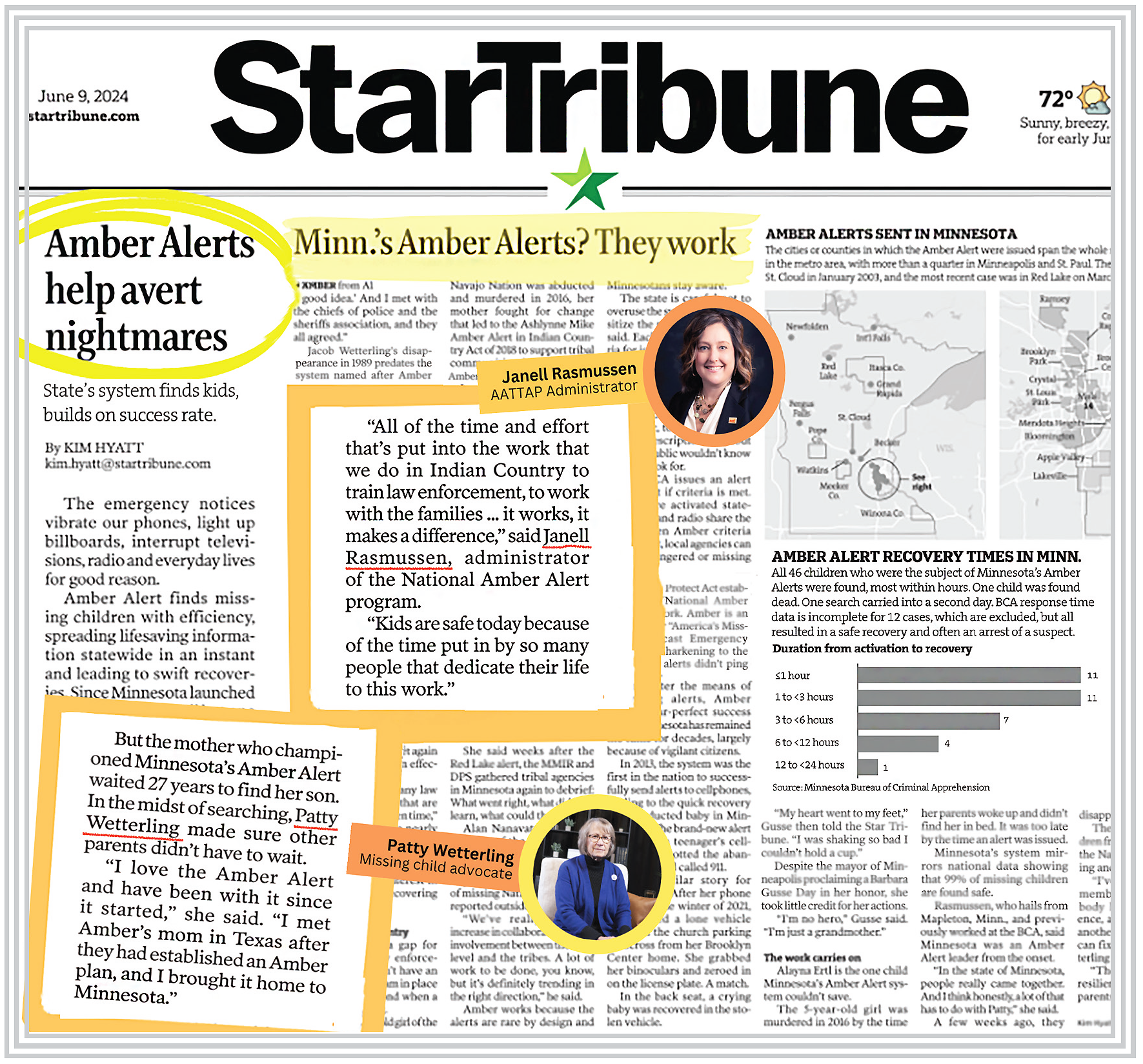
Illustration showing AMBER Alert-related feature that appeared on the front page of the Minneapolis, MN, Star Tribune newspaper. It shows two quotes, one from Janell Rasmussen, and the other from Patty Wetterling.By Denise Gee Peacock

The work of the AMBER Alert Training & Technical Assistance Program (AATTAP) and its Minnesota-based partners was front-page news this week in the state’s largest newspaper, the Minneapolis Star Tribune.

The June 9, 2024, article—entitled “Amber Alerts help avert nightmares: State’s system finds kids, builds on success”—was written by reporter Kim Hyatt.

“AMBER Alert finds missing children with efficiency, spreading lifesaving information statewide in an instant and leading to swift recoveries,” Hyatt reports. “Since Minnesota launched the program in 2002, all but one of the 46 children subject of the alerts here were safely recovered—most within the same day.”

The state’s success with AMBER Alert “does not mean the system is static,” Hyatt noted. “It continues to improve through training and by spreading to new communities 22 years after it was initiated by the state Bureau of Criminal Apprehension (BCA).”

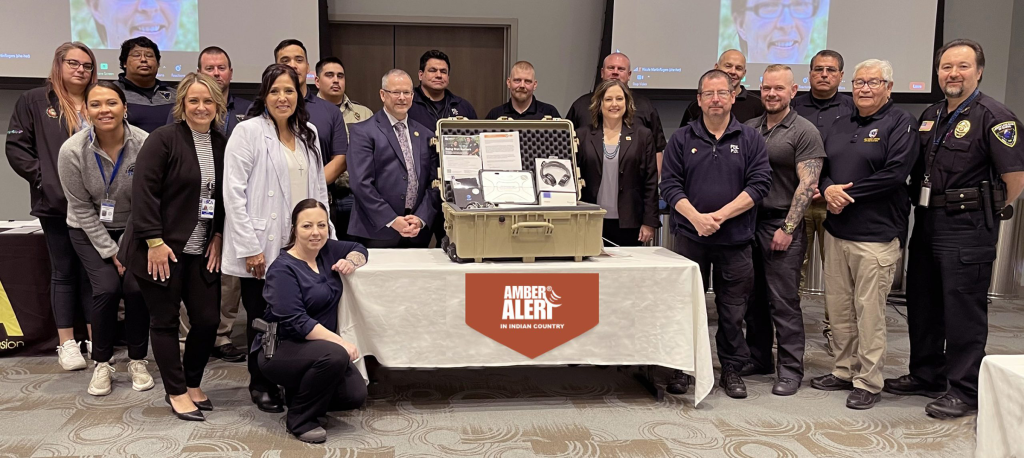
Photo of AATTAP-AIIC team with Minnesota Tribes and law enforcement during a Technology Toolkits presentation in May 2023.
The AATTAP’s AMBER Alert in Indian Country (AIIC) team provided free Technology Toolkits to Minnesota’s 11 federally recognized Tribes in May 2023. The AIIC was created after passage of the Ashlynne Mike AMBER Alert in Indian Country Act of 2018, which provides training and technical assistance to Tribes to foster stronger and faster communication and with regional, state, and federal law enforcement partners.
The article includes these highlights:
  • Since inception of the state’s AMBER Alert program in 2002, 46 children have been the focus of AMBER Alerts. Nearly half of those children (22) were safely recovered in less than three hours. One child, Alayna Ertl, was not able to be safely recovered.
  • In 2013, Minnesota became the first state in the nation to successfully send AMBER Alerts to cellphones, which led to the quick recovery of a baby in Minneapolis.
  • The state’s most recent AMBER Alert was the first to be issued by a Minnesota Tribe (the Red Lake Tribal Police). The alert led to the successful recovery of a missing 3-year-old child.
  • Interviews with two native (and current) Minnesotans who not only have made significant impacts in Minnesota, but in the nation—and beyond:
    • Patty Wetterling, a longtime advocate for missing children. She is the mother of Jacob Wetterling, who was abducted at age 11 on October 22, 1989, by a masked gunman near their home in St. Joseph, Minnesota. (Jacob’s remains were found nearly 27 years after his abduction, and his abductor charged with murder.) Wetterling co-founded and is past director of the National Center for Missing & Exploited Children’s counseling network Team HOPE, and has shared countless victim impact sessions with law enforcement across the U.S.—much of them for the AATTAP and its parent organization, the National Criminal Justice Training Center of Fox Valley Technical College. (Read more about Wetterling’s work for U.S. Department of Justice resource, When Your Child is Missing: A Family Survival Guide, and her new book, Dear Jacob: A Mother’s Journey of Hope.)
    • Child protection expert Janell Rasmussen. Rasmussen serves as Administrator of the AATTAP, which is funded by the U.S. Department of Justice to provide training and technical assistance to law enforcement throughout the United States and its territories, Indian Country, and abroad. Early in Rasmussen’s career she worked as AMBER Alert Coordinator for the Minnesota BCA—and became a good friend of the Wetterling family. Read more about her AATTAP work here.
  • Insight into the state’s AMBER Alert work from BCA Superintendent Drew Evans. “There’s only so many law enforcement officers that are out working at any given time. Yet we have nearly six million Minnesotans that can be our eyes and ears out in the community, and everybody has a vested interest in recovering our children,” he told the Star Tribune. (Note: The Star Tribune reported that access to AMBER Alerts is spreading to new communities, but everyone in the state has had the ability to request AMBER Alerts since the state plan was created in 2002.)
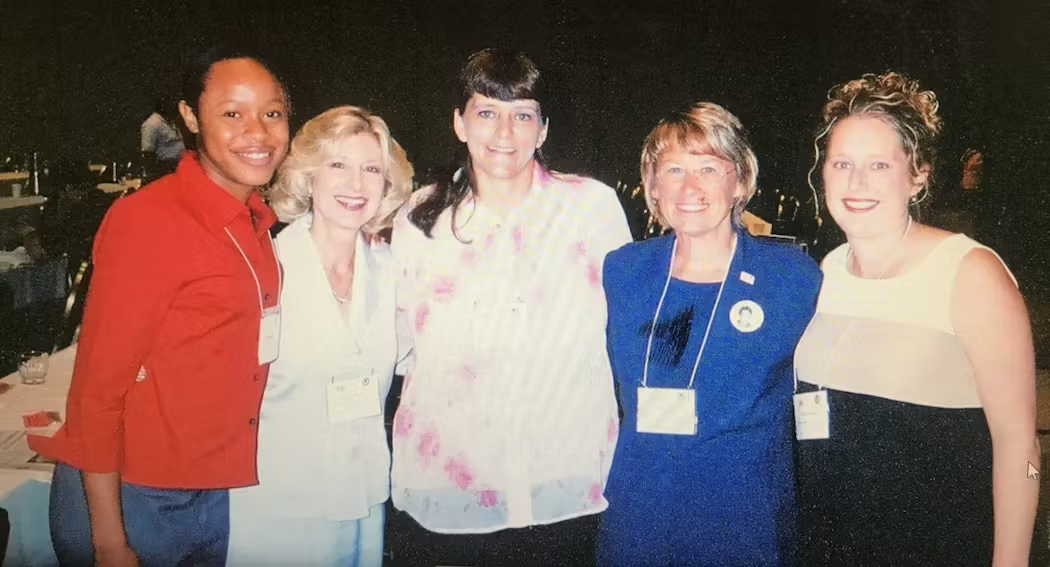
Photo showing Patty Wetterling (second from right), Janell Rasmussen (far right), Donna Norris (mother of Amber Hagerman, center), U.S. DOJ Assistant Attorney General Deborah J. Daniels (second from left), and abduction survivor Tamara Brooks (far left) at the first national AMBER Alert Conference in 2003.
At the first national AMBER Alert Conference in 2003, Patty Wetterling (second from right) and Janell Rasmussen (far right) are photographed with Donna Norris (center), the mother of AMBER Alert namesake Amber Hagerman. Also shown are then-U.S. DOJ Assistant Attorney General Deborah J. Daniels (second from left), and abduction survivor Tamara Brooks (far left). “There’s strength in the resilience of these searching parents,” Wetterling told the Star Tribune. Rasmussen notes that when this photograph was taken, she was pregnant with her daughter, who is expected to graduate next year with a degree in criminal justice.


The White Earth Nation in Minnesota received a $1.2 million donation for its Boys & Girls Clubs. The gift from author and philanthropist MacKenzie Scott is part of a $281 million donation to 62 clubs across the nation. “Today young people face an unprecedented number of obstacles to their success and well-being,” said White Earth Nation Boys & Girls Club Interim Chief Executive Officer James Hvezda. “Studies show a lack of access to technology, positive mentors and guidance, food insecurity and other critical factors can cause long-term setbacks and trauma for millions of young people.”

Both New Hampshire and Vermont will now issue Blue Alerts when a law enforcement officers is injured, killed or missing. New Hampshire Governor Chris Sununu signed a bill on June 21, 2019, authorizing the Blue Alert program. The New Hampshire system will use the same channels as an AMBER Alert, including radio broadcasts and state highway signs. “We hope we never have to use it,” said Sununu. “But, unfortunately, we know that those days may come.”

The Vermont Attorney General and Department of Public introduced its Blue Alert program on August 13. The Vermont system will disseminate messages by email, text, phone, traditional and social media, roadside and lottery signs.

Minnesota became the first state to test the Blue Alert system, after sending a test message on August 14, 2019, to the media and subscribers to the state’s alert program. Minnesota has yet to issue an actual Blue Alert. Learn more about Blue Alerts across the nation by visiting the USDOJ COPS office website at https://cops.usdoj.gov/bluealert.

The Olmsted County, Minnesota, Sheriff's Office is warning the public of a fake AMBER Alert that has been posted about an abducted 3-year-old boy. The alert has been circulating on Facebook since 2010 and includes a description of the suspect's car and license plate. Authorities are asking the public not to share alerts that do not come through the state's AMBER Alert system.

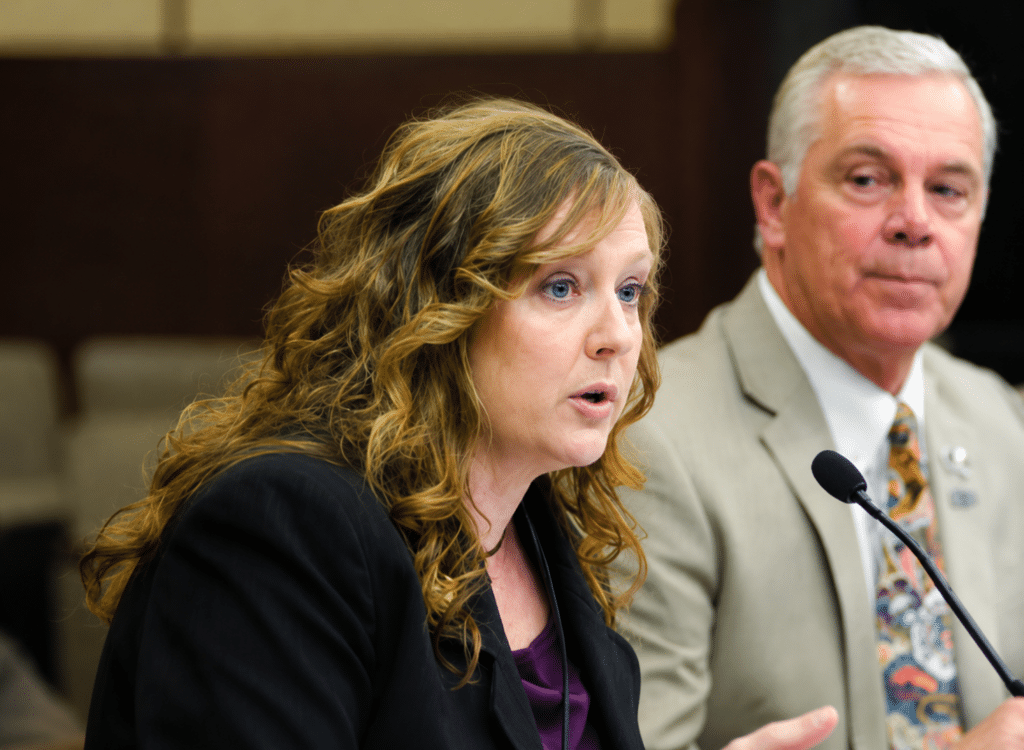
Photo of a woman (Janell Rasmussen) speaking at a table with microphone
Janell Rasmussen

Minnesota AMBER Alert Coordinator Janell Rasmussen has stepped down after setting up the state's AMBER Alert Program and overseeing the recovery of abducted children for the past 16 years. Rasmussen now serves as the Deputy Director for the Archdiocese of St. Paul, Minneapolis, where she plans to continue her work in protecting children.

“This has been the most meaningful work that I have ever done,” said Rasmussen. “I can point blank say, kids are alive today because of the AMBER Alert program.”

Minnesota was the 7th state in the U.S. to implement a statewide AMBER Alert program, along with a missing and endangered persons alert through the Minnesota Crime Alert Network for cases not meeting AMBER Alert criteria.

“One of my fondest memories was the very first interstate success with Utah,” said Rasmussen. “The work between the two states in this case and the many interstate cases that followed were a direct result of the training and relationships developed for AMBER Alert coordinators.”

The case occurred in 2003, when an 11-year-old girl was abducted in Minnesota and police had information the suspected abductor was taking the child to Utah. Utah issued the AMBER Alert. A Utah State trooper monitored one of the highways likely to be used by the suspect and calculated the approximate travel time from Minnesota. Moments later the trooper recognized the vehicle based on the description in the AMBER Alert. The suspect was arrested and the child was recovered safely.

“I cannot tell you how hard it is to see Janell leave,” said James Walters, AMBER Alert Training and Technical Assistance Program Director. “Janell has been such an important part of the AMBER Alert program not only in Minnesota but everywhere else. She had been a vital mentor and provided guidance to AMBER Alert coordinators and Missing Person Clearinghouse managers across the country.”

Rasmussen credits the U.S. Department of Justice, National Center for Missing and Exploited Children, Fox Valley Technical College and her colleagues for helping make the AMBER Alert program a success. “When children were abducted, we were ready to work together to bring them home,” she said.

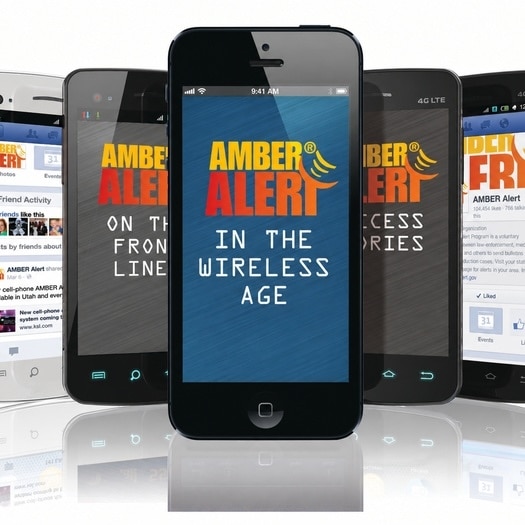
Cellphone screens showing "AMBER Alert in the Wireless Age"Vicky Orozco put her 8-month-old son, Carlos, in his car seat so he could nap while she took a shower. When she returned a short time later, her son was gone.

Shortly after noon on February 20, 2013, the Minnesota Bureau of Criminal Apprehension issued its first AMBER Alert that included the new Wireless Emergency Alert (WEA) to help notify the public. WEA sent the alert to nearly every cell phone in Minnesota.

The alert included information about a female acquaintance who police suspected had abducted the child and the car she was reportedly driving. Like thousands of other people, teenager Daisy Buenrostro was surprised to see the alert on her phone. Buenrostro also spotted the suspect's car across the street and checked the license plate to make sure it was the right one.

“I was so shocked,” she told a reporter. “I was like, ‘This is the car.’ So, I ran back inside the house and told my dad.”

The teen and her father called 911, and within minutes after the alert was issued, the suspect was in custody and the baby was home safe with his mother. It also is the first AMBER Alert success story directly linked to WEA.

“The AMBER Alert was a success. It was an excellent use of the new cell phone technology,” noted Minnesota AMBER Alert Coordinator Janell Rasmussen. “I cannot tell you how many people were talking about the alert. The media was going crazy and everyone was talking about it on the social media. They were giddy to get this information. We had no complaints about this.”

The Wireless Reach
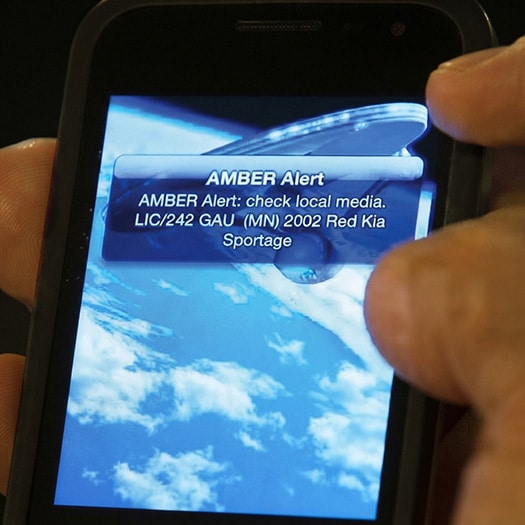
Smartphone with an AMBER Alert on its screenMore people than ever can now receive an AMBER Alert. Beginning January 1, 2013, the alerts reach 97% of all people in the area where the child has been abducted through the WEA which is also called the Commercial Mobile Alert System (CMAS).

The Federal Emergency Management Agency (FEMA) operates WEA and distributes alerts from authorized government agencies about emergency situations to customers with capable mobile devices.

The messages supplement the existing Emergency Alert System which broadcasts alerts over radio and television. FEMA worked with the Federal Communications Commission, U.S. Department of Justice (DOJ), and the National Center for Missing & Exploited Children (NCMEC) to expand the alert system to include AMBER Alerts. WEA is also used for National Weather Service, Presidential, and Imminent Threat Alerts.

Wireless Beginnings

Some state AMBER Alert programs included the ability to send alerts to cell phones as far back as 2002. In May 2005, a voluntary partnership between the wireless industry, DOJ, and NCMEC started the national Wireless AMBER Alert Initiative to provide alerts to cell phones in all 50 states.

The program distributed Wireless AMBER Alerts to more than 700,000 cellular subscribers who signed up to receive the messages. The initiative also brought awareness to the AMBER Alert Program through public service announcements and press events.

However, people had to register their phones to get the alerts, and one could choose to be notified in only five zip code areas. For example, if you lived in Utah and were vacationing in Florida, you would receive an AMBER Alert for Utah, but you would not get an alert issued in Florida.

“It made sense to send a succinct text message to alert users so they would be on the lookout for the kidnapped child and abductor in their area,” said Steve Largent, president and CEO of CTIA-The Wireless Association and president of The Wireless Foundation. “The WEA AMBER Alerts will be an even better tool to help find abducted children.”

Bigger but Focused

The new alert system was developed with lessons learned from the AMBER Alert Program. WEA uses a channel called Cell Broadcast and is not affected by congestion on voice or SMS text channels. The alerts are targeted to cell towers instead of relying on zip codes. If you have a mobile device in the area where the alert is issued, you will automatically receive the alert. Unlike a text message, the alert will pop up on the screen of the wireless device.

“Wireless AMBER Alerts were an important evolution of that program, and we are grateful to those who made it possible,” said John Ryan, NCMEC CEO. “They understand that the eyes and ears of many are better than the eyes and ears of few when a child's life is at stake.”

The new system means the people who can actually do something about an abducted child will get the alerts. However, 3% of phones are not equipped to receive the alerts. The goal of the wireless industry is to have all phones compatible with the system by the end of 2013.

Louder but Shorter

The new AMBER Alerts include a loud, audible tone. The first AMBER Alert in Florida using the new system went out at 1:45 a.m. on January 14. A 2-year-old girl was missing, and her bedroom window was open. The alert went out statewide, and some people were upset that a generic message that said a child had been abducted had awakened them.

Florida AMBER Alert Coordinator Jessica Davenport and most people did not know the alert would include an audible tone that went out to everyone in the state. Davenport worked with NCMEC to change how the alert is used. The state's temporary policy now states that alerts will only go out to specific regions, and WEA will not be used for alerts between 10 p.m. and 7 a.m.

“We have a large population of older folks,” said Davenport. “As long as we use it conscientiously, we should be able to reach a lot of people.”

Davenport also decided not to use WEA unless they have vehicle information. In this case, the missing girl was found safe 15 hours later in a field a half mile from her home.

Developers of the WEA system included a tone with the alerts so people would know they may be in danger when receiving a National Weather Service, Presidential, or Imminent Threat alert. Because of the loud sound, NCMEC is also recommending that WEA should not be used between 11 p.m. and 6 a.m.

“If we have people opt-out, then we may never get them back,” said Bob Hoever, Director of Special Programs in the Missing Children Division at NCMEC.

NCMEC is also asking AMBER Alert coordinators to notify NCMEC about how they want to use WEA. Coordinators need to decide if there are times that WEA would not be used and if the alert is going statewide or to specific regions. NCMEC should be informed about these details.

“You should not be deciding about your maps in the middle of an AMBER Alert,” warned Hoever. “Proper planning is the key.”

The new alerts are limited to only 90 characters, including spaces. The alerts cannot contain photos, web links, or phone numbers. To make WEA a more effective tool, NCMEC suggests that it should not be used if authorities do not have vehicle information or very specific information about the child.

“If you are going to put out generic information, you better put your call center on nuclear power because you are going to get swamped with generic leads,” said Hoever. “The information in the alert has to be meaningful.”

Public Awareness

Unless they have received an alert, most people still do not know about WEA. NCMEC is encouraging AMBER Alert coordinators to talk to the media and let the public know what has changed with AMBER Alerts.

“I think there is a critical need for all of us to educate the public on what these alerts can do and where they can receive information,” said Hoever.

Florida is already developing a public relations campaign. “I think the ability to reach a wider number of people will be very useful,” said Davenport. “We want to make sure everyone knows what the new alert is and how to use it.”

Minnesota's first AMBER Alert involving WEA sparked immediate interest from the media. Rasmussen's only regret is that she did not educate the public before the first alert using WEA went out.

“The alert was shocking to some people. Some people were driving, and they had never heard that type of tone in their car,” said Rasmussen. “I think everyone should put together an education plan because the media will be very excited about it.”

NCMEC is offering webinars to teach AMBER Alert coordinators about WEA. Coordinators can also direct the public to detailed information on how the new alerts work and how to respond, available through NCMEC, the U.S. Department of Justice, FEMA, and the wireless industry's consumer information pages.


A Hastings, Minnesota, motorcycle group donated $25,000 to help fund the state's AMBER Alert Program. The motorcycle group has raised $100,000 for the program since 2003. The Minnesota Bureau of Criminal Apprehension says the money will help defray the $6,000 to $12,000 it costs to distribute each AMBER Alert.

The social networking website Facebook is used by millions to connect people with friends. The Minnesota Bureau of Criminal Apprehension and Clinton, Indiana, Police Department are joining other law enforcement agencies that are using Facebook to help find and identify missing people. The Minnesota website includes crime prevention tips, agency updates, and solicits help on cold cases. The Clinton site posts AMBER Alerts, most wanted criminals, and mug shots.