

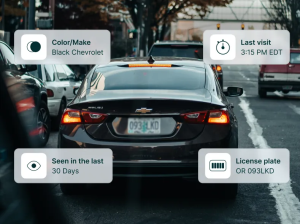
Illustration of what license plate readers capture

Working with the Department of Homeland Security, Wayne County, Michigan, law enforcement officers posed as kids on a website where seven men—including a Wyandotte school teacher—thought they were setting up underage sexual encounters. But as each would-be predator made his way to meet the child, Taylor, Michigan, police used Flock Safety cameras/license plate readers (LPRs) to track the men and arrest them as they entered the city (five miles southwest of Detroit). Flock Safety traffic cameras log LPR data (including the vehicle’s make and model) for 30 days, and the information can be shared with law enforcement across the nation.

A Michigan mother was ordered to serve three years of probation for claiming her baby had been kidnapped, which sparked an AMBER Alert. The woman told police her car had been stolen with her 18-month-old daughter inside. Someone saw the alert and told police the child was safe with her father. The mother admitted to making up the story because of a dispute with the girl’s father.

A Grand Rapids, Michigan, mother is facing prison after telling police her 18-month-old daughter had been stolen by a stranger on August 5, 2018. An AMBER Alert woke residents up after it its 3:21 a.m. issuance. Jennell Ross stuck by her story until the baby’s father told police the child was with him the entire time. “It kind of destroys the credibility of the AMBER Alert, which is really sad that one person did that, and she should be charged,” said Michigan State Police Detective Sergeant Sara Krebs. “It’s very frustrating for us, but I will always err on the side of caution for that child.” Ross could face up to four years in prison and a $2,000 fine.

Michigan changed its criteria for issuing an AMBER Alert in 2017 so it would only be used for cases of child abductions for victims under the age of 18. At that same time, the state added an Endangered Missing Persons Advisory to notify law enforcement and the public about missing person cases that do not meet AMBER Alert criteria. After issuing 15 AMBER Alerts in 2016, Michigan issued just four alerts in 2017 and one in 2018. Michigan State Police said people are now paying more attention to AMBER Alerts and the Endangered Missing Advisory has become a great success in finding missing people of any age.

Michigan legislators are proposing a bill that would require law enforcement officers to enter all missing person cases into the U.S. Department of Justice NamUs database. Proponents say it will help solve more missing person cases. The legislation would also require details about unidentified bodies to be submitted to the database. Similar laws have been passed in Tennessee, Connecticut, New Jersey, and New York. While these other states have differing requirements regarding when the information must be entered, the Michigan law would require entries to be made as soon as the preliminary investigation is completed.

Michigan has changed the state's AMBER Alert criteria to make sure notifications are used only for child abductions. AMBER Alerts had previously been authorized for missing children with severe mental or physical disabilities. Those cases will now be eligible for an Endangered Missing Advisory, which will be sent to the media but not to cell phones.

Michigan will now issue a Blue Alert if a law enforcement officer is killed or seriously injured on the job. Legislators said they wanted the alert because a suspect who is willing to kill or injure an officer is a serious danger to the public. The alert will report where the incident occurred along with a description of the suspect and vehicle. The information will be sent to media outlets and cell phones. Michigan is believed to be the 25th state to adopt the Blue Alert system since it began on February 1, 2016.

A bipartisan effort by legislators in Michigan hopes to create a statewide active shooter alert system. The legislation was spurred after a shooting spree in Kalamazoo left six people dead and two seriously injured. The proposed bill would have the Michigan State Police send alerts via radio, television and text messages when there are “urgent and immediate threats” to public safety.

For the second year Michigan celebrated AMBER Alert Awareness Week to help promote awareness of efforts to recover abducted, missing and endangered children. Since its inception in 2001, the Michigan AMBER Alert Program has been activated 327 times and has helped to recover 321 children. Six children are still missing. This statewide AMBER Alert Week was held this year on May 19-25, 2013.

Ten TV stations aired false alerts about a zombie invasion in February 2013. Hackers entered the Emergency Alert System through the “back door” of the security system and sent the message to viewers in Montana, Michigan, California, Utah, and New Mexico. Each incident included a TV crawl and a mechanically altered voice warning of “zombies attacking the living.” The FBI and FTC are investigating the breach.