A total of 220 children were found safe during the six years that Assistant Chief LD Maples oversaw the California AMBER Alert Program. The former State Coordinator created a statewide AMBER Alert training team to teach law enforcement and media. He also created the “California AMBER Alert Criteria Reference Card” to help law enforcement officers make quick decisions during missing or abducted child investigations.
Maples partnered with the National Weather Service to activate the Emergency Alert System and was involved in getting alerts distributed to cell phones, billboards, Internet sites, and tens of thousands of California State Lottery digital terminals. He also developed Endangered Missing Advisories for cases that did not meet the AMBER Alert criteria. On a personal note, the father of 3 recently traveled to Cambodia to help rehabilitate girls rescued from human trafficking. “Maples has demonstrated leadership, innovation, and a personal passion for the AMBER Alert Program,” said California Highway Patrol Officer Janet Lockhart who nominated Maples for this award.
In March 2011, the Department of Justice published the “Guide for Implementing or Enhancing an Endangered Missing Advisory.” The guide suggests ways that states can develop a plan to help find missing endangered people without jeopardizing the success of the AMBER Alert.
On August 18, 2009, Katy, Texas, Police Officer Julio Reyes abducted fellow officer Rachel Hillsman at gunpoint. Exactly one year earlier, Texas had initiated the Blue Alert system to notify the public when a law enforcement officer was killed or seriously injured in the line of duty. In a strange coincidence, on the first anniversary of the system, Texas issued its first alert for an officer who had been abducted by another officer.
After the alert was issued, police launched an extensive search on the ground and in the air. The suspect and hostage were found near some homes under construction. Reyes opened fire and used Hillsman as a human shield to get away. A standoff lasted several hours before Reyes released Hillsman unharmed. Before officers could move in to arrest Reyes, he shot himself. He was pronounced dead at the scene.
The state has issued two more alerts since that day. Texas AMBER Alert Coordinator Sam Allen says the Blue Alert has become an important tool for the state.
“The Blue Alert is definitely important because it is such a heinous crime to attack a police officer who is protecting our life and liberty,” said Allen. “It is a way for the public to give back to the people who serve us on a day-to-day basis.”
On October 17, 2011, Utah became the tenth state to initiate an alert for fallen officers. Six more states have pending legislation for a Blue Alert.
“We have learned from the AMBER Alert how the public can quickly provide important tips and save lives,” said Utah Attorney General Mark Shurtleff. “The Blue Alert will also protect the public and other officers.”
Utah law enforcement officers and broadcasters worked together to create a plan that would help fallen officers without creating any confusion with the AMBER Alert. In Utah, a Blue Alert notifies law enforcement and the media; it is also posted on highway signs. Broadcasters decide when to break into programming.
In Utah and most states, only law enforcement can issue a Blue Alert that meets strict criteria: has the suspect killed, seriously injured, or assaulted a law enforcement officer with a deadly weapon; is the suspect an imminent threat to the public and other law enforcement personnel; is information available for the public about the suspect, the suspect's vehicle, and vehicle tag; and will public dissemination of available information help avert further harm or accelerate apprehension of the suspect.
“Law enforcement officers put their lives on the line every day,” said Layton (Utah) Police Chief Terry Keefe. “The Blue Alert will quickly let law enforcement and the public know that an officer is down and a suspect is on the loose.”
California also has a Blue Alert system, but so far, the state has not used it. California Highway Patrol Assistant Chief LD Maples helped implement the Blue Alert while serving as the state's AMBER Alert Coordinator. Initially, Maples was reluctant to add another alert.
“We were always concerned about something that would affect AMBER Alert,” said Maples. “But anyone who will threaten law enforcement is threatening society. People who kill police officers have no hesitation to kill any other person, and we need to bring those resources to bear to make sure no one else gets hurt.”
So far, California and Texas have not seen a negative impact on the AMBER Alert. “I did not see it watering down the AMBER Alert,” said Allen. “It would have an impact if we had hundreds of officers being killed, but fortunately that is not the case.”
Endangered Missing Advisory
The Blue Alert may be new, but 39 states have a plan to notify the public for missing people who do not fit the AMBER Alert criteria. Six years ago, five states had an alert for non-AMBER Alert cases.
In March 2011, the Department of Justice published the “Guide for Implementing or Enhancing an Endangered Missing Advisory.” The guide suggests ways that states can develop a plan to help find missing endangered people without jeopardizing the success of the AMBER Alert.
For most states, the advisory goes out to law enforcement and the media. Broadcasters decide whether they want to break into programming. Maples says it was important to have a title and a plan for how law enforcement responds when a person is missing and in danger.
“Even before the guidelines came out, we implemented something to give a title of what we do when we do not issue an AMBER Alert,” said Maples. “It is not just a case of doing nothing. We always do something. The Endangered Missing Advisory lets the public know we are doing something that has led to safe recoveries in many cases.”
Utah was one of the first states to develop an alert for cases that did not meet the AMBER Alert criteria. During the first five years, Utah issued 92 advisories for 100 people, of which 80 people returned home safely, and 17 people were recovered specifically because of the advisory.
About half of the states have no age restrictions for the advisory. Most of the states with age restrictions issue advisories for the elderly only. An alert for a senior citizen is often called a Silver Alert, and senior citizen groups have lobbied federal and state legislators to create national or state Silver Alert programs.
Bottom Line on Additional Alerts
It should not be a surprise that the success of the AMBER Alert has spurred others to imitate the program for other uses. Many AMBER Alert partners seem eager to try something new if it does not negatively impact what is tried and true.
“As legislatures pass more of these programs, we need to make sure the public is not desensitized,” said Allen.
“Whether it is a Blue or Silver Alert, you are still meeting needs, but keep the AMBER Alert what it is,” concluded Maples.
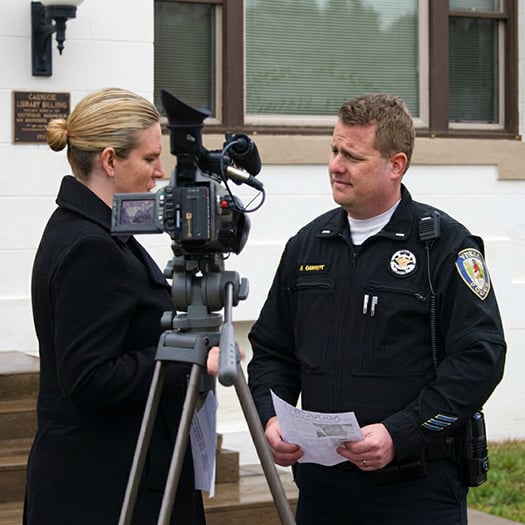
Lieutenant Dave Gamache speaks with a journalist about the case.
A late-night party turned into a nightmare for parents living in the small Northern California town of Yreka. On March 2, 2009, a stranger stopped by the party at the parent's home and later fled with their 3-year-old girl.
The victim's father heard his daughter's screams at 4:30 a.m. and saw the man leave in a 1992 Pontiac Grand Am.
Yreka Police Department's Lieutanant Dave Gamache was contacted, and an AMBER Alert was issued at 6:53 a.m. for 22-year-old Kody Lee Kaplon and a small brown-haired girl wearing a tie-dyed T-shirt.
“It was unbelievable” said Gamache. “I had no idea the AMBER Alert was so simple to use and would be so widespread in such a short period of time. Within 30 minutes after issuing the alert, I was up to my eyeballs with phone calls ringing off the hook. It worked seamlessly.”
Since Yreka is close to the Oregon and Nevada borders, the California Highway Patrol asked both states to also issue alerts. The Yreka Police Department had never handled a stranger abduction case, and this was the agency’s first AMBER Alert.
“The thing that sticks out in my mind is that we deal with bigger agencies with a lot of resources and this was a small agency and they did an amazing job handling everything that was going on,” said Captain LD Maples, California AMBER Alert Coordinator.
Ironically, Gamache said his agency had just signed up to take AMBER Alert training the following month. “We have everything but not very much of it,” he said. “I was not going to let pride get in the way of asking for help to find this girl.”
The National Center for Missing & Exploited Children also called to offer help and immediately sent two agents from Team Adam.
“The AMBER Alert went very smoothly. Everything happened by the book,” said Adrienne Abbott, Nevada Chair for the Emergency Alert System. “The California Highway Patrol, Nevada Highway Patrol, and the Yreka Police department were constantly in communication.”
The AMBER Alert was working as planned but a 3-year-old girl was still missing. Temperatures were dropping, snow was falling and authorities knew they were running out of time to save the girl.
Suspect Kody Lee Kaplon
At 2 p.m., the suspect called a designated AMBER Alert phone line to ask police why they were looking for him. Yreka had recently set up a phone bank for natural disasters and officers asked an animal control officer, a secretary, and others to handle all the calls for the alert.
At about the same time, a Yreka officer ran into people panning for gold in the search area and they offered to drop their pans and start looking for the girl. The volunteer searchers took a 4-wheel-drive vehicle and followed car tracks on a remote dirt road. They found the suspect's abandoned vehicle and discovered the girl hiding in some bushes at 3:21 p.m.
The alert was cancelled three minutes later and Kaplon surrendered to police. The girl told police that the suspect had buried her in the mud and left her, but she was able to dig herself out.
“The recovery was the direct result of the AMBER Alert,” said Abbott, and then he asked, “Isn't that the point of the AMBER Alert? You're always thankful when the child is recovered alive. As a parent what else can I say?”
Kaplon is now charged with kidnapping, sexual abuse and cruelty to a child, burglary, and attempted murder.
An AMBER Alert, the response of ordinary citizens and a small police department that was not afraid to ask for help, changed what could have been a tragedy into a miracle.
“There were so many pieces of the puzzle I hate to think what would have happened if one of the pieces would have been missing,” concluded Gamache. “I probably will never have another case that makes me feel so good that everything worked.”