
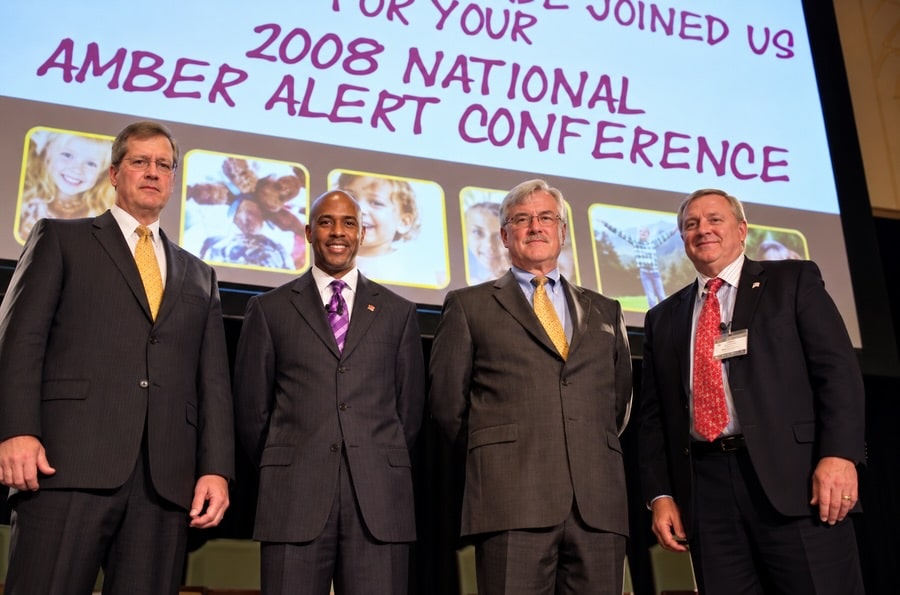
Group of speakers at the 2008 AMBER Alert Conference
Speakers at the 2008 AMBER Alert Conference.

Many firsts were noted by AMBER Alert partners at the 2008 National AMBER Alert Conference in Orange County, California. It was the first conference to include members of Child Abduction Response Team (CART) representatives, first to involve European AMBER Alert partners, and some broadcasters said it was the first conference to fully recognize and incorporate the important role of the media.

The conference was also the first and last opportunity to hear from Assistant Attorney General for the Department of Justice's (DOJ) Office of Justice Programs (OJP) and National AMBER Alert Coordinator Jeffrey L. Sedgwick. “We have a strong foundation, thanks to the selfless work of broadcasters, transportation officials, and law enforcement,” said Sedgwick. “But we have to maintain our level of vigilance. We don't have the luxury of letting our guard down.”

Several training sessions focused on incorporating the CART concept into each AMBER Alert plan. More than 160 teams of law enforcement officers, forensic experts, victim service providers and others have been trained since DOJ launched the CART initiative in November 2005. “There's no time for turf wars,” added Sedgwick. “What is needed is the full crush of resources and expertise so that the child can be recovered as swiftly as possible.”

Surprisingly, the number of AMBER Alert activations are actually going down each year. Here is the breakdown: 2005 had 275 activations, 2006 had 261 activations, and 2007 had 227 activations. Projections for 2008 indicate there will be less than 200 activations.

“We are trying to identify trends,” said Bob Hoever, Associate Director of Training and Outreach for the National Center for Missing & Exploited Children. “I think part of it is there is much better training. We are miles ahead of when we met at the first AMBER Alert Conference in 2002.”

However, secondary notifications have increased from 49% in 2005 to 85% in 2008. “When you get a text message sent directly to you saying that a child has been abducted, you take it seriously,” Sedgwick said. “Suddenly, it is personal.” However, some secondary notifications do not go out because the child has already been recovered.

Presenters noted that AMBER Alert plans should constantly be refined and training must be ongoing. “There is no finish line,” said Knoxville Deputy Chief of Police Gus Paidousis. “You may be cutting edge today but not be cutting edge tomorrow.” He stressed that telecommunicators need practice in testing and scenarios for AMBER Alerts. Volunteer coordinators also need to be prepared for all the people who will show up to help. “It doesn't matter if you want volunteers, they are going to show up,” said Paidousis.

The role of transportation also continues to be important for AMBER Alerts. The Department of Justice developed a “Best Practices Guide” in 2005 and transportation officials were urged to update their practices, policies, and messages. One presenter noted more does not always mean better and people can be desensitized to AMBER Alerts if they are not timely or displayed in an area where people can help. “Despite all the technology, it is still a very human decision made by law enforcement officers across the country,” said Dale Bonner, Secretary of the California Business, Transportation and Housing Agency.

One panel considered what would have happened if an AMBER Alert plan was in place when Amber Hagerman was abducted in 1996. The panelists were unsure if the alert would have saved her life but were certain the media and the public would have received the information about her abduction much quicker.

“We have a lot of missing children,” noted Ron Laney, Associate Administrator for Child Protection Division, OJJDP. “We need to keep in touch with each other. I know we are doing a lot, but we are not there yet. When we are working together there is nothing that we cannot do.”

For 28 years, Jeffrey L. Sedgwick, the Acting Assistant Attorney General for the Office of Justice Programs and current National AMBER Alert Coordinator, taught Political Science at the University of Massachusetts at Amherst and now he's turning his skills as a professor into educating people about the Department of Justice's Office of Justice Programs and the AMBER Alert system.

Photo of Jeffrey Sedgwick
Jeffrey L. Sedgwick

“I was humbled,” Sedgwick said, when he learned President George W. Bush nominated him for the position of Assistant Attorney General for OJP. “I spent my whole life in academia,” said Sedgwick, who is currently on extended leave from the university. But he was ready for another challenge, and a challenge is what he received.

Now, instead of educating the minds of tomorrow's leaders, Sedgwick is responsible for providing overall management and oversight of OJP and for assisting state and local officials with coordinating, developing, enhancing and promoting AMBER Alert plans.

Sedgwick talks with emotion about two separate meetings he had with two parents, both of whom had highly publicized child abduction cases covered throughout the media: Ed Smart, the father of Elizabeth Smart, who was abducted from her home on June 5, 2002, and rescued nine months later, and the British family, Kate and Gerry McCann, who had their four-year-old daughter, Madeleine, abducted May 3, 2007, from their Portuguese vacation resort.

“If you reflect, you can see the differences,” Sedgwick said. “One family got their child back, and the other family is still actively looking.” And one country had an AMBER Alert in place, whereas the other country is still advocating for one.

During Sedgwick's time as the AMBER Alert Coordinator, his goal is to keep the momentum pertaining to AMBER Alerts up and keep the vision of a national AMBER Alert network on the forefront.

Sedgwick supports a “seamless” AMBER Alert network. “We are working with our Native American partners on the use of AMBER Alert in Indian Country, and with Mexico and Canada in case children are abducted across our northern or southern borders. Everyone from law enforcement to government to broadcasters has worked very hard to make the AMBER Alert program a success in their state and nationwide,” said Sedgwick. “We are constantly looking for ways to expand the AMBER Alert program, so police and sheriffs' departments gain thousands or even millions of allies in the search for missing children.”

While Sedgwick is actively advocating for AMBER Alert expansion, he also knows that in order to keep AMBER Alerts operating successfully, people need to be constantly looking toward the future.

“The sooner you find the child, the more likely the positive outcome,” he said. “Time is your enemy, so you really have to have a good sense of what people are paying attention to and get the information out in the shortest amount of time. For example, 20 years ago people were listening to Sony Walkmans, but now it's iPods and MP3 players. We need to keep up with the times and get the AMBER Alert system out there.”

A prime example of keeping up with technology is the Wireless AMBER Alert initiative, and how wireless subscribers can receive AMBER Alert text messages on their cell phones by registering at wirelessamberalerts.org. Sedgwick said, “a few years ago, this would have been unheard of, but because we are staying focused on technology, we are keeping the AMBER Alert system successful.”

Sedgwick has written on many aspects of the United States government, such as policy analysis and evaluation, criminal justice policy, executive leadership and public finance. He also authored Law Enforcement Planning: The Limits of an Economic Approach and Deterring Criminals: Policymaking and the American Political Tradition.

Sedgwick's education consists of an A.B. from Kenyon College (1973) and his M.A.P.A and Ph.D. from the University of Virginia (1975 and 1978 respectively).