

 Casey Jo Pipestem excelled at basketball and poetry in high school and was known for her lanky build and big smile. But the Native American teen was shuffled from home to home because her mother was attempting to get out of a difficult relationship.
She started running away and later began trading sex for drugs at truck stops near Oklahoma City. Casey was only 19 when her body was found after being tossed from a bridge. Authorities believe she had been murdered by an “Interstate” serial killer.
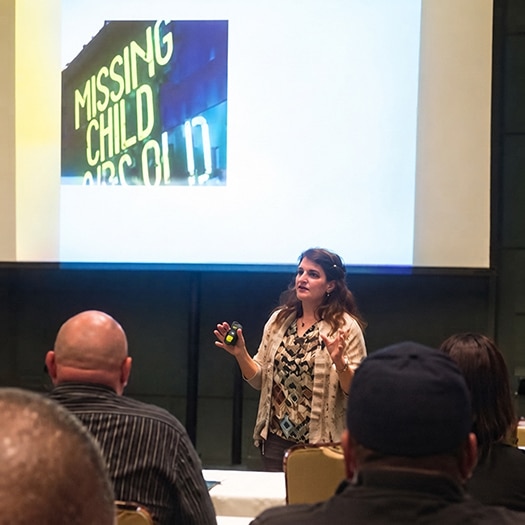
Pipestem's story was just one shared at the Child Protection in Indian Country Meeting to show that Native American children may be the most vulnerable of all children when they are missing.
The meeting held May 7-8, 2013, in Jacksonville, Florida, included law enforcement representatives from 19 Tribes residing in eight states. Organizers hope the training will help end what was called an “epidemic” of missing and runaway children from Tribal communities.
Jim Walters, the Native American liaison for the AMBER Alert Training and Technical Assistance Program, shared that Native American children have the highest levels of runaway and thrownaway children of any ethnic group. “They typically leave their homes and support systems for urban areas,” said Walters. “They are also less likely to have access to positive resources to help them while they are away.”
When Native American children end up in a placement shelter or foster home, Walters said they are often placed with people outside their race and they are twice as likely to run away. “Native American boys are five times more likely to run away from placement than Caucasian boys,” he added.
Why do they run? Participants offered some possible factors, including children moving from house to house when their parents are not around, a belief that a better life can be found away from home, a belief that the home has overly restrictive rules, physical or sexual abuse, drug and alcohol use by parents, teens and peers, and poverty and hopelessness.
Janet Draper is a police officer and the director of Children and Family Services for the Potawatomi Nation. She said checkerboard jurisdictions in Tribal communities also create problems for placing a child. “State agencies make it difficult when they take a child into custody and they do not notify us or the tribe,” she said. “Once we are notified we transfer the case to the tribe and start over.”
Presenters noted that people living outside Tribal lands often do not understand the culture or Indian Child Welfare laws. Also, some communities do not have the needed resources and infrastructure or a centralized source of reporting for cases involving children.
Unique Dangers for Native American Women and Girls
Indigenous women have been exploited since the first Europeans came to America. Today studies show that Native American women and girls are significantly overrepresented in the sex trade industry.
An analysis of 2007 prostitution arrest data in the county encompassing Minneapolis found that 24% of arrests involved Native American women, more than 12 times their representation in the county's population. Other studies found similar results in Washington, Oregon and Montana.
The Centers for Disease Control and Prevention did the largest study ever done on family violence and found that 39% of Native American women were victims of intimate partner violence, the highest rate for all ethnic groups.
Other studies found that Native American women have the highest rate of sexual assault and rape: 7.7 per 1,000 women versus 1.5 for African American women, 1.1 for White women, 0.6 for Hispanic women and 0.2 for Asian women.
Team Approach
Participants learned that a team approach is capable of making a big difference in protecting Native American children. Child Abduction Response Teams (CART) can be developed in Tribal communities to respond with the needed resources and expertise to handle missing and abducted child cases. An Internet Crimes Against Children (ICAC) Task Force can be used to protect children from online predators.
Some Tribes have already implemented Multi-Disciplinary Teams (MDT) or Child Protection Teams (CPT) made up of representatives from law enforcement, social services, schools, health, courts, and elders. These teams are responsible for prevention, intervention, investigations and aftercare for children.
Native Americans have strong beliefs about family relationships and extended families. Some Tribal communities have been able to reduce the number of runaways by placing a child with other family members or even with families from the same Tribe. Successful programs also helped in cultural immersion, mentoring, and community service. The ultimate goal is to make sure Native American children are protected and those who prey on children are aggressively prosecuted.