

The aunt of a missing child has started an online petition to broaden Iowa’s AMBER Alert criteria. Michelle Harrelson has gathered more than 3,000 signatures on Change.org after Xavior Harrelson went missing on May 27, 2021. Authorities said the situation did not qualify for an AMBER Alert. Harrelson plans to approach lawmakers about her proposed changes in January.
Some Nebraska legislators would like Silver Alerts to be issued for missing children with disabilities. The alerts are voluntarily shared on TV and radio for disabled adults who wander from their home without assistance. Iowa Representative Sharon Negele said Silver Alerts have helped recover 88 percent of missing persons between 2013 and 2017. She said the same protection should be provided for children.

Iowa State Trooper and longtime advocate for the AMBER Alert Todd Misel has retired after a 34-year career in law enforcement. Misel was part of a group that created Iowa's AMBER Alert program in 2003. Iowa's governor told the group he wanted the alert up and running soon. “He brought it up at the state fair and gave us 90 days to put it together and figure it out,” said Misel. “It was an extremely aggressive time line but we had something by early spring of the (following) year.” Misel has also worked with the AMBER Alert Training & Technical Program for more than a decade.

The Jefferson County Chiefs and Sheriff Association in Wisconsin recognized an Iowa man as the “2015 Citizen of the Year” after hearing an AMBER Alert and helping officers safely recover a 3-year-old Milwaukee girl. Authorities said a 32-year-old man forced the girl’s mother out of her car and drove off with the child still inside. Paul D. Smith was sitting in his hotel room when he saw the AMBER Alert on TV. He went out to the hotel parking lot and discovered the missing vehicle and called the sheriff’s department. Deputies arrested the suspect after he tried to flee his hotel room.

“My dad always said we are put on this earth to help one another and I try and honor him by doing that every time I get a chance,” said Smith at the awards ceremony. “I am so grateful and humbled that I was able to do that in your community and, with law enforcement, we were able to return a child to her home.”

Iowa has changed the criteria to make it easier to issue an AMBER Alert when all the information is not available. Authorities now need to have only one of the following descriptions: the abducted child, the suspect or the suspect's vehicle. Before the change the state required all three descriptions before an alert could be issued. The change was made after a review was held of two high-profile kidnapping and murder investigations. The review board also recommended more AMBER Alert training in the state.

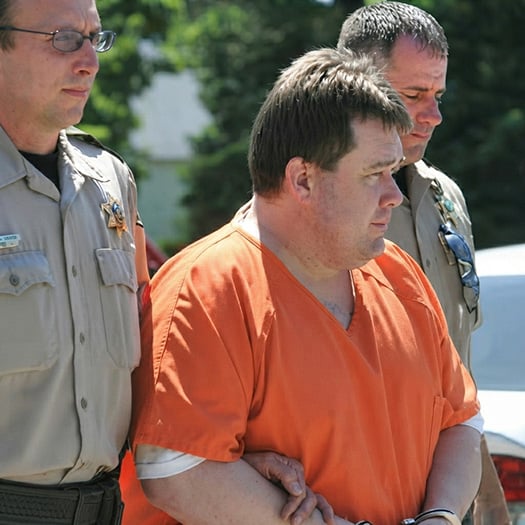
Suspect Thomas Petersen being escorted by law enforcement
Suspect Thomas Petersen being escorted by law enforcement.

On June 4, 2011, Thomas Petersen allegedly stabbed and killed his wife Judy and then fled in a red pickup with their 2-year-old son Jacob. Iowa issued an AMBER Alert and asked South Dakota to issue an alert the next day when detectives learned the suspect was using credit cards near Kadoka, South Dakota.

The 2011 AMBER Alert Law Enforcement Leadership Award was given to two sheriffs and a park ranger who risked their lives trying to bring young Jacob home safely.

Badlands National Park Ranger Bryan Warner heard the AMBER Alert and had a hunch that the suspect would travel by an exit on I-90. About 20 minutes later, Warner saw the suspect's truck, and he pulled Petersen over.

“I thought he was going to comply,” said Warner. “But he was talking really erratic and ran on me.”

Petersen raced off at speeds exceeding 120 miles per hour. Meanwhile, Jackson County, South Dakota Sheriff Ray Clements was asleep when he heard the AMBER Alert on the radio. He got up and was checking convenience stores in the area when he heard on the police scanner that a park ranger was following Petersen. The sheriff joined the park ranger in the high-speed pursuit of the suspect.

“Petersen looked at me and pointed to his 2-year-old boy to let me know he was in there,” said Clements. “I tried to get him to pull over and he would not stop.”
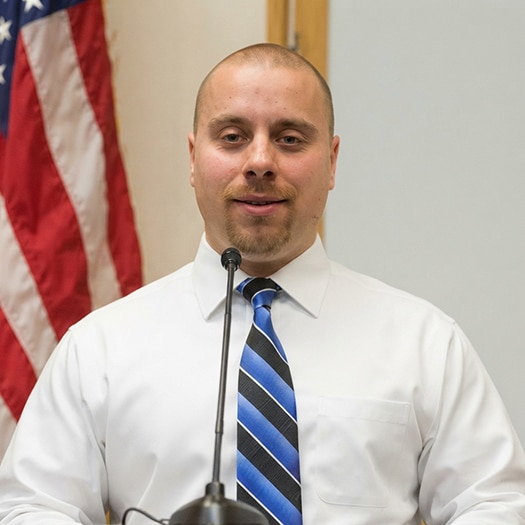
Badlands National Park Ranger Bryan Warner

Petersen nicked the park ranger's car and then rammed and sideswiped the sheriff. “I had a sick feeling this was going to get pretty bad, pretty quickly,” said Warner.

The sheriff's vehicle was hit three times, went into a spin, and rolled over four or five times. The suspect stopped; Warner pulled his gun. As Petersen drove away, he threw his son from the pickup. Warner grabbed the boy and put him in his car and went to check on Clements.

“I thought the sheriff was dead,” said Warner. “I was worried the suspect threw the kid out as a diversion to come back and kill us.”

The sheriff's vehicle was upside down, and Clements had three broken ribs. Despite his injuries, he urged Warner to continue the pursuit and leave the boy with him.

“This kid was so nice,” said Clements. “He was scared obviously, but he would not let go of me when the ambulance came. My number one goal was to protect that kid.”

Other law enforcement agencies joined the chase, including Haakon County, South Dakota Sheriff Mel Smith. Petersen was driving at more than 90 miles per hour when he tried to crash into Smith's vehicle.

“He was trying to hit me head on,” said Smith. “But I think he thought ‘This is it!’ and closed his eyes and the truck hit me on the side and forced me in a ditch. I thought it was over for me, as well.”

The suspect's truck caught fire and Petersen jumped out and tried to come after Smith. “I was ready to shoot him,” said Smith. “I lost my glasses in the accident and thought he had a gun on me.”

Within moments other law enforcement officers arrived, including Ranger Warner. A standoff ensued, and Petersen begged officers to shoot him.

“Time stood still,” said Warner. “He hid a weapon under his shirt while we were talking to him.” Another deputy used a taser gun, and Petersen was finally taken into custody.

Sheriff Clements was taken to the hospital, but he returned to work the next day. “I was only doing my job,” said Clements. “If I had to do it all over again I would do it again. I was not going to let him hurt somebody.” Clements started in law enforcement in 1994 and has been sheriff of Jackson County for three years. The sheriff was also involved with the first AMBER Alert in South Dakota, and he credits this alert for bringing the boy safely home.

Ranger Warner has been with the National Park Service since 2010 and recently relocated to Washington. Prior to that, he was a sheriff's deputy in Grand Traverse, Michigan. He became involved with another AMBER Alert in California, and he is grateful park rangers receive the same child abduction training as other law enforcement officers.

“Next to my marriage, the second happiest day of my life was seeing the sheriff walk out and having the kid safe,” said Warner. “It is just part of being a police officer. I was honored to get the award, but I never thought I would get anything more than someone saying, ‘Hey good job.’”

Sheriff Smith was a homebuilder and a rancher before he was elected sheriff of Haakon County in January 2011. He was treated for his injuries and returned to work the next day.

“The award is a great honor. The AMBER Alert made it possible for us to reach the suspect quickly. We should support the AMBER Alert and stay behind it because it works,” said Smith.

Petersen has been charged with the attempted murders of the two sheriffs in South Dakota and the murder of his wife in Iowa.

Three recipients of a law enforcement leadership award
Law Enforcement Leadership Award winners (from left) Mel Smith, Bryan Warner, and Ray Clements.

Former Iowa AMBER Alert Coordinator Todd Misel helped set up the statewide child abduction alert system in 2003. He has been involved with every AMBER Alert in the state or been given a heads up an alert was about to go out. At least that was the case until 8:18 a.m., November 27, 2010, when he and everyone who had signed up for Iowa AMBER Alerts by e-mail received this message: “The AMBER Alert status has been set to IN PROGRESS!”

“I got the e-mail message, and no one had contacted me. I thought, ‘What’s up with that?'” said Misel, who is also a Captain with the Iowa Department of Public Safety’s State Patrol Division.

The message directed recipients to a website that still had information on a February AMBER Alert for a teenage girl that had been cancelled because she had been safely recovered.

It was the first time a hacker had broken into the newly automated Iowa AMBER Alert Plan website. It also may have been the first time in the nation that a hacker issued an AMBER Alert. Five minutes later, Misel received another e-mail that the hacker also apparently sent: “The AMBER Alert has ended.”

Iowa’s notification system was set up nearly four years ago; Iowa uses the original National Crime Information Center (NCIC) missing child entry as the trigger for its AMBER Plan. AMBER Alert information entered into the IOWA system/NCIC automatically posts to the Iowa Website and triggers e-mail notifications to thousands of people who registered to receive the alerts. The system was automated to avoid human error, but the Website proved to be vulnerable to someone intent on hacking into the system.

“We were embarrassed,” said Misel. “It is like having someone break into your home. You feel violated, not only as an individual, but for the sanctity of the AMBER Alert system.”

The good news is the AMBER Alert did not go out through the other means of notification. The Emergency Alert System was not activated, highway signs did not post the alerts, and the Iowa Lottery did not issue lottery tickets with the alerts. The media reported on the breach but did not broadcast an AMBER Alert.

Two days later, the Iowa Department of Public Safety launched a criminal investigation to find the hacker and solicited help from the FBI and the Internet Crimes Against Children (ICAC) Task Force. ICAC investigators were involved because of their computer investigative skills, and the crime directly affected the safety of Iowa children.

Iowa’s AMBER Alert partners also went back to find out what went wrong with the Website and take steps to ensure it would not happen again. The Iowa Department of Public Safety and the Iowa Department of Administrative Services Information Technology Enterprise, which oversees the Website, quickly instituted new safety measures to prevent another breach. They also put together a list of lessons learned for others with automated AMBER Alert plans:

  • Document training and practice the AMBER Alert notification procedure.
  • Develop a backup plan so the AMBER Alert will go out even if the website is down.
  • Clarify ownership and responsibilities of the website application with the service provider through a Service Level Agreement.
  • Have a process in place to build security into the website application from the beginning to end.
  • Scan the application and review the source code prior to deployment and during production.
  • Develop and implement regular monthly or quarterly security scans of the application.
  • Have a communications plan in place. One spokesperson should be available to speak with the media and all state agencies and partners.
  • Have a script prepared for individuals who the media may contact that directs them to the single point of contact.
  • Hold a daily internal briefing or conference call to discuss any issues so you can control the message and keep information consistent.

“Automation of the AMBER Alert Website is great, but make sure there are checks and balances in place,” added Misel. “There is an expectation from the public that you will be able to continue AMBER Alert operations, even when your internal systems are compromised.”