

A Chevrolet dealership in Twin Falls, Idaho, is working with Idaho AMBER Alert partners to provide child identification kits. On October 21, 2017, they held an event to create printouts that include a child's photo and fingerprints in case the child ever becomes missing or is abducted. The information can also be uploaded for police investigations.
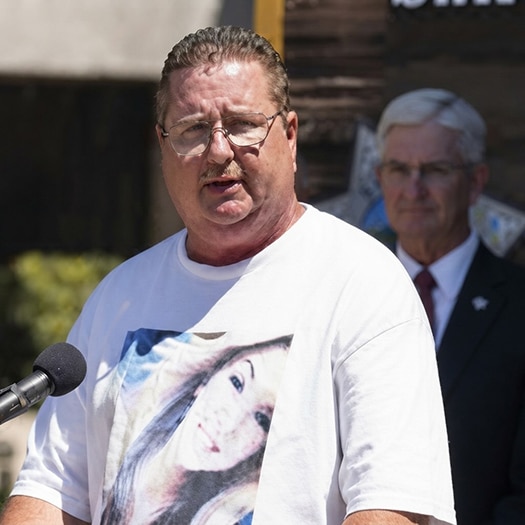
The search for Hannah Anderson received international attention after AMBER Alerts were issued in five states to find her. On August 4, grandparents called police to report their 16-year-old granddaughter and her 8-year-old brother Ethan were missing from their home in National City, California.
The San Diego Sheriff's Office asked the California Highway Patrol to issue a regional AMBER Alert on August 5 and later requested a statewide alert. Nevada, Oregon, Washington and Idaho also issued AMBER Alerts as the search intensified for Anderson and the suspect, 40-year-old James Lee DiMaggio.
On August 9, horseback riders in the backcountry near Cascade, Idaho recognized a man and a girl that matched the description of the victim and suspect in the AMBER Alert. The next day FBI agents shot and killed DiMaggio after he shot at them. Anderson was found with no visible injuries and taken to a hospital.
Biggest Activation Ever
An AMBER Alert being issued in five states is unprecedented and the search for the suspect and victim expanded into other states as well as Canada and Mexico. This was also the largest activation ever of the new Wireless Emergency Alert system or WEA.
“I think this case is a great example of how the AMBER Alert system should be used,” said Bob Hoever, Director of Special Programs Missing Children Division for the National Center for Missing & Exploited Children. “The expansion of the AMBER Alert was driven by the investigation.”
Hoever said the Anderson case did a lot to increase national awareness of WEA because so many people received the alert for the first time on their cell phones. He said some of the media coverage focused on people who were upset that the alert was issued late at night.
“I explained I am sorry that people were inconvenienced that late in the evening,” said Hoever. “But I was confident that when they discovered the minor inconvenience helped rescue a child, they would have a different point of view.”
While the alert was activated the Anderson case was the most searched item on Google, receiving more than 500,000 searches.
California
Initially the San Diego Sheriff's Office did not have enough information to issue an AMBER Alert because they did not have any evidence the children were abducted. Investigators soon discovered the badly burned body of the victim's mother, Christina Anderson, and a child's body that was burned beyond recognition in DiMaggio's home.
Ninety minutes after getting the initial call, the San Diego Sheriff's Office determined the criteria had been met for an AMBER Alert. The alert went out at 5:27 p.m. (Pacific Standard Time or PST) in San Diego and Imperial Counties. The AMBER Alert was disseminated to the entire state at 9:30 p.m. (PST).
California Highway Patrol Captain Greg Ferrero is also the state AMBER Alert Coordinator. He said all the components of the statewide AMBER Alert worked as designed.
“I think the human element was the most essential component of the success of the Anderson AMBER Alert,” said Ferrero.
Looking back, Ferrero said a current list of state AMBER Alert coordinators, point-of-contact information and criteria for each state would have made it easier to get the alerts out in the other states. The lack of uniformity between state plans also led to some delays and miscommunication but Ferrero said all the coordinators worked together well.
“The cooperation among the states and out-of-country coordinators was astounding,” added Ferrero. “The sense of urgency to recover the victim was a common goal of all coordinators.”
Nevada
The Nevada AMBER Alert Program got involved early on because the state's Emergency Alert System sends AMBER Alerts to Eastern California. On November 7, a caller from Utah called the Nevada AMBER Alert Coordinator about a possible sighting of the suspect and victim in Las Vegas. The caller was connected to the San Diego Sheriff's Office to see if an AMBER Alert was also needed in Nevada.
“We had to receive confirmation from the activating agency in California that they had a valid reason to believe there was a high probability that the suspect would most likely travel through Nevada,” said Nevada Statewide Emergency Alert/AMBER Alert Committee Chair Stephanie Parker.
Nevada's statewide AMBER Alert went out at 4:20 p.m. (PST) on August 7. The media coverage intensified after the alert was issued in the state because now it was a local story.
Parker said the coordination and timely responses between the National Center for Missing & Exploited Children, California and eventually other states worked well throughout the activation.
The Nevada AMBER Alert Committee plans to review the alert. In addition, the state has recently acquired Common Alerting Protocol technology that will simplify the process for issuing AMBER Alerts when an agency requests a statewide alert. The current Legacy EAS system requires agencies to call the three main EAS stations in Elko, Las Vegas and Reno for a statewide AMBER Alert.

Oregon
Oregon activated the AMBER Alert at 4:17 p.m. (PST) on August 7 after authorities received a tip that the suspect's vehicle was seen near Alturas, California and heading north on Highway 395 towards Oregon. Another person reported seeing the vehicle in the Lakeview area, which is north of the Oregon/California border.
“One of our criminal detectives contacted the woman in Alturas to get additional information and he felt what we had was enough to activate our AMBER Alert for the state of Oregon,” said Oregon AMBER Alert Coordinator Richard Culley.
Because of the location, Culley said it would have been easy for the suspect to continue into Oregon or head back into Nevada.
Some doubts were later cast about the tips concerning sightings in Oregon, but law enforcement officials decided to keep the alert active just in case. “We are not turning our back to this, and we are doing what we can to locate that suspect vehicle and the missing children,” said Oregon State Police Lt. Gregg Hastings to a reporter.
Washington
The state of Washington also issued an AMBER Alert at 4:40 p.m. (PST) on August 7. Washington State AMBER Alert Coordinator Carri Gordon said the Washington State Police reached out to the San Diego Sheriff's Office to see if the agency could help in the search. She said the decision to activate the alert was made after receiving information the suspect may be heading to Washington.
“In my opinion we should have reached out to the San Diego Sheriff's Office earlier,” said Gordon. “As involved as they were in their investigation, extending the alert beyond California was probably a low priority.”
Washington used the Law Enforcement Alert Portal to distribute the AMBER Alert. Overall, Gordon thinks the system worked well.
“There was excellent coordination between our state and the command center in San Diego,” said Gordon. “We were included in conference calls regarding the investigation, and they kept us up to date on events as they occurred.”
Idaho
Idaho turned out to be the key state for the AMBER Alert. But the request for Idaho to issue an alert came from the Washington State Police. Idaho AMBER Alert Coordinator Dawn Peck said they had to consider whether the case met their state criteria and whether there was a real possibility the suspect and victim could be in Idaho.
“The coordination between the states is key,” said Peck. “When another state calls and asks for assistance, you need to do all you can to accommodate the request. The investigating agencies do not ask unless they feel the alert in your state will help in the recovery of the child. In Idaho, we always err on the side of the child.”
The AMBER Alert went out in Idaho at 5:52 p.m. (PST) on August 7. The alert notified broadcasters, law enforcement and the public through the AMBER Alert Portal but it did not go out initially on the EAS system or on the highway signs. Two days later the California Highway Patrol called about a credible sighting in Idaho and the alert went out again using all of the state's notification methods, including EAS and the highway signs.
Relief All Around
Peck said the conference calls between all the coordinators helped to keep them informed and to make sure the message going out to the public was consistent. “We were very happy that this team effort led to Hannah Anderson's safe recovery,” said Peck.
Everyone involved with the multistate AMBER Alert summed up what was accomplished with the alert with one word: relief.
“Relief primarily that she was alive and safe,” said Carri Gordon from Washington. “The information about her being located as a result of the AMBER Alert was very reaffirming that the system works as intended.”
“It was a relief she was found alive, and it was also an affirmation that the system worked again,” added Nevada's Stephanie Parker. “Law enforcement, broadcasters, wireless alerts, social media and the public saved a life.”
“We are glad everything worked out and that Hannah was recovered safely,” added Oregon's Richard Culley.
Greg Ferrero of California offered this closing thought: “Due to the violent events surrounding the abduction, I think we all knew that the stakes were very high in this case. All involved employees had a sense of accomplishment and felt responsible for Hannah's safe recovery.”