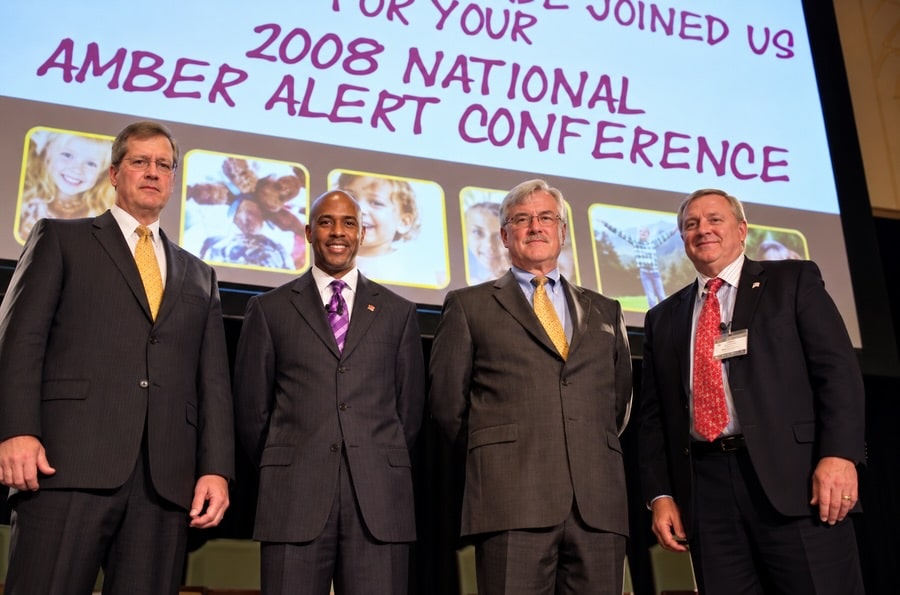
Many firsts were noted by AMBER Alert partners at the 2008 National AMBER Alert Conference in Orange County, California. It was the first conference to include members of Child Abduction Response Team (CART) representatives, first to involve European AMBER Alert partners, and some broadcasters said it was the first conference to fully recognize and incorporate the important role of the media.
The conference was also the first and last opportunity to hear from Assistant Attorney General for the Department of Justice's (DOJ) Office of Justice Programs (OJP) and National AMBER Alert Coordinator Jeffrey L. Sedgwick. “We have a strong foundation, thanks to the selfless work of broadcasters, transportation officials, and law enforcement,” said Sedgwick. “But we have to maintain our level of vigilance. We don't have the luxury of letting our guard down.”
Several training sessions focused on incorporating the CART concept into each AMBER Alert plan. More than 160 teams of law enforcement officers, forensic experts, victim service providers and others have been trained since DOJ launched the CART initiative in November 2005. “There's no time for turf wars,” added Sedgwick. “What is needed is the full crush of resources and expertise so that the child can be recovered as swiftly as possible.”
Surprisingly, the number of AMBER Alert activations are actually going down each year. Here is the breakdown: 2005 had 275 activations, 2006 had 261 activations, and 2007 had 227 activations. Projections for 2008 indicate there will be less than 200 activations.
“We are trying to identify trends,” said Bob Hoever, Associate Director of Training and Outreach for the National Center for Missing & Exploited Children. “I think part of it is there is much better training. We are miles ahead of when we met at the first AMBER Alert Conference in 2002.”
However, secondary notifications have increased from 49% in 2005 to 85% in 2008. “When you get a text message sent directly to you saying that a child has been abducted, you take it seriously,” Sedgwick said. “Suddenly, it is personal.” However, some secondary notifications do not go out because the child has already been recovered.
Presenters noted that AMBER Alert plans should constantly be refined and training must be ongoing. “There is no finish line,” said Knoxville Deputy Chief of Police Gus Paidousis. “You may be cutting edge today but not be cutting edge tomorrow.” He stressed that telecommunicators need practice in testing and scenarios for AMBER Alerts. Volunteer coordinators also need to be prepared for all the people who will show up to help. “It doesn't matter if you want volunteers, they are going to show up,” said Paidousis.
The role of transportation also continues to be important for AMBER Alerts. The Department of Justice developed a “Best Practices Guide” in 2005 and transportation officials were urged to update their practices, policies, and messages. One presenter noted more does not always mean better and people can be desensitized to AMBER Alerts if they are not timely or displayed in an area where people can help. “Despite all the technology, it is still a very human decision made by law enforcement officers across the country,” said Dale Bonner, Secretary of the California Business, Transportation and Housing Agency.
One panel considered what would have happened if an AMBER Alert plan was in place when Amber Hagerman was abducted in 1996. The panelists were unsure if the alert would have saved her life but were certain the media and the public would have received the information about her abduction much quicker.
“We have a lot of missing children,” noted Ron Laney, Associate Administrator for Child Protection Division, OJJDP. “We need to keep in touch with each other. I know we are doing a lot, but we are not there yet. When we are working together there is nothing that we cannot do.”