Photo of a man and woman hugging

Forty-two years after her abduction from Kentucky, Michelle Newton has reunited with her father. Taken at age 3, Michelle recently discovered her true identity and contacted authorities. Simultaneously, a Crime Stoppers tip led investigators to Florida, where her mother, Debra, lived under an alias. DNA confirmed the identity of the former FBI “Top 8 Most Wanted” fugitive, who now faces felony custodial interference charges. “This is the kind of case you see once in a law-enforcement career,” said Colonel Steve Healey of Kentucky, noting how persistent investigative work and public tips can resolve even the coldest cases.

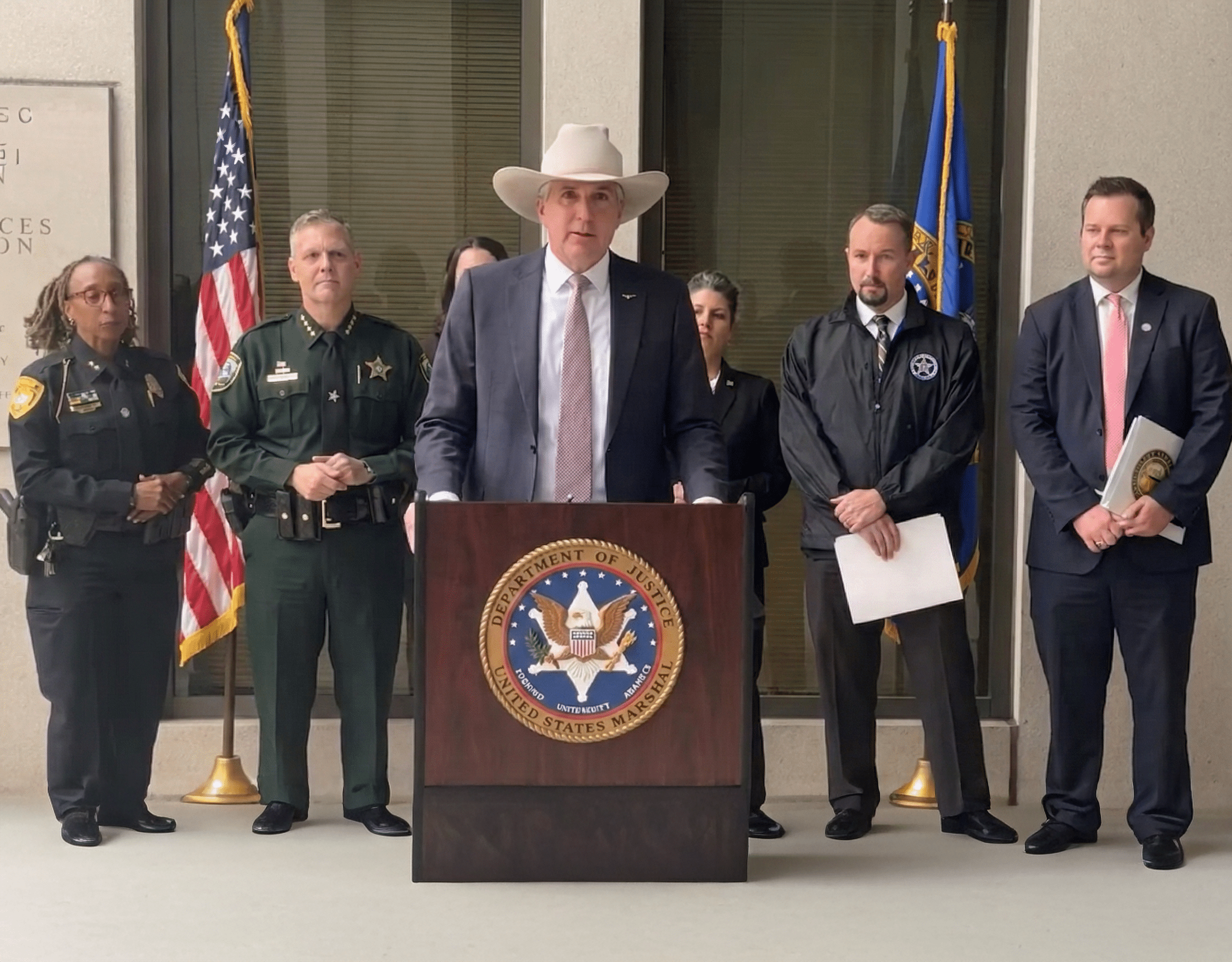
Man in cowboy hat at podium flanked by colleagues at a press conference for the U.S. Marshals

The U.S. Marshals Service (USMS) led “Operation Northern Lights,” a landmark multi-agency initiative resulting in the recovery of 43 critically missing children across North Florida. The two-week operation, involving over 80 personnel from 25 agencies, targeted youth at risk of trafficking and exploitation. Recoveries spanned Florida, Tennessee, Mississippi, and Louisiana, with victims ranging from 18 months to 17 years old. The operation led to nine arrests and potential future trafficking charges. “This was the most successful missing child operation ever conducted in Northern Florida,” said Acting U.S. Marshal Greg Leljedal.

Good samaritans in Jacksonville, Florida, rescuing a girl from an abductor in a parking lot

More than a dozen Good Samaritans are being called heroes after rescuing two children, ages 2 and 6 months, and their mother, from a vehicle fleeing a Jacksonville, Florida, parking lot. Video footage released by the Jacksonville Sheriff’s Office (JSO) shows bystanders rushing forward and safely pulling the woman and a child, who were being dragged by the vehicle, and the other child from the SUV. Witnesses provided a detailed vehicle description that led to the driver’s arrest at a shopping center. “The situation could have ended in tragedy,” a JSO social media post stated. “Your JSO is grateful for the quick action and bravery of the Good Samaritans who stepped up.” The driver, Yanni Human, 26, faces multiple felony charges including child abuse and false imprisonment. 

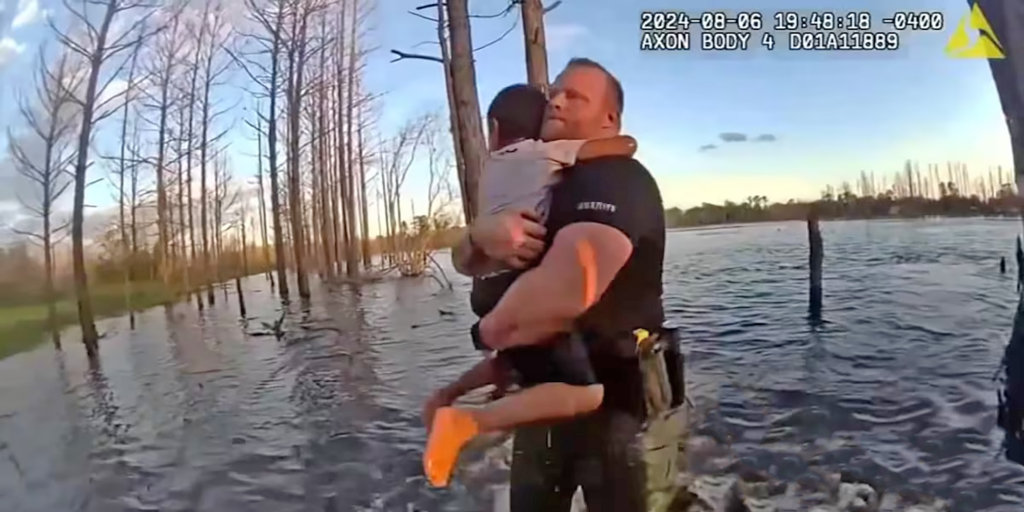
Photo of boy with arms wrapped around rescuer as he is carried from a pond. Caption for photo reads: The child clung tightly as Deputy Wes Brough carried him to safety. Brough received an email from the boy’s out-of-state relatives who watched the rescue footage. “They said that they could tell how thankful he was by the way he touched my face,” Brough says.
The child clung tightly as Deputy Wes Brough carried him to safety. Brough received an email from the boy’s out-of-state relatives who watched the rescue footage. “They said that they could tell how thankful he was by the way he touched my face,” Brough says.
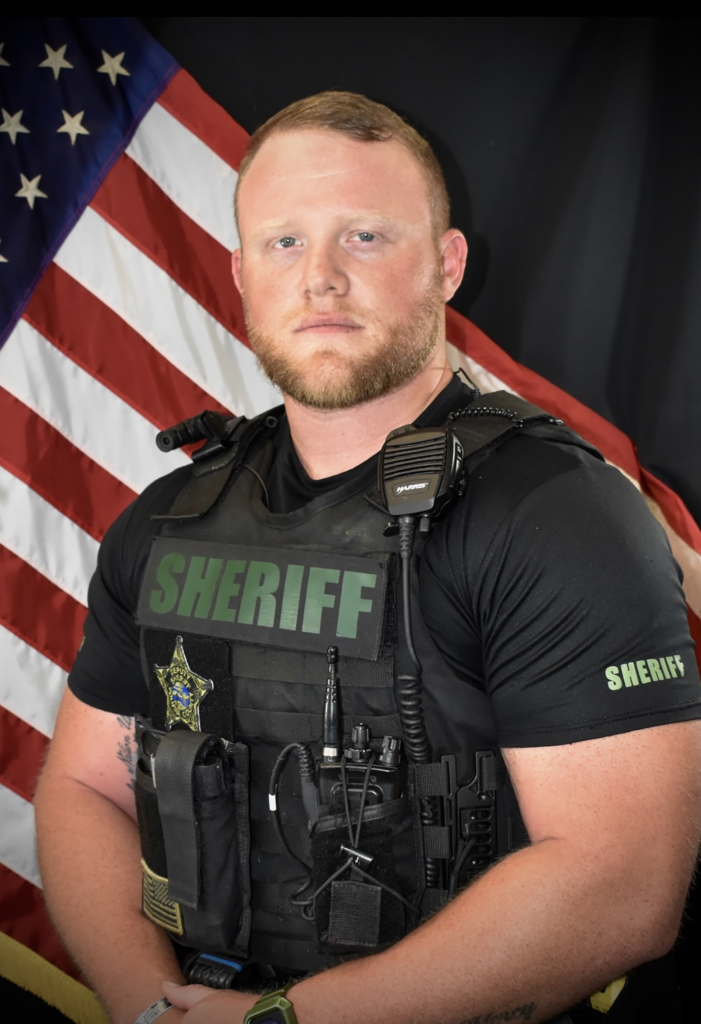
Photo of Volusia County, Florida, Sheriff's Deputy Wes Brough
Volusia County, Florida, Sheriff's Deputy Wes Brough

By Jody Garlock

Deputy Wes Brough has been in law enforcement for what he matter-of-factly describes as “a crazy” five years. In that short time with the Volusia County Sheriff’s Office in DeLand, Florida, he has worked AMBER Alerts, saved a teen who was contemplating jumping off a bridge, and, most recently, been hailed a hero for rescuing a missing 5-year-old boy with autism.

In the latter case, the dramatic body-cam footage of Brough running into a large pond to carry the missing child to safety put him in a national spotlight after the video went viral—and showed how dangerously close the story was to a sad outcome.

That August 2024 day remains fresh in his mind. Brough (pronounced “Bruff”) was on routine patrol in Deltona (in east-central Florida) when a 911 call reporting the child missing came in—a call he and other officers were able to hear in real time thanks to a new telecommunication system.

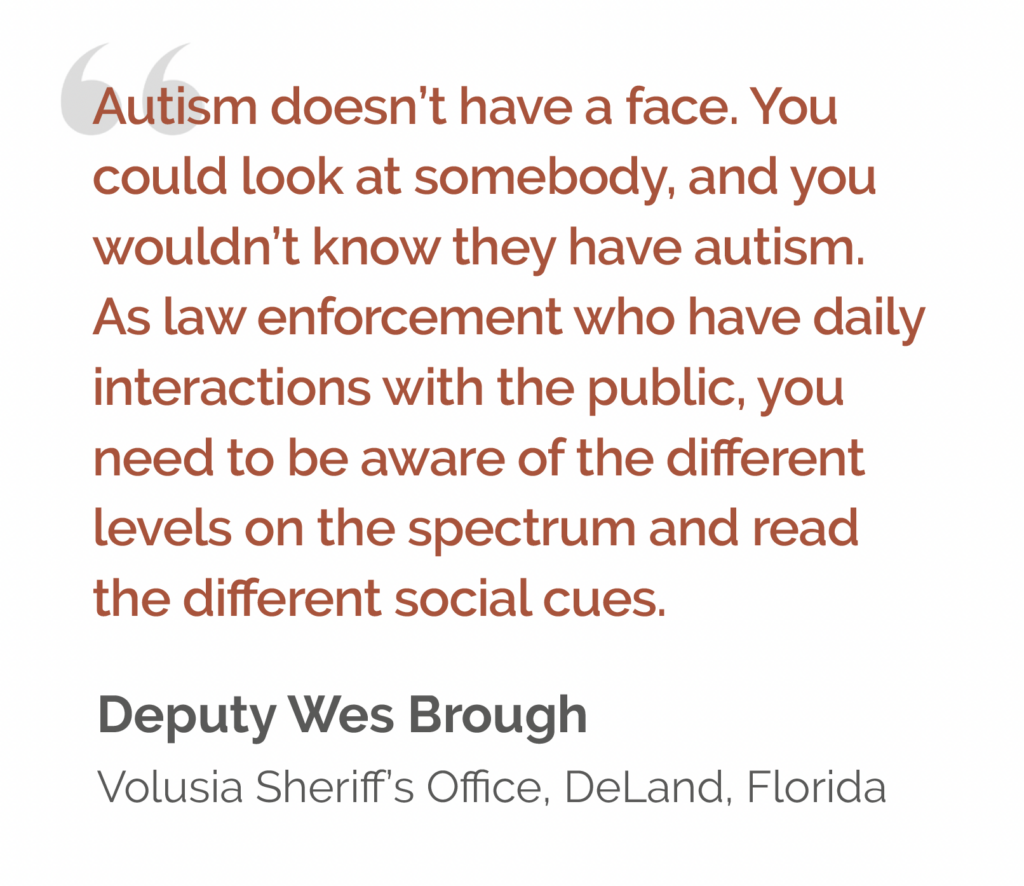
Quote: “Autism doesn’t have a face. You could look at somebody, and you wouldn’t know they have autism. As law enforcement who have daily interactions with the public, you need to be aware of the different levels on the spectrum and read the different social cues.” Deputy Wes Brough Volusia Sheriff’s Office, DeLand, Florida Brough was first on the scene, followed shortly by another officer who helped search the family’s house to confirm the boy wasn’t there. Dispatched officers soon arrived and the search area expanded.

After hearing of a possible sighting of the child behind a nearby home, Brough’s autism awareness training kicked in. Knowing that area had wooded wetlands and that children with autism are drawn to water, Brough took off running. Hurling tree debris and calling the boy’s name as he approached a nearby trail and pond, the breathless deputy would momentarily stop to look for any signs of movement in the water or footprints on the swampy ground.

At first Brough didn’t see any signs of the child. But then the boy, who is nonverbal, made a noise, likely after noticing Brough through the trees. The deputy ran toward the sound, and after spotting the boy in the pond, yelled, “I got him! I got him!” as he ran into the near-waist-high water where the 5-year-old was holding on to a branch. He would soon cling safely to Brough as they made their way back to land. There, as darkness neared, medics checked the boy’s health before he was reunited with his frightened family. The swift recovery was completed about 20 minutes after the 911 call that reported the child missing.

We talked with Brough about the incident and the lessons it may hold for others in law enforcement.

How does it feel to be called a hero?
That’s a big title honestly—especially when anybody in my position would have done the exact same thing. I’m very honored, but I’m staying humble and giving the glory to God for helping me do the right thing in the right moment.

What type of training helped prepare you for such an incident?
We have critical incident training when we come through the sheriff’s office, and it focuses on different types of behavior. We also go through autism awareness training which includes meeting with children with autism and their families who live in our community; it’s very in depth. It covers the dangers a child with autism can face, and understanding the biggest cause of death: drowning. That’s a big factor here in Florida, where there’s so much water. We learn how to interact with children with autism and the different levels of the autism spectrum. We also look at different scenarios that we in law enforcement might face, whether it’s responding to a runaway child or a suspicious person. You never know when the person you’re interacting with may have autism, so being aware, and picking up on social cues, is important.

Are there ways to better engage the public about missing autistic children?
There’s always room for more communication between an agency and the public, especially on a subject like this. An easy way is through social media posts. Also, parents should be encouraged to never hesitate to call 911 if their child goes missing. The boy’s family did a wonderful job of calling as soon as they heard the alarm on their door go off. We’d rather have the call get canceled on the way to search for a missing child instead of being 20 minutes behind the curve.

What lessons did you learn that others could apply—what are your takeaways?
One, a lot of good work gets done when you stay calm under pressure. And two, it’s important to have a sense of urgency. Too often complacency can kick in; you think a missing kid may be at a friend’s house or hiding in a shed. You might walk rather than run. When I picked up the log the boy was holding onto in the water, it broke in half. It was only a matter of time before it broke while he was holding on to it, or that he went out deeper into the water. Hindsight is 20/20, but I’m glad I had the sense of urgency to run from the road to the pond. It was moving with a purpose. There can’t be hesitation when the priority is someone’s life.
SIDEBAR with headline "4 tips: Be in the know about autism" [TEXT] Children with autism spectrum disorder (ASD) wander or go missing at a higher rate than other children—a behavior known as elopement. They may be trying to get away from loud sounds or stimuli, or seeking out places of special interest that pique their curiosities. The National Autism Association (NAA) shares the following tips all first responders should know. • Know the signs: A person with autism may have an impaired sense of danger, and, as such, may wander into water, traffic, or other perils. They may not speak or respond to their name, and may appear deaf. They need time to process questions, may repeat phrases, and may try to run away or hide. And they may rock, pace, spin, or flap their hands. • Know how to search: Act quickly and treat the case as critical since a child with autism may head straight to a source of danger, such as water, traffic, or an abandoned vehicle. First search any nearby body of water, even if the child is thought to fear it. Ask about the child’s likes and dislikes, including potential fears such as search dogs or siren sounds. • Know how to interact: Don’t assume a person with autism will respond to “stop” or other commands or questions. If they’re not in danger, allow space and avoid touching. Get on the child’s level and speak in a reassuring tone, using simple phrases—even if the person is nonverbal. Offering a phone to a nonverbal person to communicate via typing may be helpful. • Know about resources: Beyond agency training, law enforcement officers can find online resources. The National Autism Association offers a downloadable brochure with tips for first responders on its website. Additionally, the National Center for Missing & Exploited Children also offers excellent online resources (visit missingkids.org).


A new monument has been created to honor two Florida boys who vanished at sea. A large crowd gathered in July 2021 for the unveiling of the statue recognizing Perry Cohen and Austin Stephanos. The 14-year-olds disappeared in 2015 near Jupiter, Florida. The family of Stephanos hope to create an Austin Alert to help find missing boaters.

The Wisconsin legislature is considering creating a Purple Alert to help find missing and endangered domestic violence survivors. The law would eliminate any waiting period before law enforcement can issue a statewide notification with the missing person’s picture and information.

Florida lawmakers are considering a Purple Alert also; however, it would be used by law enforcement for a missing adult with a developmental disability. State Senator Lori Berman says she wants the alert in place after a man died while wandering away from a care center.

A U.S. hacker asserts he can break into the U.S. and Canadian Emergency Alert Systems and claims he could send a nationwide message through both systems. He said he was able to discover passwords from key manufacturers to access their systems. “Theoretically I can send anything from a volcano warning to the entire U.S. to an AMBER alert. If I really wanted, I could send out custom messages too,” he said. The hacker also warns of others with the same technological know-how.

In November 2020, hackers gained access to Florida’s emergency communications channel and sent an unauthorized message to the state’s emergency response team. “The fact that someone would use an emergency alert system for their own purpose, whatever it is, is both irresponsible and unlawful,” said Jason Mahon, communications director for the Florida Division of Emergency Management. The Florida Department of Law Enforcement has been asked to investigate.

A boy who was 8 years old when Florida issued an AMBER Alert on September 11, 2000, remains missing. Zachary Bernhardt would now be 28 years old; the case is the longest-running AMBER Alert in the state. Investigators continue to look for Bernhardt and seven other children still missing after alerts were issued on their behalf.

The Florida Department of Law Enforcement (FDLE) has updated the criteria for an AMBER Alert following the state AMBER Alert Review Committee’s adoption of an Enhanced Missing Child Alert in late 2019. “This means that AMBER Alerts may now be issued if authorities believe a child is facing imminent danger, regardless of whether he or she was abducted,” said FDLE Communications Director Gretl Plessinger.

Live Oak, Florida, police arrested a woman for falsely claiming her children had been taken, resulting in the issuance of an AMBER Alert. On September 28, 2018, Roseangel Sanchez was booked for fraud, passing forged checks, and false reporting. Sanchez told police her seven-year-old son and six-year-old daughter were taken by a group of people. She later told police she told the lie in an attempt to get out of check fraud charges. The children were later found safe.

A Largo, Florida, mother accused of murdering her 2-year-old has also been charged with lying to police after an AMBER Alert was issued. Clarissa Stinson claimed her son was abducted after they accepted a ride from a stranger on September 1, 2018. Police say the lies cost them critical time in finding the boy and resulted in $500,000 in law enforcement costs. Fifteen agencies, including 163 law enforcement officers and 28 staff members, took part in the search. “A price cannot be put on that,” said Largo Police spokesperson Randy Chaney. Stinson could face an additional five years in prison for giving the false story to police.

SEARCH, The National Consortium for Justice Information and Statistics, will honor Donna Uzzell for its highest practitioner award for 2018. The Special Agent in Charge for the Florida Department of Law Enforcement has been actively involved with promoting AMBER Alert, human trafficking and child safety training, and protecting vulnerable populations like the elderly and disabled. “It is enormously gratifying that the 2018 Hawkins Award will recognize and honor Donna's fearless leadership, passionate devotion to duty and relentless pursuit of programs and policies that have measurably improved our justice and public safety systems nationwide,” said SEARCH Chair Bradley D. Truitt, Director of Information Systems, Tennessee Bureau of Investigation. Ms. Uzzell has worked with the AMBER Alert Training and Technical Assistance Program for more than a decade and continues to contribute as an Associate with the National Criminal Justice Training Center of Fox Valley Technical College. She will be presented with the award on July 24, 2018, in Washington, D.C.

The U.S. Department of Justice has certified two additional Child Abduction Response Teams (CART). The Pasco County Sheriff’s Office in Florida and the Pierce County, Washington, Regional CART are the latest teams to meet the rigorous standards required to join the elite ranks of certified teams across the U.S.

“Support starts at the top,” said Alan Wolochuk, CART Certification Manager. “The total commitment of the sheriff and top law enforcement leaders for both teams set a standard for all CARTs to follow. The citizens in these communities should be very proud of what has been accomplished.”

The CART certification process is very challenging, requiring teams to meet 12 standards and demonstrate proficiencies outlined across 47 sections of the AMBER Alert CART Certification Manual. The CART must conduct a mock child abduction exercise which includes scoring across areas including: CART response and AMBER Alert activation, call-intake procedures, leads management, incident command structure, resource management, information technology, legal issues, victim assistance and reunification.

In Pasco County the mock abduction utilized a mock city named “Safety Town,” a scaled down version of a small city containing a small park, residences, bank, home improvement store, streets, sidewalks and a school. This was the first certification conducted in a facility of this kind.

The mock abduction began at 9 a.m. and involved the witnessed abduction of a 10-year old female. The female was abducted while walking to a school bus stop. A witness called law enforcement and reported the incident.

“We fight as one,” said Pasco County Sheriff Chris Nocco. “Being part of the CART Certification process was extremely rewarding. It helped validate all the hard work and training we did and continue to do. Preparing for the protection of our children is one of the most important things we can do for our community. No agency can ever truly be ready for an abducted child investigation. However we are committed to being as ready as we can.”

The Pierce County Regional CART had more than 100 participants during the certification process including the sheriff’s department, federal and state investigators, police and fire departments, prosecutors, emergency management and the 911 call center.

The U.S. now has 21 certified Child Abduction Response Teams.

Photo captions: Pasco County CART certification exercise; Tacoma CART certification exercise.


Certification Is Not the End of Training for Child Abduction Response Teams

For Child Abduction Response Teams (CART), achieving certification by the U.S. Department of Justice, Office of Justice Programs, is just the beginning. Following initial certification, the CART must prepare to meet the criteria for annual recertification every year thereafter.

In January of each year, following the awarding of initial certification, the CART must be able to show completion of specified tasks and required documentation in order to maintain its certified status. Requirements for annual re-certification include:

  • Absent an actual CART activation, the CART is required to conduct at least one field exercise during the calendar year. The CART is required to provide a summary of each incident to include the date, circumstances of the incident, number of individuals and agencies activated, outcome and lessons learned and changes made to policy, practice, use of resources or personnel deployment or other significant changes to the CART.
  • Document any changes to personnel, CART leadership, participating agencies, resources and any significant changes to the CART.
  • Verify the CART remains in compliance with all applicable standards and certification requirements.

The required recertification forms must be signed by the CART Coordinator and CEO of the lead agency, certifying the accuracy of the information provided. The documentation is forwarded to the CART Program Director during the first quarter of each year following certification. Once reviewed and approved, the CART is notified of its recertification status.

The Florida Department of Law Enforcement and Florida Sheriff's Association held a “build-a-course” event in February with trainers from the AMBER Alert Training and Assistance Program. Organizers selected specific courses needed in their area. They hope to hold classes in Kissimmee, Orlando, Tallahassee, and Fort Myers to reach officers throughout the state.

Two people seated at a table: Jessica Davenport, left, and Peter Warren
Jessica Davenport, left, has been the Florida AMBER Alert Coordinator for the past two years, and Peter Warren became the state's new AMBER Alert Coordinator in March 2013. He is also looking to use new technology to streamline the AMBER Alert process.

Jessica Davenport always wanted a job where she could make a real difference. Her goal was realized when she was asked to be the Florida AMBER Alert coordinator two years ago.

She already had worked for the Florida Department of Law Enforcement for three years, and she jumped at the chance to develop policies for the AMBER Alert program.

“I was really interested in missing child issues and what happens to a child after he or she is abducted,” said Davenport. “We need to identify those needs and have policies in place to help protect children.”

During the past two years, she has worked on ways to streamline the process to issue an AMBER Alert. Florida sends the alerts to law enforcement, media, Emergency Alert System, highway signs, 511 Traffic Information Line, Highway Advisory Radio, social media, lottery machines, and through e-mails to people who register to receive them.

“We are always looking for new ways to put out AMBER Alerts,” said Davenport. “We also found a way to send alerts when we are at home so we can get the AMBER Alert out faster.”

Florida issued seven AMBER Alerts during her first year on the job in 2011. The state issued nine alerts last year, and so far, the state has issued only one in 2013.

Davenport said one memorable alert involved a suspect who met a woman on Facebook and then abducted her baby. “We didn't know the suspect's name, so we contacted Facebook and got enough information to identify the woman and find the child,” said Davenport. “Our program is very successful. We have recovered a lot of children from AMBER Alerts.”

She offers this advice to new AMBER Alert coordinators: “I think it is important to understand how your AMBER Alert process works, but do not be afraid to make changes and try new ways to make the process more effective.”

Davenport is the oldest of six children in her family and said this has helped her have empathy for parents of abducted children. “I know the feeling of how terrifying it would be to lose a child,” she said. “I keep this in mind all the time.”

When she is not working, Davenport is actively involved in politics and community issues. However, she says the AMBER Alert program has given her a chance to see real results from her efforts. “It is nice to have an impact,” she said. “I think a lot of us who work for criminal justice are looking to make a difference. The AMBER Alert is one way you can really see you are making an impact.”

Davenport has been the Florida AMBER Alert Coordinator for the past two years, and Peter Warren became the state's new AMBER Alert Coordinator in March 2013. He is also looking to use new technology to streamline the AMBER Alert process.

Cellphone screens showing "AMBER Alert in the Wireless Age"Vicky Orozco put her 8-month-old son, Carlos, in his car seat so he could nap while she took a shower. When she returned a short time later, her son was gone.

Shortly after noon on February 20, 2013, the Minnesota Bureau of Criminal Apprehension issued its first AMBER Alert that included the new Wireless Emergency Alert (WEA) to help notify the public. WEA sent the alert to nearly every cell phone in Minnesota.

The alert included information about a female acquaintance who police suspected had abducted the child and the car she was reportedly driving. Like thousands of other people, teenager Daisy Buenrostro was surprised to see the alert on her phone. Buenrostro also spotted the suspect's car across the street and checked the license plate to make sure it was the right one.

“I was so shocked,” she told a reporter. “I was like, ‘This is the car.’ So, I ran back inside the house and told my dad.”

The teen and her father called 911, and within minutes after the alert was issued, the suspect was in custody and the baby was home safe with his mother. It also is the first AMBER Alert success story directly linked to WEA.

“The AMBER Alert was a success. It was an excellent use of the new cell phone technology,” noted Minnesota AMBER Alert Coordinator Janell Rasmussen. “I cannot tell you how many people were talking about the alert. The media was going crazy and everyone was talking about it on the social media. They were giddy to get this information. We had no complaints about this.”

The Wireless Reach
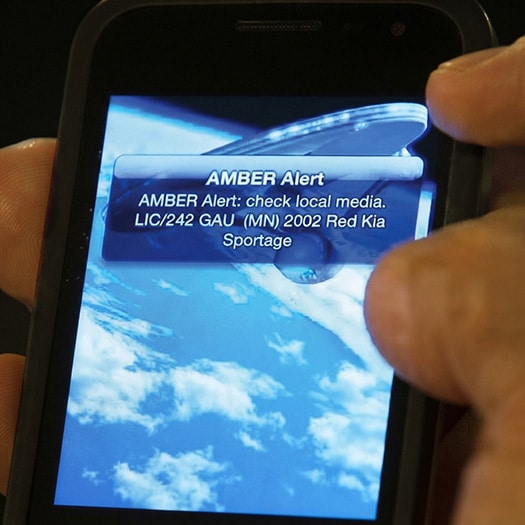
Smartphone with an AMBER Alert on its screenMore people than ever can now receive an AMBER Alert. Beginning January 1, 2013, the alerts reach 97% of all people in the area where the child has been abducted through the WEA which is also called the Commercial Mobile Alert System (CMAS).

The Federal Emergency Management Agency (FEMA) operates WEA and distributes alerts from authorized government agencies about emergency situations to customers with capable mobile devices.

The messages supplement the existing Emergency Alert System which broadcasts alerts over radio and television. FEMA worked with the Federal Communications Commission, U.S. Department of Justice (DOJ), and the National Center for Missing & Exploited Children (NCMEC) to expand the alert system to include AMBER Alerts. WEA is also used for National Weather Service, Presidential, and Imminent Threat Alerts.

Wireless Beginnings

Some state AMBER Alert programs included the ability to send alerts to cell phones as far back as 2002. In May 2005, a voluntary partnership between the wireless industry, DOJ, and NCMEC started the national Wireless AMBER Alert Initiative to provide alerts to cell phones in all 50 states.

The program distributed Wireless AMBER Alerts to more than 700,000 cellular subscribers who signed up to receive the messages. The initiative also brought awareness to the AMBER Alert Program through public service announcements and press events.

However, people had to register their phones to get the alerts, and one could choose to be notified in only five zip code areas. For example, if you lived in Utah and were vacationing in Florida, you would receive an AMBER Alert for Utah, but you would not get an alert issued in Florida.

“It made sense to send a succinct text message to alert users so they would be on the lookout for the kidnapped child and abductor in their area,” said Steve Largent, president and CEO of CTIA-The Wireless Association and president of The Wireless Foundation. “The WEA AMBER Alerts will be an even better tool to help find abducted children.”

Bigger but Focused

The new alert system was developed with lessons learned from the AMBER Alert Program. WEA uses a channel called Cell Broadcast and is not affected by congestion on voice or SMS text channels. The alerts are targeted to cell towers instead of relying on zip codes. If you have a mobile device in the area where the alert is issued, you will automatically receive the alert. Unlike a text message, the alert will pop up on the screen of the wireless device.

“Wireless AMBER Alerts were an important evolution of that program, and we are grateful to those who made it possible,” said John Ryan, NCMEC CEO. “They understand that the eyes and ears of many are better than the eyes and ears of few when a child's life is at stake.”

The new system means the people who can actually do something about an abducted child will get the alerts. However, 3% of phones are not equipped to receive the alerts. The goal of the wireless industry is to have all phones compatible with the system by the end of 2013.

Louder but Shorter

The new AMBER Alerts include a loud, audible tone. The first AMBER Alert in Florida using the new system went out at 1:45 a.m. on January 14. A 2-year-old girl was missing, and her bedroom window was open. The alert went out statewide, and some people were upset that a generic message that said a child had been abducted had awakened them.

Florida AMBER Alert Coordinator Jessica Davenport and most people did not know the alert would include an audible tone that went out to everyone in the state. Davenport worked with NCMEC to change how the alert is used. The state's temporary policy now states that alerts will only go out to specific regions, and WEA will not be used for alerts between 10 p.m. and 7 a.m.

“We have a large population of older folks,” said Davenport. “As long as we use it conscientiously, we should be able to reach a lot of people.”

Davenport also decided not to use WEA unless they have vehicle information. In this case, the missing girl was found safe 15 hours later in a field a half mile from her home.

Developers of the WEA system included a tone with the alerts so people would know they may be in danger when receiving a National Weather Service, Presidential, or Imminent Threat alert. Because of the loud sound, NCMEC is also recommending that WEA should not be used between 11 p.m. and 6 a.m.

“If we have people opt-out, then we may never get them back,” said Bob Hoever, Director of Special Programs in the Missing Children Division at NCMEC.

NCMEC is also asking AMBER Alert coordinators to notify NCMEC about how they want to use WEA. Coordinators need to decide if there are times that WEA would not be used and if the alert is going statewide or to specific regions. NCMEC should be informed about these details.

“You should not be deciding about your maps in the middle of an AMBER Alert,” warned Hoever. “Proper planning is the key.”

The new alerts are limited to only 90 characters, including spaces. The alerts cannot contain photos, web links, or phone numbers. To make WEA a more effective tool, NCMEC suggests that it should not be used if authorities do not have vehicle information or very specific information about the child.

“If you are going to put out generic information, you better put your call center on nuclear power because you are going to get swamped with generic leads,” said Hoever. “The information in the alert has to be meaningful.”

Public Awareness

Unless they have received an alert, most people still do not know about WEA. NCMEC is encouraging AMBER Alert coordinators to talk to the media and let the public know what has changed with AMBER Alerts.

“I think there is a critical need for all of us to educate the public on what these alerts can do and where they can receive information,” said Hoever.

Florida is already developing a public relations campaign. “I think the ability to reach a wider number of people will be very useful,” said Davenport. “We want to make sure everyone knows what the new alert is and how to use it.”

Minnesota's first AMBER Alert involving WEA sparked immediate interest from the media. Rasmussen's only regret is that she did not educate the public before the first alert using WEA went out.

“The alert was shocking to some people. Some people were driving, and they had never heard that type of tone in their car,” said Rasmussen. “I think everyone should put together an education plan because the media will be very excited about it.”

NCMEC is offering webinars to teach AMBER Alert coordinators about WEA. Coordinators can also direct the public to detailed information on how the new alerts work and how to respond, available through NCMEC, the U.S. Department of Justice, FEMA, and the wireless industry's consumer information pages.



Seven-year-old Somer Thompson vanished on October 19, 2009, while walking home from school in Orange Park, Florida. She had separated from her twin brother and her sister after an argument. Somer's mother flagged down a passing deputy and reported her daughter was missing.

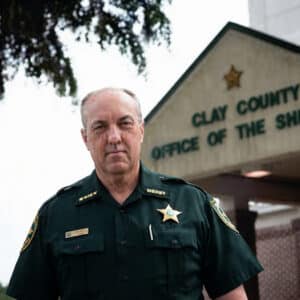
Clay County, Florida, Sheriff Rick Beseler had never handled a child abduction case and thought the chances it would happen were small. But the sheriff wanted to be ready just in case and during the past four years his deputies attended more than 20 training sessions on the AMBER Alert and missing child investigations. Six months prior to this reported missing child incident his office had a table-top exercise involving a child being abducted while walking home from school.

"It was very fortuitous we did this because we found a lot of problems in our system," said Beseler. "If we did not have the training and the table-top exercise we would have been lost." The exercise helped the sheriff's office develop a better leads tracking system and protocols for searching and canvassing.

The same day Somer went missing, the sheriff set up a command post at the local junior high school. More than 100 law enforcement officers from Clay County, two surrounding counties, the Florida Department of Law Enforcement, the U.S. Marshals Service and the FBI gathered for the first activation of the newly formed Child Abduction Response Team (CART). After eliminating all possibilities other than abduction, an AMBER Alert was issued at 10:45 a.m. the next day.

The CART had all the needed equipment, protocols and personnel in place immediately. "I had confidence because we had trained and learned from the AMBER Alert Training & Technical Assistance program offered through Fox Valley Technical College what ultimately can happen," said Beseler.

CART members called themselves Team Somer to connect with the family and community. They wore purple bracelets and gold pins with the Team Somer logo and placed a banner at the command post with Somer's picture that read "Remember this is why we are here."

More than 2,000 leads came in during the first 24 hours. Each investigative team had a member from every law enforcement agency to foster teamwork and prevent anyone's ego from getting in the way. "When other agencies come in you have to have trust," said Clay County Sheriff's Captain David Senters. "They have to trust that you aren't going to keep the good leads for yourself. You also have to have a plan and stick to that plan."

The Sheriff's Office had also developed a landfill protocol, and detectives searched every garbage truck. Somer's body was found the following day in a transfer truck 55 miles away in Folkston, Georgia. "If we didn't find the body, we would not have solved the crime," concluded Beseler.

"We would not know anything today. It would be a missing child buried under a thousand tons of garbage in another state."

Another key part of the child recovery plan was to foster good relations with the media and the victim's family. "You always want the family on your side," said Beseler. "We brought the Thompson family into our fold."

Diena Thompson, Somer's mother, issued this statement after her daughter was found: "I don't know how to describe the level of support from the Clay County Sheriff's Office. Deputies and detectives have been by my side and cried with me. The Sheriff has been there for support as well and has spared no expense in the search for Somer and now for the killer."

Just 19 days before the abduction, the Clay County Sheriff's Office had its budget cut by $1.75 million and 30 positions were eliminated. The sheriff had to solicit funds from other agencies and the community donated hundreds of thousands of dollars in goods and services. "I had nothing to pay these guys, and they were working around the clock," said Beseler.

The Sheriff also asked for the public's help to find the killer. A tip line was established so people could call in about anyone who may have made changes in their behavior, appearance or may have left the area unexpectedly. A total of 4,000 leads came in during the next five months including an early tip about Jarred Harrell.

As time passed national news organizations started doing critical stories about the investigation. Investigators were under intense pressure to resolve the case but they did not let it overshadow the need to conduct the investigation properly. On April 12, 2010, five months after Somer went missing, Harrell was arrested for the abduction, sexual assault, and murder of Somer Thompson. Detectives had followed Harrell for weeks and a DNA sample ultimately connected the 24-year-old to the crime.

Sheriff Beseler hopes other law enforcement agencies will learn from the Somer Thompson case about the need for training and having a well-prepared CART. He said a child abduction case will change a department–either for better or worse.

"There is no case that is going to generate the public pressure or the public interest like a missing or abducted child," said Beseler. "The pressure is unlike anything I have felt, and I have been in law enforcement for 36 years. It can be your finest hour, or it can be your worst nightmare. If you are not ready it will swallow you."

Erin Runnion with Ed Smart at 2009 Missing Children's Day ceremony
Erin Runnion, left, with Ed Smart

Law enforcement did everything they could to save her daughter's life, but it wasn't enough, said Erin Runnion, an advocate for the prevention of child sexual abuse and abduction and the guest speaker at the 2009 National Missing Children's Day Ceremony in Washington, D.C., on May 21.

Samantha Runnion, a 6-year-old child was brutally murdered July 15, 2002, after a man abducted her from her front yard in Orange County, California. However, her death is not in vain, as Erin Runnion has made it her life's mission to ensure Samantha's tragic death is a catalyst for positive change. As the founder and director of the Joyful Child Foundation, Runnion is motivating concerned citizens to be pro-active in their responsibility to protect children from sexual abuse and abduction.

“It should not take a tragedy to unite a community,” said Runnion. “But it does take a community to keep our children safe.”

Samantha's death did prompt the governor of California to immediately begin a statewide AMBER Alert program. But Runnion said her daughter's death has not stopped the “pandemic” of missing kids.

“We need to give law enforcement the tools they need to bring these children home,” said Runnion. “I want us to be prepared so we are not scared.”

The Department of Justice/Office of Justice Programs honored law enforcement officers and citizens at the ceremony who showed a tremendous amount of courage to save missing children. Deputy Attorney General David W. Ogden provided more tools for law enforcement by announcing that $50 million in Recovery Act funds would go to the Internet Crimes Against Children (ICAC) program. Since ICAC started in 1998 agents have handled more than 100,000 complaints of child sexual victimization.

“These perpetrators violate every notion of decency we have,” said Ogden.

This year's ceremony also marked the 25th anniversary of the National Center for Missing and Exploited Children (NCMEC). Ernie Allen, NCMEC President and CEO, said NCMEC has recovered more than 138,000 children during that time and the recovery rate has gone from 62 percent in 1990 to 96 percent today. But Allen noted that much of the change was due to personal tragedy.

2009 Missing Children's Day ceremony audience and setting
Attendees at the 2009 National Missing Children's Day ceremony.

“We have come light years,” said Allen. “America is better prepared and most of America's missing children are coming home. It has been a revolution that has taken place in our lifetime.”

Laurie O. Robinson, the Acting Assistant Attorney General for the Department of Justice's Office of Justice Programs and the National AMBER Alert Coordinator, spoke at the ceremony about what motivated law enforcement and concerned citizens to get involved when a child goes missing.

“Out of compassion and concern each of these men and women worked quickly to remove a child from imminent danger,” said Robinson. “We know nothing, but your child's return will make things right again. But you should know that others care deeply about your child and are working hard to bring your children home.”

Deputy Attorney General David Ogden also thanked AMBER Alert partners for sharing in that compassion for missing children. “Our AMBER Alert partners continue to bring children home safely,” noted Ogden. “National Missing Children's Day is not just one day, the work must continue every day.”

“We can't fight this problem alone,” Robinson added. “All of you are partners. Every child who grows up safely is a tribute to you. Never give up.”

Nurse Follows Her Instincts to Save Child

Nurse Julie Mosbacher
Julie Mosbacher

Her instincts told her something wasn't quite right. After 25 years as a critical care nurse, Julie Mosbacher, the recipient of the 2009 Missing Children's Day Citizens Award said it takes a lot to “rattle my cage.”

This held true in March 2007 when Mosbacher was working an early morning shift at the West Park Hospital in Cody, Wyo. and a man came in making strange requests and acting psychotically.

“I just knew something wasn't right,” said Mosbacher, who was recognized May 21 by the Department of Justice at the National Missing Children's Day Ceremony in Washington, D.C., for her efforts in helping to recover the abducted child.

The man eventually brought a baby boy into the hospital wearing only a diaper. The boy had been left in the suspect's vehicle for a considerable time, and it was only 20 degrees outside. “The boy was scared. He didn't know what was going on,” said Mosbacher.

Based on her “gut feeling” Mosbacher called the police and learned that an 18-month-old child had been kidnapped after a double murder 60 miles away in Red Lodge, Montana.

“I'm just a nurse doing my job and following my instincts,” said Mosbacher.

Detective Goes Undercover to Stop Fathers from Abusing Children

Detective Neal Spector

What happens in internet chat rooms can sometimes leave the most hardened investigators cold.

Detective Neal Spector, with Florida's St. Lucie County Sheriff's Office, received the 2009 Child Protection Award May 21 at the National Missing Children's Day Ceremony in Washington, D.C., for his undercover efforts in helping to apprehend child sex offenders.

Spector posed online as a father and began chatting with Lonnie Waite from Ashland, Mass., who said he was interested in sexually abusing children, including his own daughter. Waite also confided that Dominic Pace, a New Hampshire father, sent him videos of himself having sex with his 4-year-old daughter. Waite admitted he had also sexually abused his daughter. He then sent the detective videos showing him having sex with another girl under the age of 12.

Spector was concerned that the child abuse was ongoing and worked with the Massachusetts State Police to arrange a time when Waite would be online at home.

“The end result is the greatest reward, when you rescue a child,” said Spector. “You have to work as a team to save a child.”

Waite pleaded guilty and was sentenced to 20 years in federal prison and Pace was sentenced to 40 years in federal prison.

Agent Recognized for Creating Program to Find Child Prostitution Victims

A 15-year-old girl was being advertised for prostitution on Craigslist. FBI agents in Washington, D.C., knew that every second that passed put the girl's life at greater risk for harm.

FBI Special Agent Greg Ryman, the recipient of the 2009 Missing Children's Day Law Enforcement Award, received the recognition for his development of Childfinder, which is a program that analyzes phone numbers, nicknames, physical characteristics and other key words listed in advertisements. The program also allows agents to be notified when an ad matches their case. Only 19 hours after the software was up and running a match was made on the 15-year-old girl. Agents quickly set up an undercover operation and safely recovered the victim.

“It's humbling,” said Ryman of the award, which he received May 21 at the National Missing Children's Day Ceremony in Washington, D.C. “I met a couple of the parents here today who lost children. They reminded me why we do what we do.”

The FBI agents believed the girl would have been moved from city to city and knew it would have been impossible to quickly analyze the erotic service advertisements listed on the website in more than 300 cities.

“There are a lot of girls out there,” said Ryman. “The faster they can be found, the faster we can get them off that lifestyle, and the quicker they can be returned to a normal functioning life.”

The Childfinder software is now being used by other offices and has already recovered four juvenile victims.

ICAC Team Honored for Stopping Abusive Swimming Coach

Five members of the South Florida ICAC Task Force
Members of the South Florida ICAC Task Force

Florida's swimming coach of the year had a secret. Robert Caragol was a well-respected leader in the community but no one knew that he also collected child pornography or that he was sexually abusing some of his young swimmers.

The South Florida ICAC Task Force received the 2009 Attorney General's Special Commendation Award on May 21 at the National Missing Children's Day Ceremony in Washington, D.C. for investigating and prosecuting the perpetrator who betrayed a community's trust.

“We were glad to take a child predator out,” said FBI Special Agent Alexis Carpenteri. “Parents trusted their children with him because he was supposed to be trusted.”

“I'm happy to be able to protect kids and I am honored to get this award,” added FBI Special Agent Michael D. Levrock. Assistant U.S. Attorney Brent Tantillo said he was humbled by the award. “It's terrific to receive this award with agents who I admire greatly.”

The case was a team effort involving several federal and local law enforcement agencies and an Internet company. “All the different agencies came together with the same goal to accomplish the same mission: protect children,” said Immigrations and Customs Enforcement (ICE) Special Agent Mike Bentolila.

It began when America Online sent a Cybertip to NCMEC that Caragol might be sending child pornography over the Internet. ICE Agent Bentolila and Broward County Sheriff's Detective Jennifer Montgomery made the initial contact with the suspect at his home in Plantation, Florida. Caragol eventually admitted to sharing hundreds of child pornography images and sexually abusing five boys he met through coaching.

“I'm glad this guy isn't in a position to hurt any more kids,” said Montgomery. Ironically Caragol's May 21 sentence hearing had to be postponed because everyone involved in the case was at the ceremony.

Poster Contest Winner Has a Heart for Missing Children

Winning Missing Children's Day 2009 poster showing a ribbon with children's names as well as "Bring Our Missing Children Home"
Dakhota-Rae Brown's winning Missing Children's Day poster

Dakhota-Rae Brown found out there was a Missing Children's Day Poster Contest the day before the poster was due. The fifth grader at Henderson Elementary in Cheyenne, Wyo. went immediately to work.

“I made the poster that night,” said Brown, the 2009 Missing Children's Day Poster Contest winner. “I put ribbons with the names of missing children on it. There's a home with a heart to show we miss them.”

Brown said she was surprised when she found out her last minute entry was selected over posters from students in 43 states and the District of Columbia. She hopes her poster will make a difference.

“I hope people realize there are children missing and they want to come back to their home and see their family,” Brown added.

Brown attended the National Missing Children's Day Ceremony May 21 with her family and her teacher. She is the tenth winner since the poster contest was started. Before the ceremony Brown talked about the importance of the AMBER Alert when children are abducted.

“I think the AMBER Alert is a good idea,” said Brown. “We know there's someone out there looking for missing children.”

Florida AMBER Alert Coordinator Donna Hodges was enjoying her lunch with everyone else at the 2008 National AMBER Alert Conference when she received the surprise of her life. She had been named the AMBER Alert Coordinator of the year.

Donna Hodges
Donna Hodges, Florida AMBER Alert Coordinator

“I was shocked,” Hodges said. “I had no idea I was going to get the award. It made me proud, but I know there are a lot of people who deserve it.”

The Research and Training Specialist for the Florida Missing Endangered Persons Information Clearinghouse has experienced surprises and challenges since getting involved with AMBER Alerts. Hodges first heard about the AMBER Alert plan in Texas in 1999 and wanted to bring the plan to Florida.

“There were not too many people to contact to get background information,” said Hodges. “You had to try something and if it did not work you had to try something new.” Hodges persisted and she launched the nation's second statewide AMBER Alert in August 2000. “I took the ball and ran with it,” said Hodges.

Florida's AMBER Alert plan started simple, but Hodges makes sure she keeps up with new ideas and new technology. “I think we have our bases covered but I keep trying to reach other people,” said Hodges. “Right now, I don't know how we can.” If anything, she would like to simplify the process so all of the elements of an AMBER Alert could go out with the push of just one button.

During her career Hodges has developed a soft spot for the elderly and children because they are so vulnerable. “I just love children,” she said. “I always thought we needed to look for them. It is fulfilling, and it is sad, but we do have our happy moments when we find a child.”

“Because of her commitment, the AMBER Alert program has helped to bring 52 Florida children home,” said National AMBER Alert Coordinator Jeffrey L. Sedgwick while presenting the award to Hodges. The 52 children represent victims recovered directly by the AMBER Alert, but Florida has recovered 136 children safely since the AMBER Alert plan was launched.

Hodges' work with the AMBER Alert is also motivated by her 13-year-old granddaughter who takes a keen interest in grandma's work. “I think I have her scared somewhat,” said Hodges. “She is certainly more aware than someone else's child.”

She offered this advice to new AMBER Alert coordinators: “Be patient. I think someone coming in new may find it intimidating. When you think about it, you are putting yourself on a time frame for the AMBER Alert to go out quickly and if you get flustered it might interfere with what you are trying to do. Remain calm, have patience and know the ins and outs of your AMBER Alert system.”

Still, the veteran and now award-winning AMBER Alert coordinator said she has no intentions to rest on her laurels. “I always give 110% anyway and that is not going to stop.”


Florida Governor Charlie Crist signed a law on Oct. 8 creating a Silver Alert to help law enforcement agencies find missing elders with dementia or other cognitive impairments. Law enforcement will contact the media, issue a statewide “Be on the Look Out” and place information on highway signs.

Florida Governor Charlie Crist signed an executive order on May 5 to establish Officer Down Alerts. The alerts are similar to an AMBER Alert and will go out when a law enforcement officer is killed or seriously injured on the job. The alerts will go up on highway signs to help catch suspects after an officer goes down.