

View from security camera of a Hispanic girl and her dad

Following a comprehensive multiagency effort, a 5-year-old girl, the subject of a Southern California AMBER Alert, was found safe in Mexico almost three weeks after her abduction. The Los Angeles Police Department (LAPD) issued the alert on May 25 after discovering the child's mother deceased and learning the suspect intended to flee the country. The suspect's vehicle was found abandoned near the U.S.-Mexico border in San Diego, prompting coordination between the LAPD, the FBI, the U.S. Marshals Service, and Mexican authorities. The successful recovery highlights the necessity of international cooperation and rapid resource deployment in cross-border child abduction cases.

The successful recovery of 5-year-old Daleza Fregoso in Mexico underscores the critical importance of international law enforcement coordination. The initial investigation began on May 25, 2026, when LAPD officers conducted a welfare check and discovered the child's mother deceased from apparent violence. Recognizing the immediate threat, the California Highway Patrol issued an AMBER Alert across Los Angeles, Riverside, and San Diego counties.

A crucial turning point occurred when investigators located the suspect's vehicle abandoned near the San Ysidro Port of Entry. Surveillance footage obtained by a local security guard showed the suspect and the child crossing the border on foot. This early intelligence allowed investigators to quickly pivot from a local search to a cross-border operation. The case highlights the necessity of rapidly securing and reviewing surveillance footage at key transit points, particularly when a suspect has indicated intentions to flee the country.

The subsequent investigation involved a complex web of agencies, including the LAPD, the FBI, the U.S. Marshals Service, and Mexican authorities. While Mexican officials did not immediately issue an "Alerta Amber," the collaborative effort ultimately led to the safe recovery of the child and the apprehension of the suspect over a weekend in mid-June.

The suspect, the child's father, has been charged with one count of murder and one misdemeanor count of child abuse. The child was taken into custody by Mexican officials who worked with the U.S. Embassy in Mexico to reunite her with her family in the United States.

Key Findings

  • The successful recovery of the child in Mexico highlights the vital role of collaboration between local, federal, and international law enforcement agencies.
  • Security footage from a parking garage near the border provided critical visual evidence of the suspect and child crossing into Mexico on foot.
  • The prompt issuance of the AMBER Alert, coupled with the discovery of the abandoned vehicle, facilitated a swift transition to an international search.
  • The safe recovery of the child triggers complex international extradition processes for the suspect, demonstrating the long-term logistical requirements of cross-border operations.
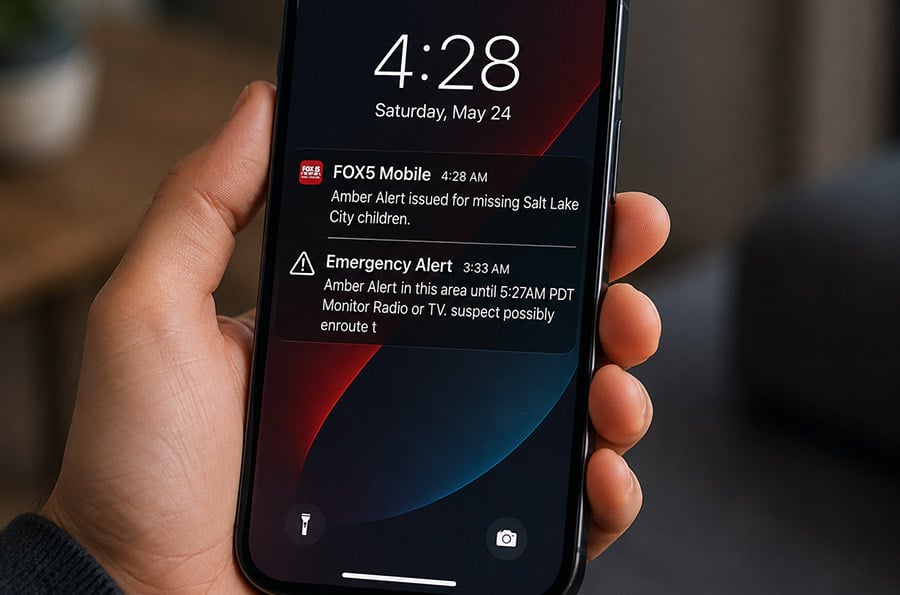
Sources

  • LAPD Press Release (June 16, 2026): Kidnapped child found in Mexico; father arrested in mother's slaying (Link)
  • CBS News (Jun 15, 2026): Los Angeles man accused of killing his wife and abducting child arrested in Mexico (Link)

Close-up of phone screen displaying AMBER Alert for 10 month old abducted in North Las Vegas

On March 5, 2026, the North Las Vegas Police Department successfully recovered a 10-month-old infant less than 90 minutes after issuing an AMBER Alert. The abduction stemmed from a domestic violence incident where the suspect, Roderick Duke, experienced an emotional crisis and threatened self-harm. While authorities quickly located the child unharmed by utilizing immediate cell phone tracking, the case highlighted a critical systemic vulnerability regarding public broadcast systems. Nevada Department of Transportation regulations prevented the AMBER Alert from displaying on overhead highway signs due to the absence of a license plate number in the initial police report. This incident demonstrates the intersection of domestic disturbances and abduction, along with the strict data requirements for highway alert activation.

This abduction began with a reported domestic disturbance. The suspect assaulted the child's mother and fled with the infant without using a car seat. Police reports indicated the suspect was in an emotional crisis and made specific threats to harm himself and the child. These immediate threats of violence and self-harm act as primary risk indicators during parental abductions.

A limitation emerged regarding public alert infrastructure. The Nevada Department of Transportation delayed posting the AMBER Alert on overhead freeway signs. State rules require specific vehicle details, including the make, model, color, and exact license plate number, before highway signs can be activated. Because the initial police report lacked the license plate number, the message could not be displayed. Officials state that posting partial vehicle descriptions could lead to public abuse or fatigue of the alert system.

Detectives successfully used cell phone tracking to monitor the suspect's movements immediately after the abduction. Interestingly, while the public AMBER Alert was issued, court documents reveal the suspect had already returned to the initial apartment complex with the baby. Officers found him there and arrested him without incident. This highlights the importance of maintaining a physical police presence at the original crime scene during domestic-related abductions, as offenders experiencing emotional crises may return to familiar locations.

Key Findings

  • The abducted 10-month-old was recovered safely within 90 minutes of the AMBER Alert.

  • Immediate cell phone tracking aided the police in monitoring the suspect.

  • Strict state regulations prevented the AMBER Alert from appearing on highway signs due to a missing license plate number.

  • The suspect returned to the original scene of the domestic dispute, where the arrest occurred without incident.

Sources

  • KTVN (Mar 5, 2026): AMBER Alert cleared for 10-month-old girl in North Las Vegas (Link)

  • FOX5 Las Vegas (Mar 6, 2026): North Las Vegas police say child in AMBER ALERT was found and unharmed, father arrested (Link)

  • FOX5 Las Vegas (Mar 12, 2026): North Las Vegas man accused of kidnapping 10-month-old daughter appointed public defender (Link)

The parents of a 21-year-old woman murdered by her husband is asking officials to create a “Bianca Alert” to help victims of domestic violence. Timothy Cox, stepfather of Bianca Vite, said the alert is needed because an AMBER Alert or Silver Alert could not be issued to help save his stepdaughter. County officials say they will continue to discuss the idea with Cox to see if the alert is feasible.

The Wisconsin legislature is considering creating a Purple Alert to help find missing and endangered domestic violence survivors. The law would eliminate any waiting period before law enforcement can issue a statewide notification with the missing person’s picture and information.

Florida lawmakers are considering a Purple Alert also; however, it would be used by law enforcement for a missing adult with a developmental disability. State Senator Lori Berman says she wants the alert in place after a man died while wandering away from a care center.

Frontline NY State Police

What began as a runaway case changed after Ogdensburg, New York, police learned a missing 15-year-old girl may have been threatened and held captive by her boyfriend. The threat prompted officers to ask the New York State Police (NYSP) to issue an AMBER Alert for Olivia Roberts.

Roberts was reported missing on December 12, 2018, after meeting with her 27-year-old boyfriend, Kenneth Snyder. A month earlier, Snyder was charged with unlawful imprisonment for forcefully restraining her during a domestic violence incident. But Snyder fled from police as he was about to be transported from court to a secure facility.

On December 19, Roberts didn't show up after she asked a friend to pick her up. The same friend was then blocked from Roberts' Facebook account. He told police he was concerned Snyder may have taken control over Roberts' Facebook account. That same day Ogdensburg police asked the public on social media to help them find Roberts.

At 6:51 p.m. on December 20, a family member told police that Roberts made a call using Facebook and was screaming frantically for someone to come get her. The family member then heard a male voice asking what she was doing and the call suddenly went dead.

“There in fact was a particular incident and that's what led to the criteria change that led to the AMBER Alert,” said Ogdensburg Police Detective Mark Kearns.

NYSP received the request for an AMBER Alert; agents first made sure the child and suspect had been entered into the National Crime Information Center (NCIC). They also started gathering information and photos of the child and suspect for the state's web-based public notification system for AMBER Alerts.

“We always have concern for the victim in every case we receive,” said NYSP Investigator Michael O'Connell. “We felt this child was being held against her will and in danger of serious bodily harm or death, thus meeting our criteria.”

The AMBER Alert was disseminated at 8:16 p.m. through faxes, emails, text messages, phone calls, highway signs, lotto terminals, broadcasters and social media. New York residents can also sign up to get the alerts at alert.ny.gov.

The NYSP Computer Crimes Unit contacted Facebook and learned the device Roberts used to make a call may have been in Massena, New York. Massena police officers arrived at an apartment and two adults claimed Roberts wasn't there.

Both adults were arrested after police discovered they told Roberts to go out a window and hide on the roof. Snyder was later found and taken into custody. The AMBER Alert was canceled at 9:30 p.m., a little more than an hour after it was issued.

“We were relieved to learn the child was recovered safe and unharmed,” said O'Connell. “It was a challenge to have people helping the suspect and child avoid the police.”

New York has issued 89 AMBER Alerts since the program began in 2002. O'Connell has been involved with 20 alerts since 2016. He said lessons are learned with every alert. “This case reiterates a need for continual communication with requesting agencies as new information develops,” he said. “We train often and try to prepare as best as we can.”

Mugshot of suspect Donnie Shelton alongside portrait of daughter Elysha Shelton
Suspect Donnie Shelton, left, and his daughter, abduction victim Elysha Shelton, right.

Donnie Shelton had a protective order forbidding him from contacting his estranged wife and their children. Authorities at the Pickens County Sheriff's Office in South Carolina said the order did not stop Shelton from breaking into the family home on Monday, November 22, 2010, and attacking his wife and 10-year-old son. The father found his 8-year-old daughter hiding in a closet and forced her into his truck.

Dispatchers received the initial call at 6 p.m. and investigators tried to find the child before contacting the South Carolina Law Enforcement Division at 11:40 p.m. about issuing an AMBER Alert. Lieutenant Cal Reighley said he considered the father's history of domestic violence and drug problems before sending the alert out just after midnight.

“We felt like the child was in danger because of his history of violence and how he took the child,” said Reighley. “It was better to be safe than sorry, and we decided to go ahead and issue the AMBER Alert.”

Reighley notified the National Center for Missing & Exploited Children and contacted all AMBER Alert partners. He also made a courtesy call to Georgia and North Carolina about the alert. Every part of the South Carolina AMBER Alert Plan seemed to be working.

At 3:30 a.m. Tuesday, a man showed up at the Baptist Regional Medical Center in Corbin, Kentucky, with a girl who said she had stomach pains. A nurse became suspicious when the girl would not make eye contact with her. Staff members checked an AMBER Alert website and discovered the child had been abducted three states away in South Carolina. The police arrived at 4:05 a.m. and arrested Shelton.

Patti Ruff, the South Carolina AMBER Alert Coordinator, said she was about to relieve Reighley when the AMBER Alert was cancelled.

“I think the alert was awesome,” said Ruff. “Whoever took the initiative to check online to see if there was an AMBER Alert should be recognized. They could have checked the little girl and sent her on her way with her father. This is a lesson for all hospital staff members to check something out even if there is not an AMBER Alert in their state.”

Ruff became the state AMBER Alert Coordinator only seven months before this alert went out. She offered this advice for other new coordinators: “Work with someone who is experienced and has been involved with AMBER Alerts. If you are a parent and you are new to the process, you will want to activate the alert as fast as you can. However, it is important to get it right, so you do not desensitize the public with too many alerts.”

“You learn something with every alert, and nothing happens exactly the same with each one,” added Reighley. “The biggest surprise was where the suspect was located. The most important lesson we learned was to check other states because the suspect can pretty much go anywhere, and you do not know where they will turn up.”

Shelton has been charged with assault and battery, burglary, custodial interference, criminal domestic violence, and trespassing.