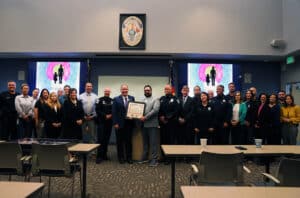



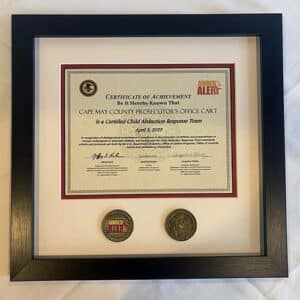

On May 11, the Cape May County Child Abduction Response Team (CART) reached a significant milestone, officially earning National CART Certification through the U.S. Department of Justice and the AMBER Alert Training & Technical Assistance Program (AATTAP).

This prestigious accomplishment is the culmination of several years of focused effort to strengthen the region's operational readiness. To achieve certification, the Cape May County team engaged in rigorous training, extensive planning, cross-agency coordination, and comprehensive policy development. Their preparedness was ultimately put to the test during a full-scale mock activation exercise designed to evaluate and refine their response capabilities under intense, real-world conditions.

The success of this initiative reflects the unwavering dedication and commitment of countless partners across Cape May County. Building a strong, effective child abduction response capability required the seamless collaboration of local law enforcement agencies, CART liaisons, emergency management personnel, search and rescue teams, and various supporting organizations. Each partner played a vital role in reaching this achievement.

Most importantly, this national certification demonstrates a unified, shared commitment to protecting children and supporting families during critical incidents where every second matters.

Congratulations to everyone who contributed their time, expertise, and professionalism to make this certification possible. The teamwork and vigilance exhibited by the Cape May County CART continue to make a profound difference for their community and serve as a model for proactive child protection.
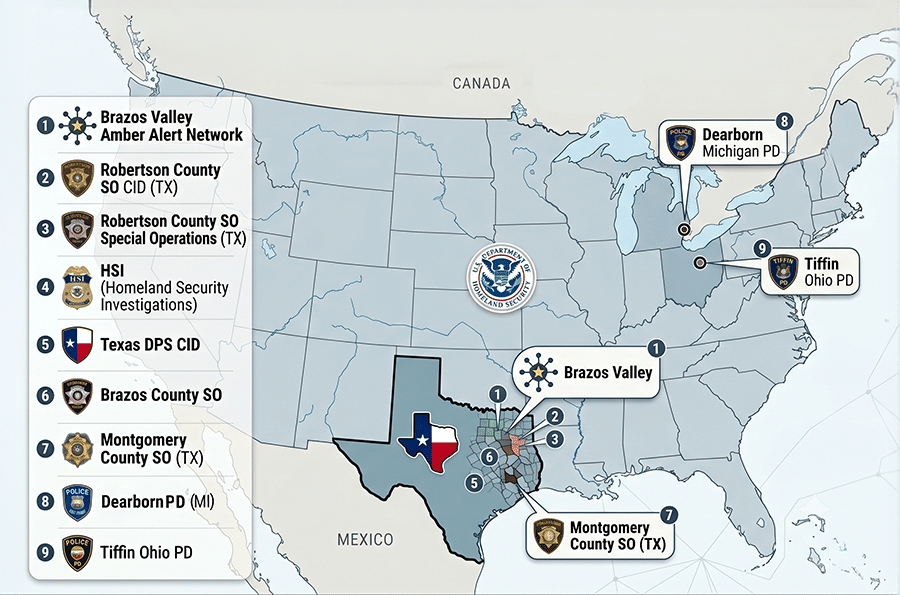

 

Map of United States with Jurisdiction in Robertson County TX Tiffin PD (OH), and Dearborn PD (MI) marked

An extensive multi-jurisdictional operation concluded successfully on February 15 with the safe recovery of a missing Robertson County, Texas, teenager in Dearborn, Michigan. The investigation, coordinated by the Robertson County Sheriff's Office alongside Homeland Security Investigations and numerous state and local agencies, resulted in the planned charging of two suspects. The successful recovery underscores the necessity of rapid, cross-border intelligence sharing when dealing with interstate incidents. Following the recovery, law enforcement issued direct guidance regarding the monitoring of youth communication platforms. This case serves as a vital example of coordinating federal, state, and local assets, including the Brazos Valley AMBER Alert Network, to resolve complex missing child scenarios crossing state lines.

Communication Platform Vulnerabilities

Following the safe recovery of the teenager, Robertson County Sheriff Bill Ruland issued a specific, public directive urging parents to closely monitor who their children communicate with and the platforms they use. This explicit statement from the lead investigative agency establishes that communication channels and third-party interactions were a central component of the disappearance. Law enforcement’s decision to pair the announcement of the recovery with a targeted warning about communication monitoring highlights an operational focus on how external contacts interact with minors prior to a disappearance.

Cross-Jurisdictional Coordination and Interoperability

The geographic trajectory of this case—originating in central Texas, involving agencies in Ohio, and concluding in Michigan—demonstrates the logistical complexity of interstate child recovery operations. The successful outcome relied entirely on the seamless integration of localized assets with federal networks. The involvement of the Tiffin Police Department in Ohio and the Dearborn Police Department in Michigan indicates a multi-state transit route that required continuous jurisdictional handoffs. Utilizing the resources of Homeland Security Investigations (HSI) and the Texas Department of Public Safety (DPS) Criminal Investigations Division allowed local sheriffs to maintain investigative continuity beyond their immediate geographic boundaries.

Key Findings

  • Law enforcement explicitly identified communication platforms as a vulnerability factor, prompting a public warning from the Sheriff for parents to monitor youth communications.
  • The integration of federal assets, specifically Homeland Security Investigations, facilitated continuous operational tracking across state lines.
  • Effective resolution required interoperability between at least seven distinct local, state, and federal law enforcement entities spanning Texas, Ohio, and Michigan.
  • The investigation culminated in impending charges against two individuals, necessitating coordination for cross-jurisdictional prosecution.
  • Regional alert systems, including the Brazos Valley AMBER Alert Network, played a documented role in the multi-agency response framework.

Sources

  • The Initial Missing Report (Feb 6, 2026): Missing Child Alert: Police search for Jaycee Makay Rose in Robertson County, Texas (Link)
  • The Regional AMBER Alert (Feb 5, 2026): Amber Alert | Authorities search for missing Robertson County teenager (Link)
  • The Recovery Report (Feb 18, 2026): Authorities find missing Robertson County teenager (Link)


Save The Children worker carrying child

A newly launched Child Protection Information Management System+ (CPIMS+) app is changing how field workers track separated children in the Dadaab Refugee Camp. Built through a partnership between Save the Children and UNICEF, this digital tool replaces slow, paper-based tracking with real-time updates. By using advanced matching technology, the app pairs family tracing requests with records of unaccompanied children. This transition to a secure, mobile database reduces administrative delays, giving field teams more time to focus directly on vulnerable youth. The app also allows many different agencies to share secure data, ensuring that no child falls through the cracks. This important upgrade offers a strong, reliable model for improving family tracing and case management in high-stress, fast-moving environments worldwide.

The transition from paper records to a digital database reveals critical advancements in child recovery operations. By implementing the CPIMS+ app in the Dadaab Refugee Camp, rescue organizations address a major vulnerability: administrative delays. Paper-based systems in the field often slow down response times and increase the risk of lost information. The new mobile tool allows caseworkers to update and monitor case files in real time.

Advanced matching technology serves as the core of this operational upgrade. The system automatically compares family tracing requests against the registered profiles of separated children. This eliminates the need for manual cross-referencing, which is highly prone to human error. When managing thousands of unaccompanied minors, reducing administration time allows field staff to dedicate more direct support to the children. Faster recovery times help limit the psychological impacts of prolonged family separation.

Data sharing across multiple agencies has historically been a challenge in large-scale rescue efforts. The app establishes a secure network where different groups, including government ministries and non-governmental organizations, can safely access the same records. This ensures continuity of support, preventing situations where a child's case stalls because it transfers between agencies. The technology, which evolved from a 2005 initiative for safe information sharing, has already proven effective in conflict zones like South Sudan and Bangladesh.

Key Findings

  • Moving from paper forms to a mobile app allows frontline caseworkers to update child protection records instantly in the field.

  • Sophisticated software pairs caregiver tracing requests directly with reports of unaccompanied children, speeding up the reunification process.

  • A secure database allows multiple organizations to work together on the same case files, preventing delays and ensuring continuous support for the child.

  • Cutting down on paperwork gives case managers more time to focus on the immediate physical and psychological needs of vulnerable children.

Sources

  • Save the Children News (Mar 14, 2022): SAVE THE CHILDREN LAUNCHES APP THAT HELPS REUNITE MISSING CHILDREN IN DAADAB WITH THEIR FAMILIES (Link)

In a significant milestone that highlights years of unwavering commitment, coordination, and excellence, the North Central Colorado Regional Child Abduction Response Team (NCCR-CART) has officially achieved U.S. Department of Justice national certification. The National Criminal Justice Training Center (NCJTC) proudly recognizes this exceptional accomplishment, celebrating a team that exemplifies the highest standards in child protection.

Founded in 2014, the NCCR-CART regional alliance brings together 28 law enforcement agencies, prosecutors, and advocacy partners, all united by a single mission: to strengthen the region’s ability to respond rapidly and effectively to child abduction cases. Earning DOJ certification reflects not only their dedication to protecting children but also their ongoing investment in rigorous training, cross-jurisdictional collaboration, and steadfast preparedness.

Behind the tactical training and interagency agreements lies a deeply poignant purpose. The drive behind NCCR-CART honors the memory of 10-year-old Jessica Ridgeway. In 2012, Jessica was abducted and tragically killed while walking to school in Westminster, Colorado. Her heartbreaking case shook communities across the region and serves as a lasting, powerful reminder of exactly why this critical work matters so much.

Recently, the team demonstrated its operational readiness to honor that mission through a full-scale exercise in Westminster. Participating agencies navigated a complex, simulated child abduction scenario that tested every facet of their response capabilities. The exercise successfully utilized specialized resources, including K-9 units, digital forensics experts, and highly coordinated field operations, proving the region is ready to act at a moment's notice.

The NCJTC is profoundly honored to support dedicated teams like NCCR-CART. Committed to advancing the capabilities of Child Abduction Response Teams nationwide, the NCJTC extends its deepest congratulations to every individual and agency involved in reaching this monumental milestone. Through their hard work and vigilance, they ensure their communities are safer, and Jessica’s legacy is remembered.

12- and 14-year old sisters wearing fuzzy red hooded jackets with Christmas tree on front and Christmas tree bulb necklaces stand in front of go carts.


Highlighting the complex decision-making involved in modern abductions, the Martin County (Florida) Sheriff’s Office (MCSO) successfully recovered two sisters, aged 12 and 15, by strategically delaying an AMBER Alert to maintain a tactical advantage. Investigators determined the suspect, 19-year-old Hser Mu Lah Say, was actively monitoring digital channels. Fearing an alert would cause him to flee or harm the victims, detectives instead commandeered the family's device, impersonating relatives in chats to track his movement along I-75 without revealing law enforcement involvement. This "silent pursuit" allowed the Georgia Highway Patrol to intercept the suspect's Honda CR-V in Lowndes County just minutes before the alert was scheduled to launch. The case offers a vital case study for Coordinators on weighing the benefits of public saturation against the risks of tipping off digitally savvy predators.