

College Station, Texas, Assistant Police Chief Charles “Chuck” Fleeger was honored for his work to help missing and abducted children when he retired after serving with the agency since 1989. The U.S. Department of Justice honored Fleeger as the AMBER Alert Coordinator of the Year in 2010. Fleeger is leaving to direct the nonprofit AMBER Alert Network of the Brazos Valley and will continue teaching and consulting on issues concerning missing and exploited children.
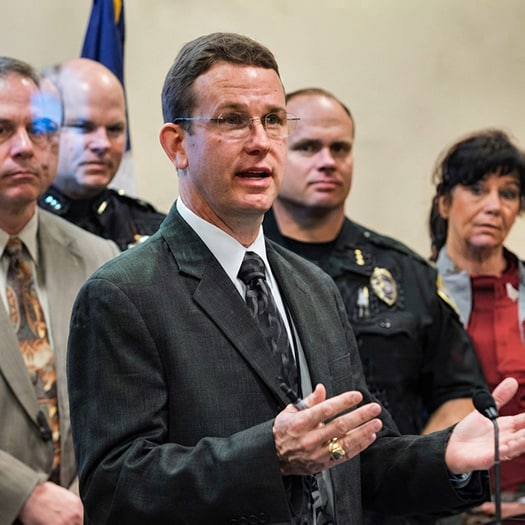
What if a child were abducted in my hometown? College Station, Texas, Police Lieutenant Charles Fleeger said that question haunted him in 2001, and it started him on a journey to do more to find missing and abducted children. He said he was also motivated by his 8-year-old daughter.
“As a dad that scared the heck out of me,” recalled Fleeger. “What would happen if something happened to my daughter? Would we be ready? I know we cannot plan for every eventuality, but as a police officer and as a parent, I wanted to be able to stand before a parent and say we did everything we could and did not wait to the last second to do it.”
Fleeger gathered representatives from law enforcement, broadcasting, and dispatch centers and they began looking at other AMBER Alert programs. The radio stations in the area were not staffed 24 hours a day, but Fleeger found out that broadcasters could be notified at any time through the Emergency Alert System. In June 2003, the Texas Region 3 AMBER Alert Plan was launched for seven counties.
“We started building relationships with the AMBER Alert Program,” said Fleeger. “We were able to get representatives from all of the law enforcement agencies in the area to agree on something, and that was pretty darn unprecedented. It was actually an easy sell. Who wants to be the sheriff who is against finding missing kids?”
The new AMBER Alert Coordinator and his team started to train, hold quarterly meetings, and wait. They continued to train, find ways to improve their AMBER Alert plan, and wait. Sometimes Fleeger would use his own money and vacation time for more training. After more than 7 years, the regional AMBER Alert plan has never had to activate an alert.
“We have gotten scared a couple of times, but I keep telling people my goal in law enforcement is that we never have to use the AMBER Alert,” said Fleeger. “We will practice, train, and get people on board, but we never have to push that button.”
Fleeger said officers learn how to storm buildings, conduct high speed pursuits, and react during a gun battle, and they should be just as prepared when a child is missing.
In 2009, Fleeger heard about the Child Abduction Response Team (CART) and more questions vexed him. “What will we do after we ring this bell? Are we ready to respond to an AMBER Alert? The answer was no. We need to set up a plan to respond.”
Fleeger and representatives from all seven counties trained to start a CART. They invited social workers, search and rescue teams, fire fighters, and others who were not involved in the AMBER Alert Program to be on the CART. In January 2010, the Brazos Valley Regional CART was launched with Fleeger as the CART Coordinator.
“Our agency does not have the resources if we have a case like Amber Hagerman or Elizabeth Smart,” said Fleeger. “We continue to build relationships across jurisdictional lines so we can help each other when something big happens.”
Not surprisingly, the CART has never been activated. It is also not a surprise Fleeger was named the 2010 AMBER Alert Coordinator of the Year for his dedication to finding missing and abducted children.
“I was so shocked and humbled when I heard about the award,” said Fleeger. “I feel like I now have to go out and earn it. I definitely do not want to rest on what has occurred in the past. I want to keep chugging forward to do the best we can.”
Next year, Fleeger plans to get the Brazos Valley CART nationally certified and bring additional training to his area on how to canvass a neighborhood when a child is missing.