

Open hotel room doorEditors' Note: This special Spring/Summer edition of The AMBER Advocate contains extensive coverage of the Trafficking in Persons Symposium held April 10-13, 2012, in Salt Lake City, Utah. The Department of Justice's AMBER Alert Training & Technical Assistance Program (AATTAP) conducted the symposium, which brought together more than 100 subject matter experts from a variety of disciplines including law enforcement, medical and legal representatives, social services, non-government organizations, educators, faith-based organizations and researchers to gather valuable insights and lessons surrounding the topic of trafficking. The symposium included collaboration from Harvard University, Johns Hopkins University, University of Texas at El Paso, and Southern Methodist University.

Change in Perspective

A 15-year-old Phoenix girl was invited on MySpace to meet up with a friend she knew from school. When she showed up to see her friend, four men grabbed her, wrapped her in duct tape, and took her to an apartment where they gang-raped her.

For the next 43 days, the men forced the girl to live in a dog cage and trafficked her. The men fed her dog biscuits and threatened to kill her every day. No AMBER Alert was issued. Even though the girl was a model student and did not have a history of problems, the police and parents thought she had run away. The incident happened in 2005 and at that time detectives thought any girl who offered sex for money had made a lifestyle choice.

“We did not understand that a prostitute is not a criminal, rather a prostitute is a trafficking victim,” said Phoenix Police Lieutenant James Gallagher. “We thought we knew everything, and we would solve everything. Our mind set changed when we found a girl in a dog crate.”

The Trafficking in Persons Symposium included horrifying stories of children who were abducted and forced into slavery. The Office of Juvenile Justice and Delinquency Prevention (OJJDP), which is a component of U.S. Department of Justice, hosted the symposium.

“We realized it was important to focus on human trafficking because the AMBER Alert did not address the problems we were seeing with endangered, runaway, and thrownaway children,” said Phil Keith, AMBER Alert Training & Technical Assistance Program Director. “It is difficult to separate child abductions from human trafficking because the research shows a strong connection between endangered and abducted children and trafficking.”

Keith said lessons learned from developing the AMBER Alert program could inform the development of a national response to human trafficking. Likewise, learning more about human trafficking will give AMBER Alert partners more insight into their response to child abductions.

The Numbers

Estimating the number of people trafficked into or out of the United States is inherently difficult because of the secretive nature of sex and labor trafficking. Using different methodologies, populations (adults versus children), units of analysis (states, counties, continents), researchers have produced wildly disparate estimates of the problem. Lacking consistency, estimates for trafficking within the United States range from 2 million to 14,000 annually; and international figures reach as high as 27 million victims per year.

Without methodologically sound techniques for determining the number of trafficking victims, some studies have turned to at-risk populations, a logical approach given the link between at-risk youth and adults, and exploitation. For instance, the second National Incidence Studies of Missing, Abducted, Runaway and Thrownaway Children (NISMART-2) published by OJJDP in 2002 estimated that 1,315,600 children were missing from their caretakers for at least an hour in 1999. The annual total includes nearly 800,000 runaway, thrownaway, injured or endangered children and 150,200 child abductions.

Taking even the lowest estimate of human trafficking within the United States reveals that more than 10,000 people face labor or sexual exploitation each year in this country. Turning to at-risk populations reveals an even larger issue with at least 100,000 in danger of sexual or forced labor situations.

People who work with human trafficking agree that even one case of a child being forced to work as a sex slave, or forced to work in agricultural fields for pennies is reason enough to take this issue seriously.

Photo of a young woman, trafficking survivor Holly Smith
Holly Smith

A Survivor's Story

Holly Smith was 14 years old when an older man approached her at a mall. After that, he started calling her frequently and buying her gifts. “He talked to me like an adult, which was important to me,” said Smith. “Most boys and girls were sarcastic, and I did not feel like I was being heard.”

The man told her they could run away to Hollywood so she could be a songwriter or a model. Smith said running away seemed like a good idea because she had been abused as a child and had a bad relationship with her parents.

Smith said she knew something was wrong when the man took her to a hotel and raped her to “test his goods.” He then told her about the rules regarding having sex with men for money. After weeks as a domestic minor sex trafficking victim a police officer approached her and asked if she was underage.

“I asked ‘What if I was not 18?’” said Smith. “The officer arrested me, searched me, and threatened me with juvenile detention and that I would get beat up. My family members did not understand what happened to me.” She said the officer's treatment convinced her that she could not trust law enforcement.

Eventually, Smith received the help she needed and now works as a microbiologist. She speaks to audiences across the nation to convince people to treat girls like her as a trafficking victim instead of a child prostitute or sex worker. “My main point is: These girls are worth saving.”

A New Approach

Detectives at the Dallas Police Department found they started making a dent against human trafficking when they began treating women and girls as victims instead of prostitutes. Between 2005 and 2010, they recovered 994 high-risk runaways; 506 identified themselves as trafficking victims, and detectives had evidence that many of the others were also victims.

“It is truly not that difficult to find trafficking victims,” said Dallas Detective Cathy Delapaz. “It is important to know what to do once they are contacted. The interviewer must help the victim find services and get help. If your sole purpose is to win a case, you are doomed to fail.”

Dallas Police soon realized these victims are different than other crime victims. “Our system is set up for compliant victims,” said Dallas Police Sergeant Byron Fassett. “It is not set up for foul-mouthed, angry, mean and scared victims who will fight you tooth and nail. We need to change the system to help them.”

Fassett said most trafficking victims do not contact police and so a community-wide approach is needed to make it safe to seek help. Law enforcement must team up with juvenile probation, state and federal prosecutors, social service agencies, and non-profit groups to make a real difference.

The Dallas Police Department is now rescuing about 90 girls each year from sexual exploitation compared to about 12 girls a year when they were simply making vice arrests.

The Phoenix Police followed the Dallas model and started partnering with federal agencies and national and local organizations that could offer help to trafficking victims. The department also started targeting pimps instead of prostitutes.

“We tried to arrest our way out of the problem and had no understanding of victimization,” said Phoenix Police Sergeant George Sutherlin. “We did not focus on the pimp or john and had no partnerships with service providers. Our partnerships are now the most important resources in trafficking cases.”

Phoenix police have partnered with Arizona State University's Project Rose, a program that provides an alternative to incarceration for women charged with prostitution. The project offers services and restores dignity to victims so they will not return to prostitution. Not everyone finishes the program, but none of the women who have finished it has been re-arrested. “Arrest alternatives do work and partnerships can help save victims,” said Associate Professor Dominique Roe-Sepowitz.

Lessons for AMBER Alert Partners

When the AMBER Alert Program began to grow across the country, many believed communities would use the alert only for stereotypical child abductions. AMBER Alert partners quickly realized that family members and people who know the victim commit most abductions. They also realized that family and acquaintance abductions can be extremely dangerous for the child.

The symposium provided an eye-opening look at the alarming numbers of child abductions that occur for the sole purpose of sex trafficking. Pimps and gangs physically abduct some of the victims. Many victims are missing children or runaways who have been lured to leave their homes without knowing the full consequences. Findings from the symposium will be essential for AMBER Alert partners to develop a comprehensive child abduction response plan that can provide for the safe recovery of all victims.

Letters to the Advocate

“I am going through all of my Trafficking in Persons Symposium notes and just wanted to say thanks for inviting me. I have lots of information that will really help our program. I learned a lot during the conference and felt that it was very well done. We are now working on putting together a task force on human trafficking.” — Amy Thurston, Trafficking in Persons Program Coordinator, Asian Association of Utah Refugee and Immigrant Center


Report: Trafficking in Persons Symposium

Survivors Offer Solutions to Get Trafficked Victims Off the Streets

Trafficking survivor Keisha Head
Keisha Head

One of the most valuable lessons that the AMBER Alert Training & Technical Assistance Program has taught is the value of listening to victims and their families when seeking solutions to child abductions. The Trafficking in Persons Symposium brought 12 survivors of child sex trafficking to offer a real-world perspective on what will and will not work to help victims.

“We thought it was very important to have a face on this mission,” said Phil Keith, AMBER Alert Training & Technical Assistance Program Director. “When you have the face of a child, it deals with our values and our heart.”

The 12 women who now call themselves “sister survivors” offered practical ways to help human trafficking victims. “We know what it takes to bring victims into becoming survivors,” said Keisha Head. She and the other survivors provided examples of what is needed to help trafficking victims, including being careful with the language and labels used during the first contact, being prepared to provide shelter, food, education, and long-term support, considering the trauma the victim experiences, and coordinating services while using survivors to help victims.

Head said her experience with law enforcement was not positive after she was forced into trafficking. She said one police officer even gave her advice on where the “pretty girls” sell themselves. Later, she went to the police after she was raped. “The officer said, ‘You were not raped, you are a prostitute.’”

In conclusion, she said, the one word all of the survivors could relate to is slavery. “This is modern-day slavery, and this is taking place under our eyes, and we need to take a stand and stop this from happening.”

Lessons From Human Trafficking Symposium Offered Online

On May 16, nearly 400 people participated in an online training course about the connection between missing children and sex trafficking. The hour-long Webinar, “Missing to Trafficking,” identified the correlation between the unknown missing child, chronic runaway, repeat victims of sexual abuse, abducted children, and the child victimized through sex trafficking.

“Child sex trafficking victims are missing kids,” said Dallas Police Sergeant Byron Fassett. “A child on the street has the highest risk of victimization. They are often approached by a pimp and forced into trafficking.”

AMBER Alert Liaison Jim Walters offered this advice from the Trafficking in Persons Symposium when assisting victims: offer help unconditionally, learn to be culturally appropriate, provide basic needs, and use a survivor advocate to assist. “It is our responsibility to give victims control and let them take charge of their own lives,” said Walters.
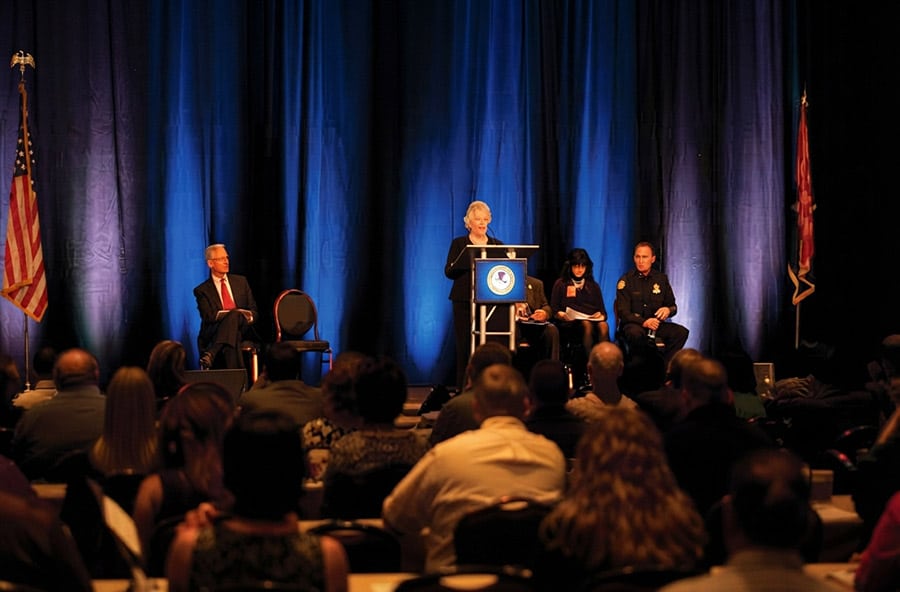
People on stage talking to a crowd of attendees
Hundreds of partners attended the 2010 conference in Phoenix.

If there was a theme to the 2010 National AMBER Alert Symposium, it would be the Boy Scouts' motto, “Be prepared.”

Clay County, Florida, Sheriff's Captain David Senters put it this way: “The only type of case that has ever scared me is a child abduction. Having been through a child abduction, I'm even more scared. You must have a plan in place.”

The symposium held November 16-18 in Phoenix was an opportunity for AMBER Alert partners to consider if they have a plan in place or if they must improve their current plan. The symposium provided three days of discussions designed to replace fear with knowledge.

“We have come a long way, but we still have a way to go,” said AMBER Alert Training Program Director Phil Keith.

The 7-Year Review

The AMBER Alert Training & Technical Assistance Program staff shared a review of all U.S. and Canadian AMBER Alert Plans during the past 7 years to see how they have evolved.

The good news: name recognition for AMBER Alert is up, the activation criteria is more uniform, the methods for disseminating alerts have improved, and more plans use tools to identify proper activation procedures.

The review noted some other positive developments: more plans employ comprehensive child recovery strategies and automatic alert cancellations and better details about the frequency of alerts and out-of-state activations. In addition, more plans use Endangered Missing Advisories for cases that do not meet the AMBER Alert criteria.

The bad news? Most plans lack details in after-action reports; few plans reference phone banks, testing, scenarios, or tabletop exercises. Also, most plans have not been updated since 2007.

The lesson learned from this comprehensive review is there is no finish line; agencies need to constantly review their plans and make needed improvements to ensure they provide the best preparation possible.

During his keynote speech at the symposium, Utah Attorney General Mark Shurtleff quoted Benjamin Franklin, who once said, “When you finish changing, you are finished.”

“We need to change from ‘That is the way it has always been done’ to ‘That is the best way to save a child,’” said Shurtleff. “Take the smallest idea and run with it. Just one person is all it takes to turn a tragedy into a triumph.”

OJJDP Deputy Administrator Marilyn Roberts noted that the AMBER Alert Program has had many triumphs over the past seven years. “The AMBER Alert Program has significantly increased public awareness of child abduction cases and public participation has increased dramatically,” she said.

National Center for Missing & Exploited Children (NCMEC) President and CEO Ernie Allen also added that this is a time to celebrate what has been accomplished. “Few partnerships have had the impact of the AMBER Alert,” said Allen. “Individually, we can do little. Together, we can change the world.”

Technically Speaking

One constant change is technology. NCMEC Associate Director of Special Projects Bob Hoever discussed the way technology is changing AMBER Alert Programs. Some examples include Walgreens posting all AMBER Alerts on its electronic pharmacy signs, smart phones soon having applications for AMBER Alerts and missing child notifications, the U.S. Immigration and Customs Enforcement Service showing AMBER Alerts and endangered missing children notifications on its LCD screens, the Integrated Public Alert and Warning System and Commercial Mobile Alert System eventually changing the way all alerts are distributed, and the Emergency Alert System soon switching to the Common Alert Protocol (CAP) as its primary method of delivery.

Washington State Broadcasters Association President Mark Allen said CAP will make it possible for alerts to include audio, graphics, maps, and text. “In addition to the standard alert, messages will be sent to cell phones, Websites, billboards, and other alerting devices,” said Allen.

The launch date for CAP has been delayed, but, Allen said, broadcasters will eventually have to buy CAP decoders and encoders.

AMBER Alert Web Expanded and Enhanced

The AMBER Alert Extranet is also undergoing a complete makeover. The Extranet serves as a secure clearinghouse for authorized AMBER Alert partners in collaborating with one another. In 2011, the Extranet will become part of the secure sites on the Criminal Justice Collaboration Portal at www.thecjportal.org/amberalert. The portal will provide users with an expanded array of Web-based collaboration and information management tools that will enhance the Extranet's features.

“Users can collaborate with other AMBER Alert and child protection partners regarding issues relevant to their roles and responsibilities and access information regarding training and technical assistance,” said Distance Learning Coordinator Bonnie Davis.

AMBER Alert's sites on the portal will provide a wide array of training and technical assistance information for the public. Users with secure login credentials, such as AMBER Alert Coordinators, Missing Children Clearinghouse Managers, active Child Abduction Response Team (CART) Program Coordinators, and their ranking law enforcement officers, will also have access to a vast collection of secure collaboration tools, document libraries, and other resources not visible to the public. The site's security will ensure that users' information and documents are protected as they collaborate with their colleagues.

Distance Learning on the Portal

The portal will also be used to share distance learning courses. The website will include an area devoted to online course information, schedules, downloads, and links to registration.

Two courses are currently available: “Public Safety Telecommunications Best Practices for Missing and Abducted Children” and “Patrol First Response for Missing and Abducted Children.”

In the first 10 months of AMBER Alert's online learning programs, more than 2,100 law enforcement and public safety personnel successfully completed training. Registrations continue to pour in and 3 to 5 more programs are expected to be added this year, including a Spanish language AMBER Alert Basics course, blended learning opportunities for the CART program, and a new course for prosecutors to support their role in missing and abducted child investigations.

CART Has Wheels

The CART concept continues to gain momentum since it was introduced at the National AMBER Alert Symposium in 2006. A CART is made up of highly trained individuals who provide the expertise and resources needed when a child is missing or abducted. So far, more than 247 teams have attended training covering 43 states, the District of Columbia, Puerto Rico, the Bahamas, and Canada.

“AMBER Alerts and CART go hand-in-hand,” said lead CART Instructor Floy Turner. “Our short term goal is to have CARTs in all 50 states. Our long term goal is to have CARTs everywhere.”

Predatory Behavior

The symposium included some frank discussions about offenders who engage in commercial sexual exploitation of children. In a presentation on Predatory Behaviors, licensed psychologist Veronique N. Valliere said child predators manipulate victims to get what they want.

“When we are talking about compliant victims and compliant behavior, we are not talking about compliance,” said Valliere. “Compliance implies full knowledge. What we have to realize is that these offenders ruin the victim's ability to consent or comply.”

Valliere warned investigators and prosecutors that predators will also act nice, show remorse, and shift the blame on the victim to manipulate them. “The more the offender can blame the victim, the more likely it is that we are not going to take the case,” she said. “Nice is a behavior, not a character trait, it means nothing. The reality is that some of the nicest people do the worst things.”

Detective Cathy Delapaz has dealt with many predators while working for the Dallas Police Child Exploitation Squad. Her job is to stop human trafficking and child prostitution. She shared how pimps groom children to do what they want and never tell.

“Most of the victims of child prostitution could leave the lifestyle and contact police, but the grooming process prevents them from even considering that an option,” said Delapaz. “These cases are not going to walk in off the street; we have to be proactive.”

Family Roundtable Underlines Real Danger, Guides Others

Diena Thompson lit a candle at a vigil for missing and abducted children at the 2010 National AMBER Alert Symposium. A similar candlelight vigil was held for Thompson a year earlier at the symposium in Tampa after the heartbreaking news that her 8-year-old daughter Somer had been found in a Georgia landfill. Somer was walking home from school when a registered sex offender abducted and murdered her.

“It is high time for the predators to fear us rather than us and our children fearing them,” said Thompson. Since the tragedy, Thompson has joined the Surviving Parents Coalition and become a powerful voice for other parents of abducted children.

“My hope is together we can get these monsters off the street,” added Thompson. “Not one more child, not here, not anywhere.”

Thompson also joined 39 mothers, fathers, and survivors in child abduction cases who took part in the Family Roundtable discussions at the 2010 symposium. The family members shared their experiences and recommended guidelines they thought would help AMBER Alert partners during child abductions. Carol Ryan, a mother of an abducted child, shared those guidelines, including that being heard is important to healing and to solving a case, that families should be given a voice and an advocate to help them with law enforcement and the media, that law enforcement agencies should immediately investigate missing children reports rather than telling parents to call back the next day, that the worst case scenario should always be assumed when looking for a child, that runaway cases may not really involve runaways and should be investigated, that children from foster care or residential facilities get lost because cases are not reported or investigated properly, that the family should be kept informed and communicated with even when there is nothing new to say, and that the home should be left the way it was found after an investigation because it is the family's place of refuge and must be protected.

“Law enforcement plays a big part in defining the whole experience for the family,” concluded Ryan. “Remind the family that there are other victims and that what occurred was not their fault. Those affirmations are powerful and stay with the family for a long time.”

Crisis, What Crisis?

Since an AMBER Alert is by its very nature a crisis, AMBER Alert partners also received a crash course on crisis communications. Lessons shared on working with the media during an AMBER Alert included that press conferences should provide everything a reporter will need to tell a story, that the victim's family should have a voice and will help generate public interest, that traditional and new media should be used to reach as broad an audience as possible, that law enforcement should always be up front with the media since a break in trust can jeopardize future cases, and that officials should explain why certain information cannot be released during an investigation.

Clay County, Florida, Sheriff Rick Beseler said it was critical that a relationship with the media already existed when 8-year-old Somer Thompson was abducted and murdered. “The media is needed to relay critical information about the suspect and case,” said Beseler. “If a relationship does not exist, it will be difficult for law enforcement to disseminate information.”

The symposium ended with a challenge from Ron Laney, then OJJDP Associate Administrator and now Senior Policy Advisor to the Administrator, to be prepared and to share. “Be sure to take home what you have learned and share it with everyone.”

2010 AMBER Alert Award Winners

Marilyn Roberts, OJJDP Deputy Administrator, presented the 2010 AMBER Alert Awards to five outstanding individuals involved with the AMBER Alert Program.

Broadcast/Media Person of the Year

Illinois Broadcasters Association President Dennis Lyle helped develop a state AMBER Alert Program in 2001 and enlisted more than 500 broadcasters to make the plan work. Lyle promotes the state's “no budget” AMBER Alert Plan to enlist partners, to educate the public, and to create public service announcements.

Law Enforcement Leadership Award

New Mexico Department of Public Safety Public Information Officer Eric Garcia works tirelessly to educate law enforcement officers and broadcasters on AMBER Alert laws, regulations, and protocols. He developed a Missing/Endangered Alert to find children who may not meet the AMBER Alert criteria. He has also been a leading force to bring AMBER Alerts to bordering states in Mexico.

AMBER Alert Citizen Award

Mike Grant helped save a 2-year-old girl after an AMBER Alert was issued in Maine, New Hampshire, and Vermont. The girl was abducted by her father, who had assaulted the victim's mother at knifepoint. Grant was hunting in the woods when he spotted the victim and suspect and convinced him to turn himself in.

Victor Perez responded to an AMBER Alert after an 8-year-old girl was abducted and forced into a truck in Fresno, California. Perez followed the suspect until he pushed the child out of the truck. The suspect was arrested 40 minutes later.

AMBER Alert Coordinator of the Year

Lt. Charles Fleeger, College Station, Texas Police Department.

CART Certification

Roberts also recognized the Child Abduction Response Teams (CART) that received national certification in 2010. Certification is achieved after the teams are determined to follow the standards and requirements of the Department of Justice. The Utah CART was certified June 1, 2010; the Georgia CART was certified September 1, 2010; the Southern Oregon CART was certified October 1, 2010; the York County, Pennsylvania CART was certified November 17, 2010; and the Kansas CART was certified November 17, 2010.

Special Award Presented to Outstanding Advocate for Children

Phil Keith, AMBER Alert Training & Technical Assistance Program Director, was surprised to receive a special award from OJJDP and NCMEC staff for his outstanding work as an advocate for missing, abducted and endangered children during the final minutes of the symposium. Ron Laney, Senior Policy Advisor to the Administrator, presented the award to Keith for his tireless efforts to train thousands of people and develop critical programs to save the lives of missing and abducted children.