
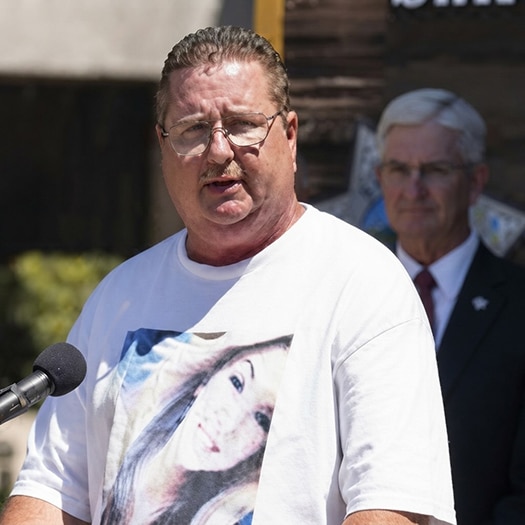
Brett Anderson speaking at a press conference related to his daughter, Hannah
Hannah Anderson's father, Brett Anderson, addresses the media.

The search for Hannah Anderson received international attention after AMBER Alerts were issued in five states to find her. On August 4, grandparents called police to report their 16-year-old granddaughter and her 8-year-old brother Ethan were missing from their home in National City, California.

The San Diego Sheriff's Office asked the California Highway Patrol to issue a regional AMBER Alert on August 5 and later requested a statewide alert. Nevada, Oregon, Washington and Idaho also issued AMBER Alerts as the search intensified for Anderson and the suspect, 40-year-old James Lee DiMaggio.

On August 9, horseback riders in the backcountry near Cascade, Idaho recognized a man and a girl that matched the description of the victim and suspect in the AMBER Alert. The next day FBI agents shot and killed DiMaggio after he shot at them. Anderson was found with no visible injuries and taken to a hospital.

Biggest Activation Ever

An AMBER Alert being issued in five states is unprecedented and the search for the suspect and victim expanded into other states as well as Canada and Mexico. This was also the largest activation ever of the new Wireless Emergency Alert system or WEA.

“I think this case is a great example of how the AMBER Alert system should be used,” said Bob Hoever, Director of Special Programs Missing Children Division for the National Center for Missing & Exploited Children. “The expansion of the AMBER Alert was driven by the investigation.”

Hoever said the Anderson case did a lot to increase national awareness of WEA because so many people received the alert for the first time on their cell phones. He said some of the media coverage focused on people who were upset that the alert was issued late at night.

“I explained I am sorry that people were inconvenienced that late in the evening,” said Hoever. “But I was confident that when they discovered the minor inconvenience helped rescue a child, they would have a different point of view.”

While the alert was activated the Anderson case was the most searched item on Google, receiving more than 500,000 searches.

California

Initially the San Diego Sheriff's Office did not have enough information to issue an AMBER Alert because they did not have any evidence the children were abducted. Investigators soon discovered the badly burned body of the victim's mother, Christina Anderson, and a child's body that was burned beyond recognition in DiMaggio's home.

Ninety minutes after getting the initial call, the San Diego Sheriff's Office determined the criteria had been met for an AMBER Alert. The alert went out at 5:27 p.m. (Pacific Standard Time or PST) in San Diego and Imperial Counties. The AMBER Alert was disseminated to the entire state at 9:30 p.m. (PST).

California Highway Patrol Captain Greg Ferrero is also the state AMBER Alert Coordinator. He said all the components of the statewide AMBER Alert worked as designed.

“I think the human element was the most essential component of the success of the Anderson AMBER Alert,” said Ferrero.

Looking back, Ferrero said a current list of state AMBER Alert coordinators, point-of-contact information and criteria for each state would have made it easier to get the alerts out in the other states. The lack of uniformity between state plans also led to some delays and miscommunication but Ferrero said all the coordinators worked together well.

“The cooperation among the states and out-of-country coordinators was astounding,” added Ferrero. “The sense of urgency to recover the victim was a common goal of all coordinators.”

Nevada

The Nevada AMBER Alert Program got involved early on because the state's Emergency Alert System sends AMBER Alerts to Eastern California. On November 7, a caller from Utah called the Nevada AMBER Alert Coordinator about a possible sighting of the suspect and victim in Las Vegas. The caller was connected to the San Diego Sheriff's Office to see if an AMBER Alert was also needed in Nevada.

“We had to receive confirmation from the activating agency in California that they had a valid reason to believe there was a high probability that the suspect would most likely travel through Nevada,” said Nevada Statewide Emergency Alert/AMBER Alert Committee Chair Stephanie Parker.

Nevada's statewide AMBER Alert went out at 4:20 p.m. (PST) on August 7. The media coverage intensified after the alert was issued in the state because now it was a local story.

Parker said the coordination and timely responses between the National Center for Missing & Exploited Children, California and eventually other states worked well throughout the activation.

The Nevada AMBER Alert Committee plans to review the alert. In addition, the state has recently acquired Common Alerting Protocol technology that will simplify the process for issuing AMBER Alerts when an agency requests a statewide alert. The current Legacy EAS system requires agencies to call the three main EAS stations in Elko, Las Vegas and Reno for a statewide AMBER Alert.

The suspect's vehicle is shown being towed
The suspect's vehicle is shown being towed.

Oregon

Oregon activated the AMBER Alert at 4:17 p.m. (PST) on August 7 after authorities received a tip that the suspect's vehicle was seen near Alturas, California and heading north on Highway 395 towards Oregon. Another person reported seeing the vehicle in the Lakeview area, which is north of the Oregon/California border.

“One of our criminal detectives contacted the woman in Alturas to get additional information and he felt what we had was enough to activate our AMBER Alert for the state of Oregon,” said Oregon AMBER Alert Coordinator Richard Culley.

Because of the location, Culley said it would have been easy for the suspect to continue into Oregon or head back into Nevada.

Some doubts were later cast about the tips concerning sightings in Oregon, but law enforcement officials decided to keep the alert active just in case. “We are not turning our back to this, and we are doing what we can to locate that suspect vehicle and the missing children,” said Oregon State Police Lt. Gregg Hastings to a reporter.

Washington

The state of Washington also issued an AMBER Alert at 4:40 p.m. (PST) on August 7. Washington State AMBER Alert Coordinator Carri Gordon said the Washington State Police reached out to the San Diego Sheriff's Office to see if the agency could help in the search. She said the decision to activate the alert was made after receiving information the suspect may be heading to Washington.

“In my opinion we should have reached out to the San Diego Sheriff's Office earlier,” said Gordon. “As involved as they were in their investigation, extending the alert beyond California was probably a low priority.”

Washington used the Law Enforcement Alert Portal to distribute the AMBER Alert. Overall, Gordon thinks the system worked well.

“There was excellent coordination between our state and the command center in San Diego,” said Gordon. “We were included in conference calls regarding the investigation, and they kept us up to date on events as they occurred.”

Idaho

Idaho turned out to be the key state for the AMBER Alert. But the request for Idaho to issue an alert came from the Washington State Police. Idaho AMBER Alert Coordinator Dawn Peck said they had to consider whether the case met their state criteria and whether there was a real possibility the suspect and victim could be in Idaho.

“The coordination between the states is key,” said Peck. “When another state calls and asks for assistance, you need to do all you can to accommodate the request. The investigating agencies do not ask unless they feel the alert in your state will help in the recovery of the child. In Idaho, we always err on the side of the child.”

The AMBER Alert went out in Idaho at 5:52 p.m. (PST) on August 7. The alert notified broadcasters, law enforcement and the public through the AMBER Alert Portal but it did not go out initially on the EAS system or on the highway signs. Two days later the California Highway Patrol called about a credible sighting in Idaho and the alert went out again using all of the state's notification methods, including EAS and the highway signs.

Relief All Around

Peck said the conference calls between all the coordinators helped to keep them informed and to make sure the message going out to the public was consistent. “We were very happy that this team effort led to Hannah Anderson's safe recovery,” said Peck.

Everyone involved with the multistate AMBER Alert summed up what was accomplished with the alert with one word: relief.

“Relief primarily that she was alive and safe,” said Carri Gordon from Washington. “The information about her being located as a result of the AMBER Alert was very reaffirming that the system works as intended.”

“It was a relief she was found alive, and it was also an affirmation that the system worked again,” added Nevada's Stephanie Parker. “Law enforcement, broadcasters, wireless alerts, social media and the public saved a life.”

“We are glad everything worked out and that Hannah was recovered safely,” added Oregon's Richard Culley.

Greg Ferrero of California offered this closing thought: “Due to the violent events surrounding the abduction, I think we all knew that the stakes were very high in this case. All involved employees had a sense of accomplishment and felt responsible for Hannah's safe recovery.”

Cellphone screens showing "AMBER Alert in the Wireless Age"Vicky Orozco put her 8-month-old son, Carlos, in his car seat so he could nap while she took a shower. When she returned a short time later, her son was gone.
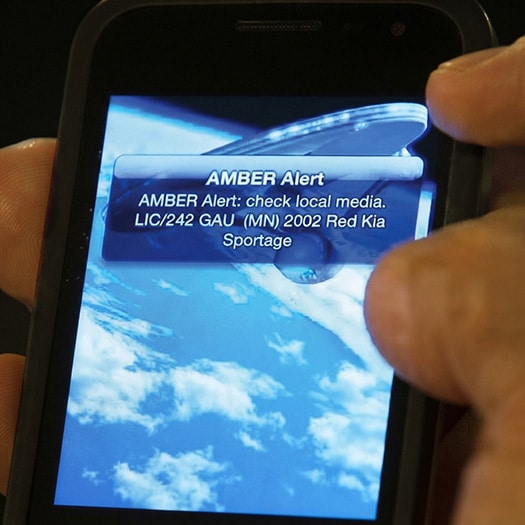
Shortly after noon on February 20, 2013, the Minnesota Bureau of Criminal Apprehension issued its first AMBER Alert that included the new Wireless Emergency Alert (WEA) to help notify the public. WEA sent the alert to nearly every cell phone in Minnesota.

The alert included information about a female acquaintance who police suspected had abducted the child and the car she was reportedly driving. Like thousands of other people, teenager Daisy Buenrostro was surprised to see the alert on her phone. Buenrostro also spotted the suspect's car across the street and checked the license plate to make sure it was the right one.

“I was so shocked,” she told a reporter. “I was like, ‘This is the car.’ So, I ran back inside the house and told my dad.”

The teen and her father called 911, and within minutes after the alert was issued, the suspect was in custody and the baby was home safe with his mother. It also is the first AMBER Alert success story directly linked to WEA.

“The AMBER Alert was a success. It was an excellent use of the new cell phone technology,” noted Minnesota AMBER Alert Coordinator Janell Rasmussen. “I cannot tell you how many people were talking about the alert. The media was going crazy and everyone was talking about it on the social media. They were giddy to get this information. We had no complaints about this.”

The Wireless Reach

Smartphone with an AMBER Alert on its screenMore people than ever can now receive an AMBER Alert. Beginning January 1, 2013, the alerts reach 97% of all people in the area where the child has been abducted through the WEA which is also called the Commercial Mobile Alert System (CMAS).

The Federal Emergency Management Agency (FEMA) operates WEA and distributes alerts from authorized government agencies about emergency situations to customers with capable mobile devices.

The messages supplement the existing Emergency Alert System which broadcasts alerts over radio and television. FEMA worked with the Federal Communications Commission, U.S. Department of Justice (DOJ), and the National Center for Missing & Exploited Children (NCMEC) to expand the alert system to include AMBER Alerts. WEA is also used for National Weather Service, Presidential, and Imminent Threat Alerts.

Wireless Beginnings

Some state AMBER Alert programs included the ability to send alerts to cell phones as far back as 2002. In May 2005, a voluntary partnership between the wireless industry, DOJ, and NCMEC started the national Wireless AMBER Alert Initiative to provide alerts to cell phones in all 50 states.

The program distributed Wireless AMBER Alerts to more than 700,000 cellular subscribers who signed up to receive the messages. The initiative also brought awareness to the AMBER Alert Program through public service announcements and press events.

However, people had to register their phones to get the alerts, and one could choose to be notified in only five zip code areas. For example, if you lived in Utah and were vacationing in Florida, you would receive an AMBER Alert for Utah, but you would not get an alert issued in Florida.

“It made sense to send a succinct text message to alert users so they would be on the lookout for the kidnapped child and abductor in their area,” said Steve Largent, president and CEO of CTIA-The Wireless Association and president of The Wireless Foundation. “The WEA AMBER Alerts will be an even better tool to help find abducted children.”

Bigger but Focused

The new alert system was developed with lessons learned from the AMBER Alert Program. WEA uses a channel called Cell Broadcast and is not affected by congestion on voice or SMS text channels. The alerts are targeted to cell towers instead of relying on zip codes. If you have a mobile device in the area where the alert is issued, you will automatically receive the alert. Unlike a text message, the alert will pop up on the screen of the wireless device.

“Wireless AMBER Alerts were an important evolution of that program, and we are grateful to those who made it possible,” said John Ryan, NCMEC CEO. “They understand that the eyes and ears of many are better than the eyes and ears of few when a child's life is at stake.”

The new system means the people who can actually do something about an abducted child will get the alerts. However, 3% of phones are not equipped to receive the alerts. The goal of the wireless industry is to have all phones compatible with the system by the end of 2013.

Louder but Shorter

The new AMBER Alerts include a loud, audible tone. The first AMBER Alert in Florida using the new system went out at 1:45 a.m. on January 14. A 2-year-old girl was missing, and her bedroom window was open. The alert went out statewide, and some people were upset that a generic message that said a child had been abducted had awakened them.

Florida AMBER Alert Coordinator Jessica Davenport and most people did not know the alert would include an audible tone that went out to everyone in the state. Davenport worked with NCMEC to change how the alert is used. The state's temporary policy now states that alerts will only go out to specific regions, and WEA will not be used for alerts between 10 p.m. and 7 a.m.

“We have a large population of older folks,” said Davenport. “As long as we use it conscientiously, we should be able to reach a lot of people.”

Davenport also decided not to use WEA unless they have vehicle information. In this case, the missing girl was found safe 15 hours later in a field a half mile from her home.

Developers of the WEA system included a tone with the alerts so people would know they may be in danger when receiving a National Weather Service, Presidential, or Imminent Threat alert. Because of the loud sound, NCMEC is also recommending that WEA should not be used between 11 p.m. and 6 a.m.

“If we have people opt-out, then we may never get them back,” said Bob Hoever, Director of Special Programs in the Missing Children Division at NCMEC.

NCMEC is also asking AMBER Alert coordinators to notify NCMEC about how they want to use WEA. Coordinators need to decide if there are times that WEA would not be used and if the alert is going statewide or to specific regions. NCMEC should be informed about these details.

“You should not be deciding about your maps in the middle of an AMBER Alert,” warned Hoever. “Proper planning is the key.”

The new alerts are limited to only 90 characters, including spaces. The alerts cannot contain photos, web links, or phone numbers. To make WEA a more effective tool, NCMEC suggests that it should not be used if authorities do not have vehicle information or very specific information about the child.

“If you are going to put out generic information, you better put your call center on nuclear power because you are going to get swamped with generic leads,” said Hoever. “The information in the alert has to be meaningful.”

Public Awareness

Unless they have received an alert, most people still do not know about WEA. NCMEC is encouraging AMBER Alert coordinators to talk to the media and let the public know what has changed with AMBER Alerts.

“I think there is a critical need for all of us to educate the public on what these alerts can do and where they can receive information,” said Hoever.

Florida is already developing a public relations campaign. “I think the ability to reach a wider number of people will be very useful,” said Davenport. “We want to make sure everyone knows what the new alert is and how to use it.”

Minnesota's first AMBER Alert involving WEA sparked immediate interest from the media. Rasmussen's only regret is that she did not educate the public before the first alert using WEA went out.

“The alert was shocking to some people. Some people were driving, and they had never heard that type of tone in their car,” said Rasmussen. “I think everyone should put together an education plan because the media will be very excited about it.”

NCMEC is offering webinars to teach AMBER Alert coordinators about WEA. Coordinators can also direct the public to detailed information on how the new alerts work and how to respond, available through NCMEC, the U.S. Department of Justice, FEMA, and the wireless industry's consumer information pages.

Portrait of Bob Hoever
Bob Hoever

The constant smile, the twinkle in his eye and his unmistakable New Jersey accent makes Bob Hoever unforgettable. His official title is Associate Director of Special Projects, Missing Children Division for the National Center for Missing & Exploited Children (NCMEC). Unofficially, Hoever is the "Waldo" of AMBER Alert training. He trains nearly every week of the year, and any picture of an AMBER Alert training will likely have Hoever in the midst.

Teaching about AMBER Alerts became a labor of love for Hoever after a rush introduction to the program in 2002. Hoever had been working missing child cases for the New Jersey State Police since 1985, and his supervisor called him into an emergency meeting to talk about two girls who were abducted the day before in California. The Governor had just announced that New Jersey would have an AMBER Alert Program in three days and Hoever was going to be the State AMBER Alert Coordinator.

"That was a defining moment," said Hoever. "We knew we had to have it ready by Monday and we knew we needed to use other means of notification besides broadcasters." Hoever was prepared because he had already heard about AMBER Alerts through NCMEC and started developing a child abduction plan with Pennsylvania and New York.

Two weeks later the first AMBER Alert was issued after police received a report that a child had been abducted. It did not take long before the child was dropped off in the same area of the reported abduction. Police became suspicious the victim was not telling the truth and the boy confessed he was throwing snowballs at cars and one motorist decided to take him to his parents. "We assume the motorist heard the AMBER Alert and took off," said Hoever.

Another memorable alert happened after witnesses said a man threw a girl into the back of a white van and took off quickly. A mother heard the alert and told police it may be her husband and daughter. The police found the girl at school and Hoever said the media was ready to criticize him for issuing the alert. But all concerns ended when Hoever pulled out a map showing recent abductions in the area by a man in a white van. "We always tip the scale on the safety of the child," he said. "It showed the AMBER Alert worked and we saved thousands of hours trying to find out if the girl was safe."

During the early years of the AMBER Alert Program, State AMBER Alert Coordinators had to learn from the successes and mistakes of others. "We really did learn from each other very quickly," said Hoever. "The greatest experience I ever had was sharing all the lessons learned from all the other AMBER Alert Coordinators."

"The most gratifying and rewarding thing for me is to see how the program has safely rescued more than 500 children and brought them home to their families. It does not matter what state that occurs in; we are all part of the AMBER Alert family. Everyone has played a part in that."

In 2004, Hoever retired from the New Jersey State Police and began working for NCMEC. Besides working with Fox Valley Technical College in the AMBER Alert Program, Hoever is the Team Adam Program Manager and liaison to Tribal law enforcement, Missing Child Clearinghouse Managers and AMBER Alert Coordinators.

Hoever said his passion for the AMBER Alert Program is flamed by the fact he is the father of three children. "Having children yourself makes you realize how precious children are. It also makes you realize how vulnerable they are and that it is up to us to make sure they are ok."

He believes more abducted children are safe because technology, training and teamwork keep getting better. "The speed in which children are being recovered now is amazing," added Hoever. "People are working as a team better than ever before."

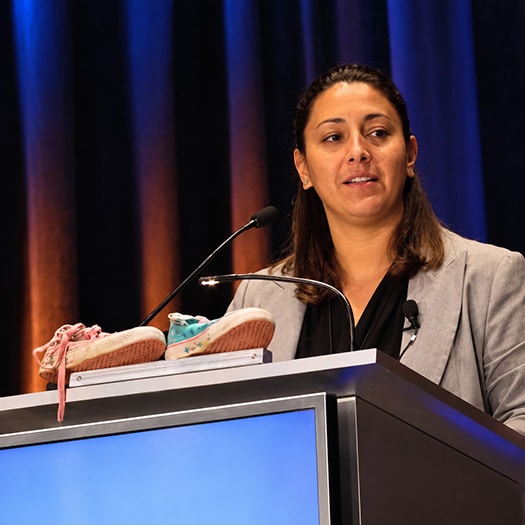
Sayeh Rivazfar speaking at the 2009 AMBER Alert Symposium
Sayeh Rivazfar

The sight of an 8-year-old girl's pink and green Punky Brewster shoes will likely be an image no one will forget from the 2009 National AMBER Alert Symposium. The shoes were worn by Sayeh Rivazfar on September 21, 1988, the night she and her 6-year-old sister, Sara, were abducted by a family friend.

“I'm going to give you the path that these shoes walked in,” Rivazfar told the symposium audience. “I loved those shoes. They were brand new to me. What those shoes went through is an eye opener.”

Rivazfar showed the shoes she wore and described in detail how Ray Wike took the two sisters out into the woods, repeatedly raped her and then slit the throats of both girls. “He told me to say my prayers and took out a knife and began to cut my throat over and over again,” said Rivazfar. Her sister's screams eventually stopped and Rivazfar realized Sara did not survive the attack.

Wike was convicted of the horrific crimes and died in prison. Rivazfar went on to become a New York State Trooper and continues to share her story so more will be done to hold dangerous criminals accountable and protect children. “We can be part of the change, a positive direction in saving our children and turning that criminal system into a justice system that works for us, and not the criminals,” said Rivazfar.

Ron Laney, Associate Administrator at the Office of Juvenile Justice and Delinquency Prevention, thanked Rivazfar for sharing her story with nearly 350 participants at the Tampa symposium on October 27-29, 2009. “We are about bringing criminals to justice,” said Laney. “We need to keep everyone informed and do a better job working together.”

AMBER Alert: A Five-Year Review

Much work has been done since the first National AMBER Alert gathering in Dallas in 2004. Phil Keith, AMBER Alert Training & Technical Assistance Program Director, offered the highlights of the past five years: 495 children have been saved directly from AMBER Alerts, most during the past five years; every state, the District of Columbia, Puerto Rico and the Virgin Islands have adopted AMBER Alert programs and more than 70 local, regional and Tribal plans have been developed; more than 8,200 people have been trained at 159 programs or regional and national conferences; and nearly all of the people trained said they learned something significant, with 75% changing their behavior and their policies in missing and abducted children cases.

“The AMBER Alert Program is working,” concluded Keith.

“When you consider that even one child harmed in an abduction is too many, you can appreciate the magnitude of what you have accomplished working together,” said Mary Lou Leary, Deputy Assistant Attorney General for the Office of Justice Programs. Leary was serving as the Acting Assistant Attorney General and National AMBER Alert Coordinator at the time the symposium was held.

Technology & AMBER Alerts

Technology is rapidly changing the way AMBER Alerts are delivered and received. Bob Hoever, Associate Director of Special Projects in the Missing Children's Division for the National Center for Missing & Exploited Children (NCMEC), shared some of the new methods being used, including more alerts being automatically placed on commercial electronic signs, with Hoever noting it is important to have a good template for alerts and use actual phone numbers because some cell phones do not list letters on the keypad. Social networking websites like Facebook and Twitter are being used to get out AMBER Alerts, and Hoever encouraged AMBER Alert Coordinators to develop their own sites and to discourage the public from distributing what may be phony or outdated AMBER Alerts. The Integrated Public Alert and Warning System (IPAWS) and the Commercial Mobile Alert System (CMAS) are being developed to transmit emergency messages, including AMBER Alerts. Some AMBER Alert partners are using computer pop-up messages, video screens in taxis and restaurants, and automated phone notification plans like “A Child is Missing” to help notify the public.

“Your program should utilize technology, but technology should not run the program,” said Hoever.

Endangered Missing Advisory

Numerous states are also adopting plans to notify the public in cases that do not meet the AMBER Alert criteria. Utah AMBER Alert Coordinator Paul Murphy gave an update on the Endangered Missing Advisory (EMA), an alert that is sent to law enforcement, the media and the public when a person is missing and believed to be in danger. Today 31 states have non-AMBER Alert notification plans, expanding from only five states with plans in 2005.

“The public needs to know law enforcement officers are actively looking for a child even though an AMBER Alert is not issued,” said Murphy. He encouraged AMBER Alert partners to develop a single alert plan that includes all ages before legislators or other government officials create multiple alerts for different ages and circumstances. A Best Practice Guide for EMA's has been written and will be released to AMBER Alert partners after a review has been completed by the Department of Justice.

Child Abduction Response Teams

The Child Abduction Response Team (CART) is fast becoming the best program to make sure every AMBER Alert plan includes a comprehensive recovery plan for child abduction victims. So far more than 200 teams from 43 states, the District of Columbia, Puerto Rico, the Bahamas and Canada have received CART training.

Citrus County Florida Sheriff Jeff Dawsy shared how the CART helped bring every resource possible for the Jessica Lunsford case in 2005. The small agency called out the CART the day after the team had finished its training. CART helped handle more than 3,000 leads and provided search teams in the air, water and ground.

Despite the massive effort, John Coey, a registered sex offender, had taken the nine-year-old girl from her bedroom and killed her. “If a Coey can live in Citrus County, then there is one in every area and they are just waiting to abduct a child,” warned Dawsy.

During a CART workshop, Utah CART Commander Jessica Farnsworth shared how an activation for a child abduction convinced her that 36 members were not enough for a team. She developed a new organizational chart and began recruiting between 160-200 members from numerous agencies for the Utah CART. “It is better to split up the team into two so half the team can trade off every 12 hours and keep everyone fresh,” said Farnsworth.

The Role of Broadcasters

The symposium also highlighted the roles of broadcasters and the media in bringing abducted children home. Andy Hill, Media Relations Sergeant for the Phoenix Police Department, said that it is important to keep the focus on the child during an AMBER Alert. “While the media is required to report on an AMBER Alert, focus is often fixated on how the case is handled rather than the case itself,” said Hill.

Lucy Caldwell, Public Information Officer for the Fairfax County, Virginia, Police Department, said one of the most important things to do during an AMBER Alert is to express empathy. “The community must know the agency cares before they begin to care what the agency has to say,” said Caldwell.

Caldwell offered these tips for public information officers during alerts: acknowledge uncertainty and do not oversell what your agency can accomplish, explain that a system is in place to find information when answers are not immediately available, and acknowledge people's fears and give the public a way to help.

“Ultimately, the public wants to know how they can protect themselves and their family,” added Caldwell.

Best Practices

The symposium also offered best practices to be considered for every AMBER Alert plan. The AMBER Alert Coordinator must make sure all partners are on board before, during and after an alert. Tips offered to AMBER Alert Coordinators during an activation included giving a heads up to media that an alert is going to be initiated, calling for a CART as quickly as possible, making themselves available to answer AMBER Alert questions, not second guessing an activation or caving to pressure from the media or public, and keeping the focus on finding the child while letting the public know everything possible is being done to bring the child home.

After the alert, formal reviews should be held with the initiating law enforcement agency and key AMBER Alert partners to find areas of strength and places for improvement in each plan. “One of the reasons you've been so successful is that you are constantly looking for ways to improve your response to children in danger,” noted Deputy Assistant Attorney General Mary Lou Leary. “You've made America a safer place for our children.”

Partners Against Crime: NCMEC & 911 Call Centers

NCMEC has created a new program to help telecommunicators respond better to cases involving missing and sexually exploited children. The “911 Call Center Partner Program” allows call centers to become partners by making a commitment to following best practices in training and policy.

Call centers become NCMEC partners by adopting the ANSI-approved “Standard for Calltakers when Handling Calls Pertaining to Missing and Sexually Exploited Children,” completing NCMEC training and then providing the training to all call takers, and implementing a formal, measurable, quality-assurance process for all calls involving missing and sexually exploited children.

“Time is the enemy in the search for a missing child, and 911 call centers are critical to a fast response because they are often the first to know when a child is in trouble,” said Ernie Allen, president and CEO of NCMEC. “That is why collaborating through our 911 Call Center Partner Program is a vital step in making sure we are all working together to help protect our children.”

As a NCMEC Partner, a call center will become part of the NCMEC family and receive preference for training and participate in development of training and testing new approaches to finding missing children as quickly as possible.

Why Victims Don't Always Flee

Lyndsey Ryan was 14 years old when she ran away with a 56-year-old convicted sex offender. She left with him after a long-term online relationship and secret meetings in person. The man threatened to kill her family if she tried to leave or disobey him. He also terrorized her by driving by homes and giving graphic details about how he had abused other boys and girls.

“Giving in to him is what I had to do to survive for what I had brought upon myself,” said Lyndsey. “I would not have left compliantly if I wasn't in fear.”

When Lyndsey finally did leave, she said the justice system treated her like a criminal. The public offered no sympathy because she went with him “willingly.” Social workers put her in a lock down facility for four and one-half months. “I couldn't tell people what happened without being judged,” she said.

“She was hardened, bitter and alienated,” said Carol Ryan, Lyndsey's mother. “She was determined to take care of herself because no one else did.” The mother and daughter shared their story at the 2009 National AMBER Alert Symposium so other victims can get help without judgment. “It's my hope that you treat the next compliant victim with love and respect,” added Carol.

One of the world’s foremost experts on mind control also spoke at the conference and explained how child abductors convince victims to stay. Licensed Mental Health Counselor Steve Hassan said captors instill false beliefs and fear to gain control of the victim.

“A person under mind control can't visualize being away from the captor and being fulfilled,” said Hassan. “There are tricks that are so slick or subtle that unless you know about it you are a sitting duck.”

Hassan uses the BITE model to explain the four areas where a captor will try and control a person: Behavior, Information, Thoughts and Emotion. Hassan recommended building trust, gathering information and strategically planting doubts to help a victim gain back control. “You ultimately want the person to empower themselves to take time away from their captor,” said Hassan.

If a child has been abducted, Hassan warned law enforcement and families from attacking the suspect in public. Instead, he suggested convincing the captor that you want to work with him to help the child. “They (captors) want to believe they are great,” said Hassan. “You play to their ego to help bring your child home.”

Eventually Lyndsey Ryan was able to get counseling to deal with the issues of running away with a sexual predator. She has reconciled with her family, and she is now serving in the military. Lyndsey said Hassan's presentation made a lot of sense with her own experience and hopes others will be less judgmental towards victims who do not flee. “I think predators have the ability to manipulate,” said Lyndsey. “More understanding is needed about mind control.”