

Electronic signs in Arlington Heights, Illinois, are now using Artificial Intelligence (AI) so AMBER Alerts, tornado warnings, and other public emergencies will take precedence over any other messaging. The signs will soon be used in smart cities, convention centers, and airports.
 Vicky Orozco put her 8-month-old son, Carlos, in his car seat so he could nap while she took a shower. When she returned a short time later, her son was gone.
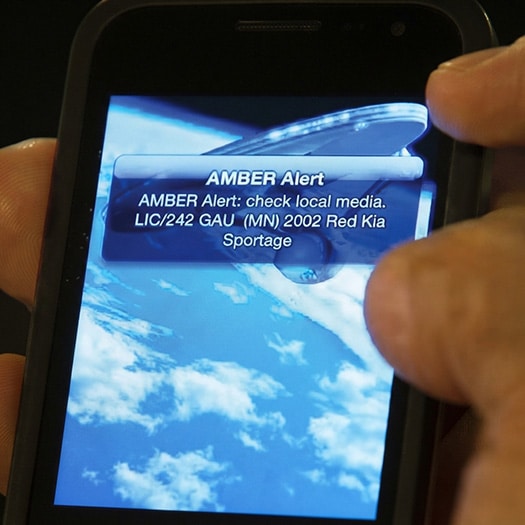
Shortly after noon on February 20, 2013, the Minnesota Bureau of Criminal Apprehension issued its first AMBER Alert that included the new Wireless Emergency Alert (WEA) to help notify the public. WEA sent the alert to nearly every cell phone in Minnesota.
The alert included information about a female acquaintance who police suspected had abducted the child and the car she was reportedly driving. Like thousands of other people, teenager Daisy Buenrostro was surprised to see the alert on her phone. Buenrostro also spotted the suspect's car across the street and checked the license plate to make sure it was the right one.
“I was so shocked,” she told a reporter. “I was like, ‘This is the car.’ So, I ran back inside the house and told my dad.”
The teen and her father called 911, and within minutes after the alert was issued, the suspect was in custody and the baby was home safe with his mother. It also is the first AMBER Alert success story directly linked to WEA.
“The AMBER Alert was a success. It was an excellent use of the new cell phone technology,” noted Minnesota AMBER Alert Coordinator Janell Rasmussen. “I cannot tell you how many people were talking about the alert. The media was going crazy and everyone was talking about it on the social media. They were giddy to get this information. We had no complaints about this.”
The Wireless Reach
 More people than ever can now receive an AMBER Alert. Beginning January 1, 2013, the alerts reach 97% of all people in the area where the child has been abducted through the WEA which is also called the Commercial Mobile Alert System (CMAS).
The Federal Emergency Management Agency (FEMA) operates WEA and distributes alerts from authorized government agencies about emergency situations to customers with capable mobile devices.
The messages supplement the existing Emergency Alert System which broadcasts alerts over radio and television. FEMA worked with the Federal Communications Commission, U.S. Department of Justice (DOJ), and the National Center for Missing & Exploited Children (NCMEC) to expand the alert system to include AMBER Alerts. WEA is also used for National Weather Service, Presidential, and Imminent Threat Alerts.
Wireless Beginnings
Some state AMBER Alert programs included the ability to send alerts to cell phones as far back as 2002. In May 2005, a voluntary partnership between the wireless industry, DOJ, and NCMEC started the national Wireless AMBER Alert Initiative to provide alerts to cell phones in all 50 states.
The program distributed Wireless AMBER Alerts to more than 700,000 cellular subscribers who signed up to receive the messages. The initiative also brought awareness to the AMBER Alert Program through public service announcements and press events.
However, people had to register their phones to get the alerts, and one could choose to be notified in only five zip code areas. For example, if you lived in Utah and were vacationing in Florida, you would receive an AMBER Alert for Utah, but you would not get an alert issued in Florida.
“It made sense to send a succinct text message to alert users so they would be on the lookout for the kidnapped child and abductor in their area,” said Steve Largent, president and CEO of CTIA-The Wireless Association and president of The Wireless Foundation. “The WEA AMBER Alerts will be an even better tool to help find abducted children.”
Bigger but Focused
The new alert system was developed with lessons learned from the AMBER Alert Program. WEA uses a channel called Cell Broadcast and is not affected by congestion on voice or SMS text channels. The alerts are targeted to cell towers instead of relying on zip codes. If you have a mobile device in the area where the alert is issued, you will automatically receive the alert. Unlike a text message, the alert will pop up on the screen of the wireless device.
“Wireless AMBER Alerts were an important evolution of that program, and we are grateful to those who made it possible,” said John Ryan, NCMEC CEO. “They understand that the eyes and ears of many are better than the eyes and ears of few when a child's life is at stake.”
The new system means the people who can actually do something about an abducted child will get the alerts. However, 3% of phones are not equipped to receive the alerts. The goal of the wireless industry is to have all phones compatible with the system by the end of 2013.
Louder but Shorter
The new AMBER Alerts include a loud, audible tone. The first AMBER Alert in Florida using the new system went out at 1:45 a.m. on January 14. A 2-year-old girl was missing, and her bedroom window was open. The alert went out statewide, and some people were upset that a generic message that said a child had been abducted had awakened them.
Florida AMBER Alert Coordinator Jessica Davenport and most people did not know the alert would include an audible tone that went out to everyone in the state. Davenport worked with NCMEC to change how the alert is used. The state's temporary policy now states that alerts will only go out to specific regions, and WEA will not be used for alerts between 10 p.m. and 7 a.m.
“We have a large population of older folks,” said Davenport. “As long as we use it conscientiously, we should be able to reach a lot of people.”
Davenport also decided not to use WEA unless they have vehicle information. In this case, the missing girl was found safe 15 hours later in a field a half mile from her home.
Developers of the WEA system included a tone with the alerts so people would know they may be in danger when receiving a National Weather Service, Presidential, or Imminent Threat alert. Because of the loud sound, NCMEC is also recommending that WEA should not be used between 11 p.m. and 6 a.m.
“If we have people opt-out, then we may never get them back,” said Bob Hoever, Director of Special Programs in the Missing Children Division at NCMEC.
NCMEC is also asking AMBER Alert coordinators to notify NCMEC about how they want to use WEA. Coordinators need to decide if there are times that WEA would not be used and if the alert is going statewide or to specific regions. NCMEC should be informed about these details.
“You should not be deciding about your maps in the middle of an AMBER Alert,” warned Hoever. “Proper planning is the key.”
The new alerts are limited to only 90 characters, including spaces. The alerts cannot contain photos, web links, or phone numbers. To make WEA a more effective tool, NCMEC suggests that it should not be used if authorities do not have vehicle information or very specific information about the child.
“If you are going to put out generic information, you better put your call center on nuclear power because you are going to get swamped with generic leads,” said Hoever. “The information in the alert has to be meaningful.”
Public Awareness
Unless they have received an alert, most people still do not know about WEA. NCMEC is encouraging AMBER Alert coordinators to talk to the media and let the public know what has changed with AMBER Alerts.
“I think there is a critical need for all of us to educate the public on what these alerts can do and where they can receive information,” said Hoever.
Florida is already developing a public relations campaign. “I think the ability to reach a wider number of people will be very useful,” said Davenport. “We want to make sure everyone knows what the new alert is and how to use it.”
Minnesota's first AMBER Alert involving WEA sparked immediate interest from the media. Rasmussen's only regret is that she did not educate the public before the first alert using WEA went out.
“The alert was shocking to some people. Some people were driving, and they had never heard that type of tone in their car,” said Rasmussen. “I think everyone should put together an education plan because the media will be very excited about it.”
NCMEC is offering webinars to teach AMBER Alert coordinators about WEA. Coordinators can also direct the public to detailed information on how the new alerts work and how to respond, available through NCMEC, the U.S. Department of Justice, FEMA, and the wireless industry's consumer information pages.