

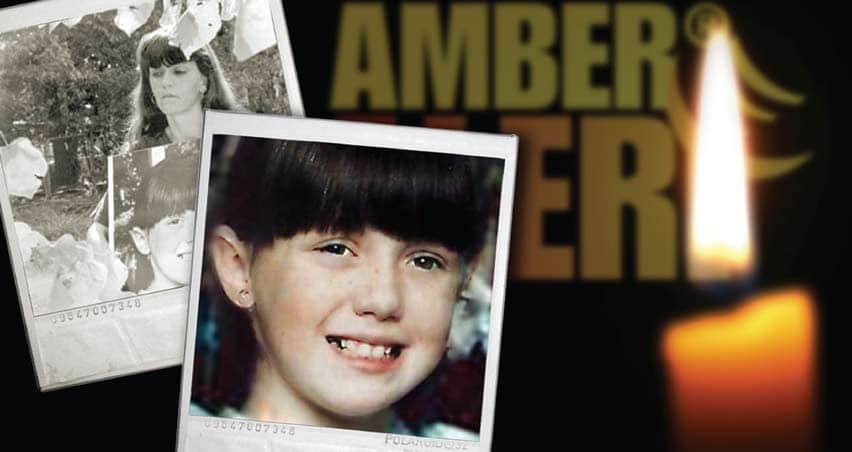

Two phone calls, one letter, and perhaps some divine intervention was all it took to get the AMBER Alert Plan started, according to Diana Simone. When the Fort Worth mother heard that the body of 9-year-old Amber Hagerman had been found, she was overcome with grief. Amber was murdered after someone in a truck grabbed her from her bicycle on January 13, 1996.
“It was devastating to think she was kidnapped in broad daylight,” said Simone. “It's impossible to me that you can drive in a densely populated area and not be seen. The problem isn't that no one saw them but that no one knew what they were seeing.”
Simone remembered being in Israel a decade earlier when a 3-year-old American girl went missing. The child's mother was hysterical, but an Israeli woman told her to sit down and have some coffee because her child would be returned shortly.
Simone heard people walking through the crowds giving the description of the missing girl. Within minutes the child was found. Simone thought Americans would also care and respond to a missing child, but they needed a tool to communicate. After hearing about Amber's death, she thought cell phones might be the best way to alert the public.
She shared her inspiration for an alert with Rev. Tom Stoker, a Baptist Church music minister. “How about the radio?” Stoker asked. “Do you think they would do that?” Simone replied.
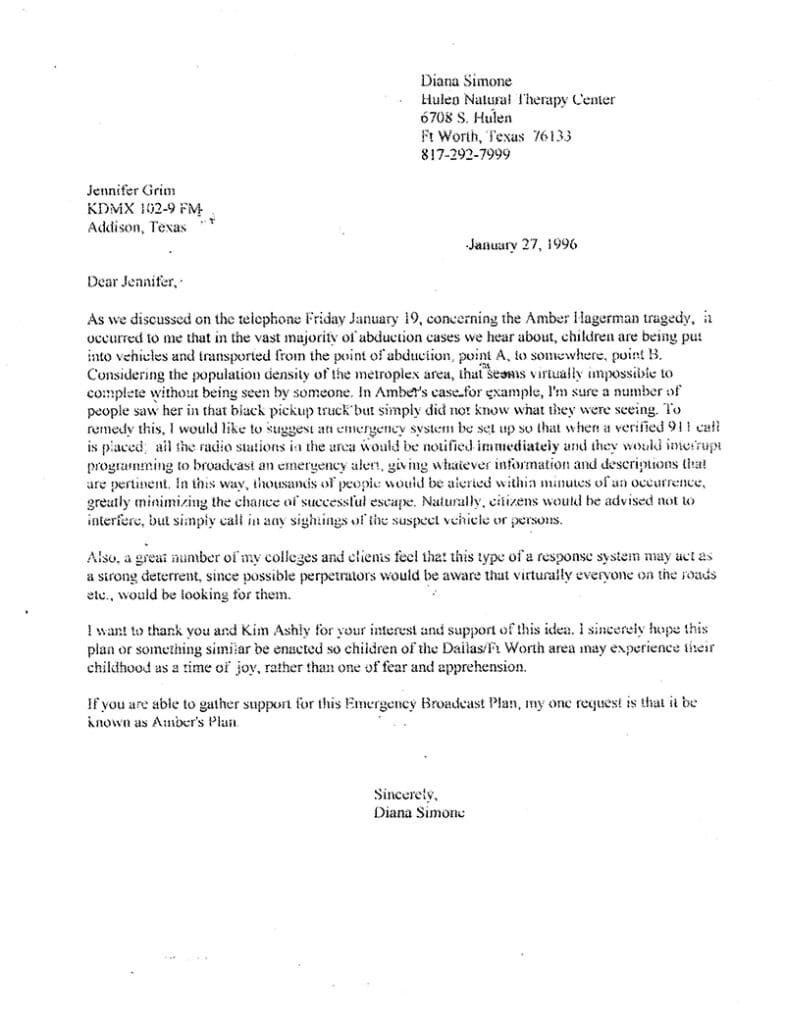
Later that same day, Simone called her favorite radio station, KDMX, and presented the idea of a “broadcast alert” for abducted children to midday host Kim Ashley. Ashley jumped on the idea and convinced Simone to call station manager Jennifer Grimm. The station manager asked Simone to write a letter with details of the plan.
Simone wrote, “I would like to suggest an emergency system be set up so that when a verified 911 call is placed, all the radio stations in the area would be notified immediately and they would interrupt programming to broadcast an emergency alert, giving whatever information and descriptions that are pertinent ... My one request is that it be known as Amber's Plan.”
Grimm then brought Simone's letter to the Radio and TV Managers Association in Fort Worth. WBAP News/Talk 820 Operations Manager Tyler Cox loved the idea, and he went to work with other broadcasters to start it.
“It's truly an example of people putting aside their differences and something cool happening,” said Cox. “When it came to this, we were of one mind.”
Cox contacted Dee Anderson, the public information officer for the Arlington Police Department, the agency that was investigating Amber Hagerman's murder. Together they developed criteria for the alert: the child must be 15 years old or younger; law enforcement must believe the child has been abducted or missing with the threat of serious bodily injury or death; and enough information must be available for the public to help.

Mark Simpson, the former Arlington, Texas Police Sergeant who supervised the case, explained that the age was chosen, “because you can get a hardship driver's license in Texas at 15, and they can take better care of themselves. We also thought it would limit the number of AMBER alerts.”
The AMBER Alert Plan allowed every law enforcement agency to determine the criteria and issue the alert. The agency would send a fax to dedicated fax machines at the two primary Emergency Alert System (EAS) stations in Dallas-Fort Worth. The stations in the area divided themselves up and re-transmitted the information so every broadcaster would receive the AMBER Alert and broadcast the alerts every 15 minutes. Simpson said the “most obnoxious tone possible” was used to begin every alert so everyone would take notice.
“The system is so simple and easy to run and maintain. It doesn't cost taxpayers one plug penny,” said Cox. “This is something we can do to do good in the community at no financial resource risk to anyone. Radio is in business 24 hours a day, police run 24 hours a day, and people find children, end of story.”
Everyone had high hopes, but the AMBER Alert did not work the first time. It did not work the second time either. Some people were prepared to scrap the whole idea if it did not work the third time. The third AMBER Alert was issued in November 1998 for 8-week-old Rae Leigh Bradbury. The child's parents called the Arlington Police Department at 10 p.m. after the babysitter did not bring her home at 5 p.m.
Sergeant Simpson was called in to investigate, and he learned the babysitter had a crack habit. He feared the baby would be traded for drugs or be left out in the cold. The AMBER Alert was activated at 7:00 a.m. the next morning. Thirty minutes later a motorist called 911 and said he spotted the suspect driving a Ford truck. Officers from the Grand Prairie Police Department stopped the suspect and safely recovered the child.
“Up to that point, I didn't have any clues where she was,” said Simpson. “The AMBER Alert allowed us to recover the child. This is a good example of how the AMBER Alert works and the power it has.”
Soon, other law enforcement agencies started asking about the new AMBER Alert Plan. “We really didn't think it would get so big,” said Simpson. “It just caught on.”
But Cox believed the idea would spread. “We thought we had something here,” he said.
He knew the AMBER Alert had arrived when it was part of a television police drama. “I nearly fell out of my chair. The AMBER Alert had become a household name.”
Diana Simone said she also expected the AMBER Alert to have a big impact. “I believe in the goodness of people, and if it works here, it can work anywhere.”
The AMBER Alert eventually became a national initiative and an acronym: America's Missing Broadcast Emergency Response. More than 500 children abducted in the United States have been recovered through AMBER Alerts. AMBER Alert Plans are sprouting up all over the world. The alerts now go out on radio and TV, highway signs, and many other ways, including Simone's original idea, cell phones.
The success of the AMBER Alert led several people to claim to have invented it. These claims trouble the broadcasters and law enforcement officers who helped set up the first AMBER Alert Plan.
“No one involved took credit because everyone looked at it as a collaborative effort,” said Simpson. “If there was ever a multi-agency effort to do something for kids, this is it.”
“If you feel you have to claim you originated the AMBER Alert, then your heart wasn't with it in the first place,” added Cox. “This was truly a collaborative effort and it needs to be remembered that way.”
Even Simone said the credit should go to the people who continue to use the AMBER Alert to save children. “They are the heroes. Without the men and women looking for children it would be completely ineffective.”
The Letter That Launched AMBER Alert
 Diana Simone
Hulen Natural Therapy Center
Ft. Worth, Texas
January 27, 1996
Jennifer Grim
KDMX 102-9 FM
Addison, Texas
Dear Jennifer,
As we discussed on the telephone on Friday, January 19, concerning the Amber Hagerman tragedy, it occurred to me that in the vast majority of abduction cases we hear about, children are put into vehicles and transported from the point of abduction (point A) to somewhere else (point B). Considering the population density of the metroplex area, that seems virtually impossible to complete without being seen by someone. In Amber’s case, for example, I’m sure a number of people saw her in that black pickup truck but simply did not know what they were seeing.
To remedy this, I would like to suggest an emergency system be set up so that when a verified 911 call is placed, all the radio stations in the area would be notified immediately. They would interrupt programming to broadcast an emergency alert, giving whatever information and descriptions are pertinent. In this way, thousands of people would be alerted within minutes of an occurrence, greatly minimizing the chance of a successful escape. Naturally, citizens would be advised not to interfere, but simply call in any sightings of the suspect vehicle or persons.
Also, a great number of my colleagues and clients feel that this type of response system may act as a strong deterrent, since potential perpetrators would be aware that virtually everyone on the roads would be looking for them.
I want to thank you and Kim Ashly for your interest and support of this idea. I sincerely hope this plan or something similar be enacted so children of the Dallas/Ft. Worth area may experience their childhood as a time of joy, rather than one of fear and apprehension.
If you are able to gather support for this Emergency Broadcast Plan, my one request is that it be known as Amber’s Plan.
Sincerely,
Diana Simone