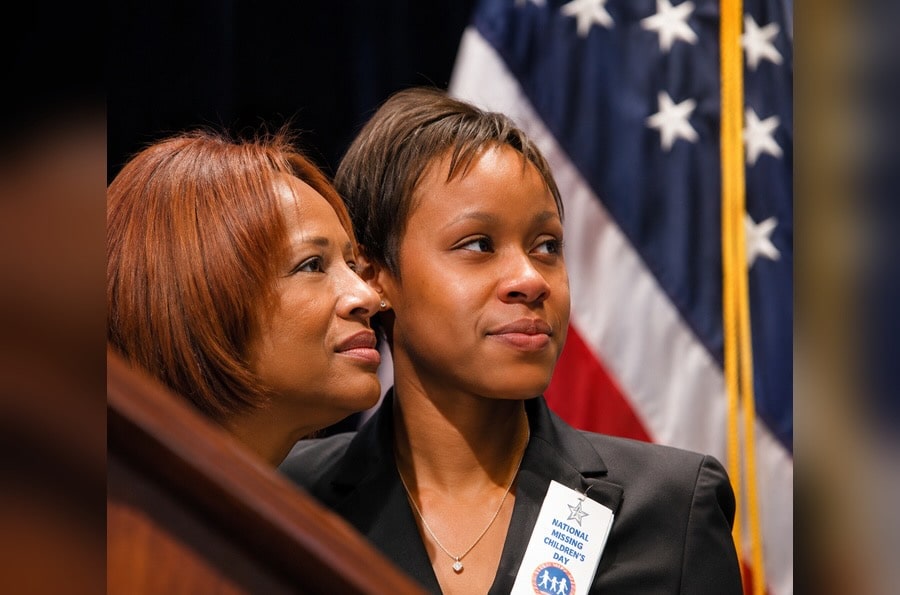
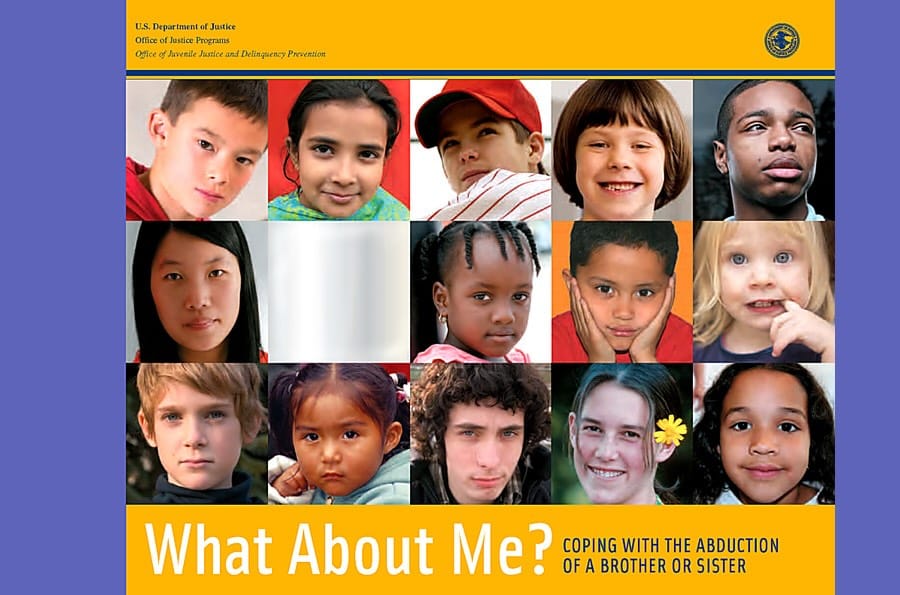
When an AMBER Alert goes out everyone's focus is centered on the missing child. The victim's siblings are often forgotten. A new guide “What About Me? Coping With the Abduction of a Brother or Sister” will help people remember the other victims of an abduction. The U.S. Department of Justice released the guide at the 2007 Missing Children's Day ceremony.
“We know it will hit the mark because it was written by kids who have already suffered this way,” said Attorney General Alberto Gonzales. “They know what it feels like. They know the emotions that well up. They know the questions that need to be answered.”
The guide explains what to expect from law enforcement, the media, school and work and how to adapt to “A New Normal”—because nothing will ever be exactly the same again after a brother or sister is kidnapped. It also has a list of where to find more help, puzzles and places to write or draw.
A message is included from the brother and two sisters of kidnapping survivor Tamara Brooks. “What you feel is valid and important; please don't let anyone tell you otherwise,” wrote Ericka, Marcus and Robin. “Remember these things: take care of yourself, find someone you can talk to. And remember you are not alone.”
National AMBER Alert Coordinator Regina B. Schofield wrote the preface for the guide and offered the opening comments in the video. “I hope that you know that people care, that you'll have resources at your fingertips. We care that you'll be able to put back pieces of your life, knowing that one piece will always be missing.”
Both the guide and the video rely on the words and emotions of siblings who lived through the abduction of a brother or sister. The interviews are touching and sometimes raw. Nearly everyone at the initial screening was moved to tears. Here is a sample of some of the comments:
“I think the most difficult part for me was I could see people feeling sorry for me, and I didn't want them to. It's very hard to have somebody look at you and not know what to say. Just try to be really strong.” — Amy
“Even though the attention is focused on your brother or sister, you are still an individual, you have feelings and you have a right to feel those feelings. And that is okay. You're not the only one who's feeling them, and there are people out there who will be willing to listen.” — Erika
“You just have to wake up and realize you just have no choice but to be okay. You can't do anything else. At least that's how I kind of live my life. I don't have any other option but to be okay.” — Carmen
The guide and video were produced by the U.S. Department of Justice and are available through the U.S. Department of Justice, Office of Justice Programs. Find the guide at https://ojjdp.ojp.gov/sites/ojjdp/files/media/document/217714.pdf.