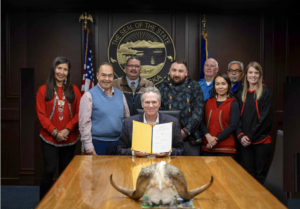

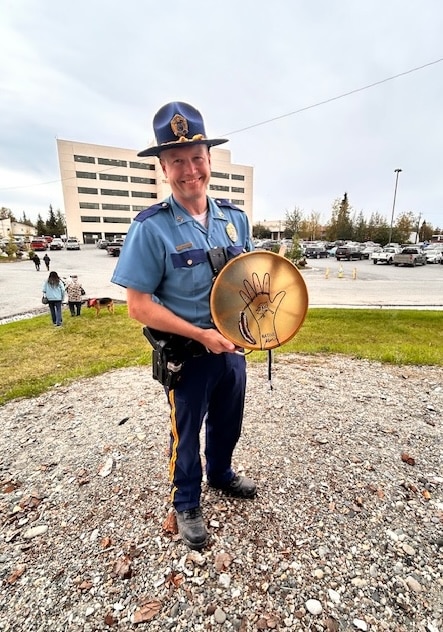
Members of AATTAP’s AMBER Alert in Indian Country (AIIC) team attended a powerful missing and murdered Indigenous persons (MMIP) memorial bench dedication in Fairbanks, Alaska, hosted by the Tanana Chiefs Conference. The event brought together families, Tribal leaders, and community members to honor the lives of those tragically taken or still missing. The dedication included heartfelt speeches and the reading of 48 names, each one representing a person, a story, and a life stolen. “We are committed to working with our partners to ensure that every community has the resources to respond swiftly when a child goes missing and to honor those we’ve lost by protecting those still with us,” said AIIC Program Manager Tyesha M. Wood. Added AATTAP Administrator/National Criminal Justice Training Center Director Janell Rasmussen, “Being surrounded by families and communities who carry such a deep pain and resilience is a powerful reminder of why we do this work.”

Draft legislation by Alaska Senator Lisa Murkowski—the federal Native Children’s Commission Implementation Act of 2025—calls for increased funding and new programs aimed at improving the well-being of Indigenous children and their families. It also seeks to address a wide range of issues including health, housing, and education. Public feedback on the proposal closed this fall, and will be incorporated in the draft bill expected to be introduced on the U.S. Senate floor at some point in 2026. “I look forward to hearing from Tribal leaders, advocates, and non-profits supporting Native families as we work to improve policies that directly impact their communities,” said Murkowski, chair of the U.S. Senate Committee on Indian Affairs. Millions of dollars are proposed for Tribally run child welfare and juvenile justice programs, as well as culturally appropriate mental health and substance use services. Proposed initiatives include Tribal advisory committees on juvenile justice and maternal health; a nationwide examination of the number and status of all missing Indigenous children cases; and an Office on Native Children at the Department of the Interior, which would, in part, serve as a clearinghouse for federal data and grant opportunities.

Alaska is ushering in the new year with an increased focus on the Missing and Murdered Indigenous Persons (MMIP) crisis. New legislation signed by Governor Mike Dunleavy requires Indigenous cultural training for new police officers, an assessment of the Department of Public Safety’s investigative resources for reporting MMIP cases, and the establishment of a commission to review and report on unsolved cases. Deilah Johnson, an advocate with the Village of Solomon Tribe, calls the commission a much-needed step. “At the state level, there was just not a lot of discussion or acknowledgment in addressing any of the overwhelming statistics surrounding the issues facing Indigenous populations, specifically women and young girls,” Johnson said. The nine-member commission, which includes seats for victim advocacy and Alaska Native Tribal organizations, will report findings to the Alaska Legislature. Johnson hopes the new measures will continue to generate awareness about MMIP and inspire partnerships to build additional resources.