


By Jody Garlock

Fred Rogers’ famous advice to “look for the helpers”—intended to steer children toward safety in times of chaos or tragedy—has endured for decades. And Morrissa Ahl-Moyer definitely falls into the category of a helper. Her 20-plus years in public safety took her from being a volunteer first responder, to a 911 telecommunicator, and now, Director and Clearinghouse Manager of the North Carolina Center for Missing Persons (NCCMP), a division of the state’s Department of Public Safety based in Cary. The NCCMP receives more than 10,000 missing persons reports annually.

“I’ve always been a helper of sorts with my career choices,” says Ahl-Moyer, whose job includes being North Carolina’s AMBER Alert Coordinator (AAC). “For me now, it’s getting to make sure troopers and dispatchers have what they need.”

Since stepping into her role in June 2023, Ahl-Moyer has stepped up NCCMP’s training, including working with law enforcement authorities to ensure they understand the state’s AMBER Alert process and the online portal.

Her outreach during her first year on the job included hosting a missing persons resources class in her hometown of Dunn, North Carolina, where she started as an EMT. To her surprise, more than 200 officers and public safety personnel showed up for the event.

“It confirmed I was on the right track,” Ahl-Moyer says. “It’s training we need, and we need to do more of it.”

That message is something she champions whether she’s training law enforcement or participating in or attending state and national conferences.

We caught up with Ahl-Moyer when she was in another form of helper mode: voluntarily working night shifts at a communication center to lessen the load on 911 telecommunicators handling calls after Hurricane Helene’s destruction in western North Carolina.

Photo of Morrissa Ahl-Moyer, Director/Clearinghouse Manager for the NC Center for Missing Persons
Quote icon

Telecommunicators tend to be overlooked in the [AMBER Alert] decision-making process, but they can be the best source of information. They’re truly the ‘first’ first responders—the ones who get the initial call when a child goes missing. And often they have the knowledge to say, ‘Hey this might fit the criteria for an AMBER Alert.’
Morrissa Ahl-Moyer Director/Clearinghouse Manager, North Carolina Center for Missing Persons
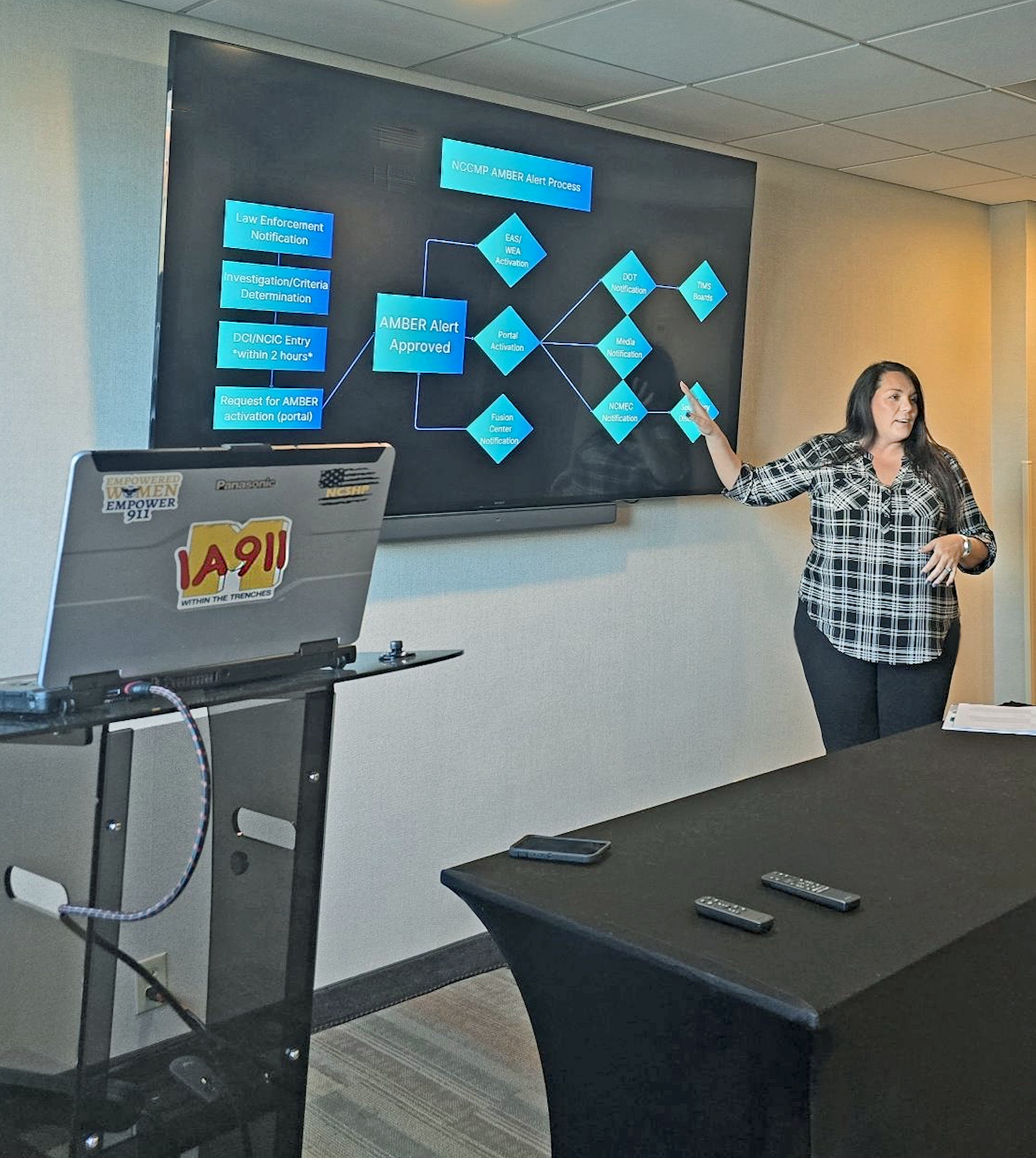
Morrissa Ahl-Moyer uses a flow chart during a training session to show the steps in activating an AMBER Alert. “I tell them the part on the left is what they need to worry about, and I handle everything else,” she says.

Morrissa Ahl-Moyer uses a flow chart during a training session to help participants visualize the steps in activating an AMBER Alert: “I tell them the part on the left is what they need to worry about, and I handle everything else.”

How does having 911 telecommunicator experience inform your AMBER Alert Coordinator (ACC) work?
As a telecommunicator who answered after-hours calls for NCCMP, I had a basic knowledge of how the alert process worked, the criteria, and the information needed before we contacted the AMBER Alert Coordinator for approval. I also recognized a knowledge gap. Most of the agencies had never requested an AMBER Alert before and weren’t sure of the process. This was further exacerbated when there was a transition from faxing forms to an online portal. I’ve been working to ensure everyone knows how the process works.

How do you help people understand AMBER Alerts and other endangered missing advisories?
Training is everything. It’s vital in our line of work. That’s why I’ve conducted sessions at symposiums, the state’s 911 Conference, local law enforcement agencies, communication centers, and more. Doing so gets important information out to those who need it the most. I go over the basic criteria for issuing an AMBER Alert and give them an overview of the process. Beyond discussing the essentials, getting out and meeting people gives me the chance to say, “Here’s my cell phone number. Even if you think a case doesn’t meet our AMBER Alert criteria, let’s talk about it.”

After transitioning from 911 to ACC did you experience any challenges?
Understanding the technical side of IPAWS [Integrated Public Alert & Warning System] was an initial hurdle. Luckily, one of the on-call team members is a guru and has helped me learn more about it. In my previous role, we would only do the EAS [Emergency Alert System]—and we were done. I’ve now realized that it’s so much deeper than that. I’m still learning it all.

What’s new with NCCMP in terms of projects you’re working on?
One project is that we’re in the building phase of a missing child repository. It will update weekly from the NCIC [National Crime Information Center] files, but it also gives me the option of real-time manual entry. If a missing child doesn’t meet AMBER Alert criteria, I can put the word out and it will send a media notification. It will increase awareness when every minute matters. It’s a first for our state, and I’m excited about it.

What issues regarding missing children concern you the most?
Human trafficking is a major problem. I really was blinded to it before coming into this role. It’s scary to see how easy it can be to end up in trouble, especially when there are so many at-risk young people across the nation. Online enticement is another growing concern. I’m also seeing that 15-year-old minority females are reported missing more than any other demographic, which needs more of our research and understanding.

Illustration of lightbulb for "bright idea" call-out

Bright idea: A training test page is available on the NCCMP website. An agency can “fake enter” an AMBER Alert without actually activating it as a way to become familiar with the intake process.

Calling All 911 Telecommunicators

911 Dispatcher working at a computer with 8 screens of informationAATTAP’s course, 911 Telecommunicators and Missing & Abducted Children (“911 T-MAC,” for short) is essential not only for law enforcement and public safety telecommunicators but also for any members of law enforcement and support staff who address public calls for help.

The interactive training session equips 911 telecommunicators with needed skills and resources by:

  • Analyzing real cases to recognize various types of missing child incidents and how they are reported.
  • Exploring optimal practices using systems and standards from the National Crime Information Center (NCIC) and the Association of Public-Safety Communications Officials (APCO ANS 1.101.4-2022).
  • Addressing resilience-building strategies to cope with emotionally demanding cases.

The course represents a full update of AATTAP’s “Telecommunications Best Practices for Missing and Abducted Children” (TELMAC) class, which launched in 2010 as both a classroom offering and as a self-paced online class.

The 911 T-MAC class launched this past fall in Appleton, Wisconsin, where more than 60 telecommunicators from around the country attended the pilot training session.

“The amount of information presented during the class was perfect,” one participant said. “It was all presented in a way that wasn’t overwhelming, but engaging and easy to understand.”

The class will be offered in person and online starting this spring. Watch for training opportunities at bit.ly/911tmac.

 

Illustration of an anonymous girl sending a 911 text

A teenage girl abducted and trafficked from Mexico was safely recovered after sending a series of text messages in Spanish to a 911 telecommunicator in California. About 20 minutes after her pleas for help came in, Ventura County Sheriff’s Office deputies safely recovered the frightened girl, who was believed to be no older than 17. The case highlights the effectiveness of allowing text messages to a call center and using integrated translation technology to bridge language barriers. “Young people text—that’s how they communicate,” a Sheriff’s Office spokesperson said. “So her first instinct is to text. Well, she texted 911 and … that works.” The girl, who had no idea where she was when she was able to quietly gain access to a cell phone in the early morning hours, identified landmarks that led deputies to her. A subsequent investigation revealed she had been trafficked from Mexico two months earlier. She provided information that led to the arrest of a 31-year-old man from Veracruz, Mexico, for human trafficking and luring, among other charges.

AI-generated photo illustration of two boys in a swampy forest using a cell phone to find help
Staff illustration

By Rebecca Sherman

David Boots, Battalion Chief of the Denton, Texas, Fire Department, was at home listening to radio communications when the call went out. It was 8:30 p.m. on June 5, 2024, and the sun was beginning to set. Two teenage boys on bikes were stranded deep inside Denton’s Greenbelt Corridor, a 20-mile, heavily forested nature trail connecting the Ray Roberts Dam with the headwaters of Lake Lewisville.

Chief Boots felt a knot in his stomach. He knew the area well; the department had rescued hikers who had become lost on the trail before, but this time was different. Storms earlier in the week had created treacherous flooding conditions that forced the closure of the Greenbelt. 

Getting the teens out in the dark would be difficult and risky, not only for them, but also his rescue teams. Worse still was the news that high winds and torrential rains would soon be barreling in from Oklahoma. “A flooded greenbelt is not a good place to be during a storm,” Boots says.

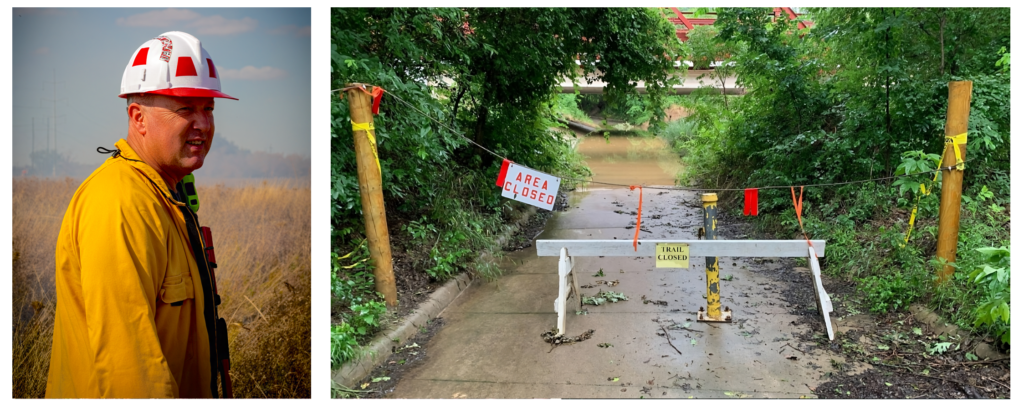
One photo showing Denton, Texas, Fire Department Battalion Chief David Boots. The other photo showing a flooded section of the north Texas Greenbelt Corridor.
Top left: Denton, Texas, Fire Department Battalion Chief David Boots. Top right: A flooded section of the north Texas Greenbelt Corridor.

Thankfully one of the teens had a cell phone with him. And the Denton Police Department had access to what3words, a revolutionary new geolocation tool.

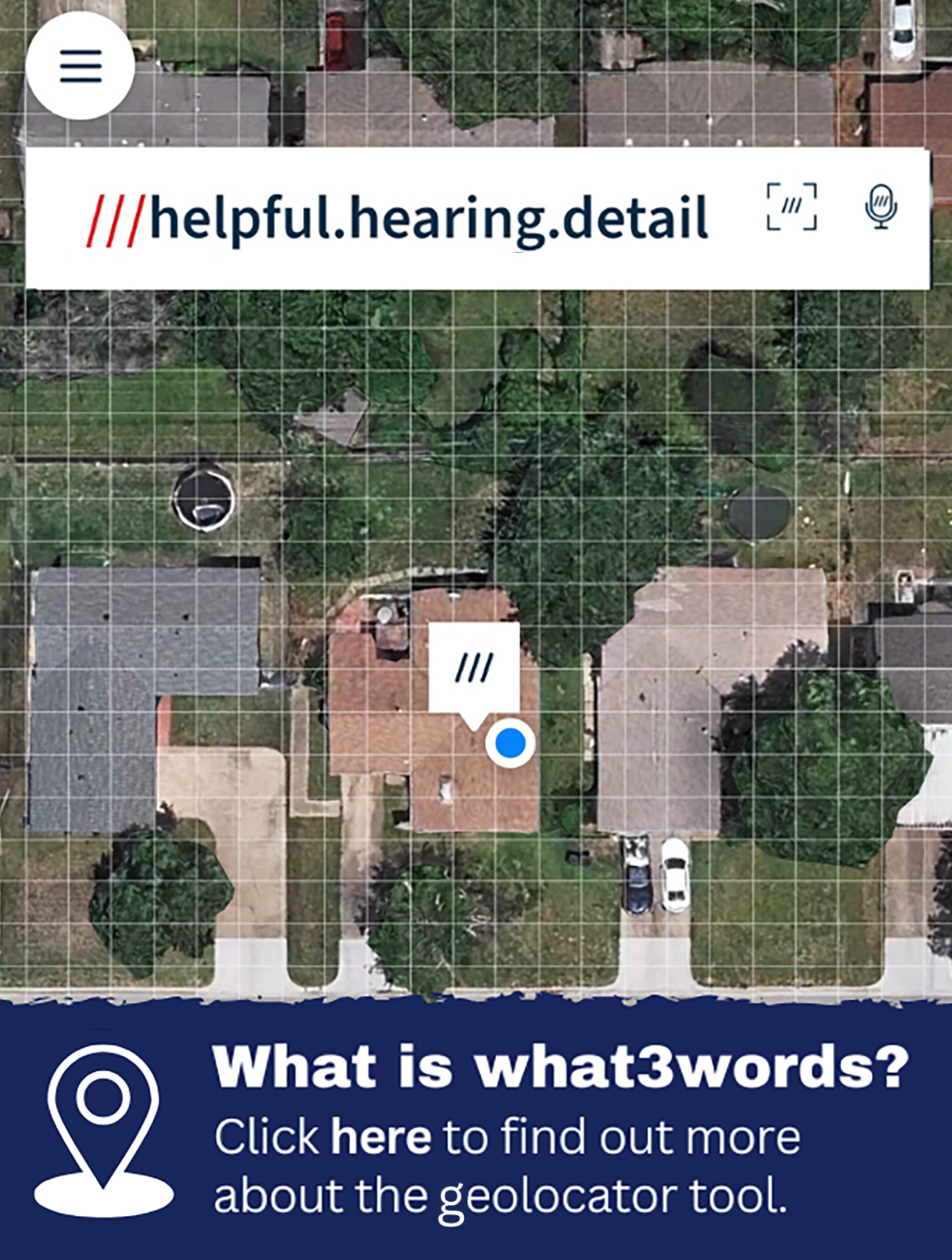
Image of screen with what3words app in use, with embedded URL link to more information.A Call for Help

The boys’ day had begun well enough, with sunny skies accompanying them on their morning ride to the lake. But after wheeling onto the Greenbelt trail, bypassing closure barriers, they found themselves in dire straits. They had lost their bearings trying to navigate around impassable, and at times impossible to see, pathways to safety. They had no real sense of where they had meandered, or the danger they were in, and needed to be located and brought to safety quickly. Their lives were in danger. 

“They got down into swampy water—deep at times—and muddy, with logs covering the trails,” Boots says. The boys had been there for hours. “One of their cell phones went dead,” Boots continues. “When the sun went down, they were well into the Greenbelt and surrounded by water. They knew they were in trouble.”

When the boys called 911, the Denton Police Department Dispatch Center enlisted what3words technology to immediately pinpoint their precise location—as well as the best route to find them. That data was then forwarded to rescue teams.

In the past, the Denton Police Department relied solely on triangulated pings from nearby cell phone towers to get a general idea of where to find missing individuals when mobile devices were involved. And while they could also request helicopter assistance, such resources take time to deploy. Thus, the location data provided by what3words has proven to be invaluable, says Suzanne Kaletta, Assistant Director of Public Communications for the City of Denton. The app’s accuracy has been “a game-changer” since they began using it in 2022, Kaletta says. It has shaved hours from searches involving difficult terrain.

Harrowing Rescue Mission

Racing against time, Boots led more than 20 rescuers who were deployed to find the teens. “We put an ATV in at the halfway point between the lakes, but it couldn’t get to them,” he says. “Another team in an inflatable boat had to paddle the creek upstream to try to get close enough, but debris blocked the way.” The team abandoned the boat and set out on foot, in the dark and through deep, snake-infested waters.

In the summer heat, the rescuers were “soaked to the bone and sweating so much they had trouble holding onto their phones for navigation,” Boots recalls. A drone crew attempted to guide their way, but the forest’s dense tree canopy below made it difficult to spot them.

Rescuers reached the teens at around 11:25 p.m., some three hours after their call to 911. They were hot, wet, tired, and scared—and their ordeal was far from over. A journey with rescuers leading the way back to the boat through swampy floodwaters and nighttime conditions still lay ahead. So did the storm’s approach from the north. 

Everyone was on edge as they did the mental countdown of when it would hit. “We knew we had an hour; then just 30 minutes,” Boots says. “We finally got them out with 15 minutes to spare. It was unnervingly close.”

And this much is certain: Without the geolocation assistance from what3words—coupled with the tenacity and skill of the North Texas emergency responders—the boys may not have made it out of the woods.