

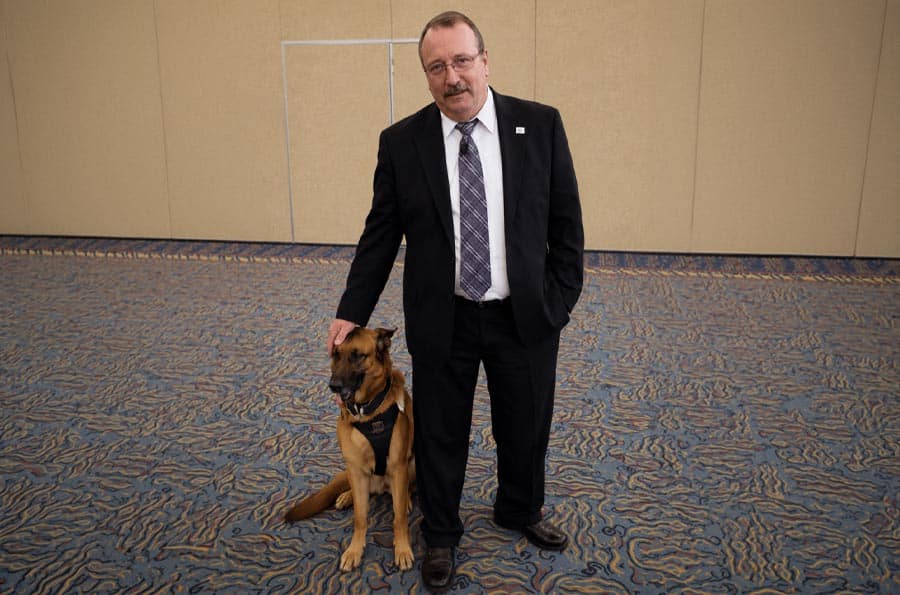
 When James “Jim” Walters took over as the program administrator for the AMBER Alert Training and Technical Assistance Program in July 2014, he wasn’t exactly the new kid on the block.
For the past 10 years he had been working with the program by overseeing the AMBER Alert in Indian Country and 6 of those years he also headed the Southern Border Initiative, a program that has been working to coordinate child abduction recovery efforts in Mexico and border states in the U.S.
Walters grew up in rural east Texas and Oklahoma and decided to join the military instead of working on a farm or in the oil fields. He spent more than 35 years in law enforcement and the military including working as a military police officer in Alaska, patrol officer in southern California and command positions in northern California and Texas.
Since Walters once again lives in Texas, wearing two hats just isn’t enough. Here are a few more caps he’s still wearing:
- Program Administrator for the National Criminal Justice Training Center.
- Founder of a non-profit group to assist developing counties and rural U.S. areas develop safe havens for abused, exploited and trafficked women and children.
- Founder of another non-profit organization that supports other non-profit organizations to develop security and protective services for free.
Despite all of his experience, Walters said it was a challenge to take over the U.S. Department of Justice AMBER Alert Program that had been overseen during its first 10 years by Phil Keith. “I was very fortunate to follow Phil in this role,” said Walters. “Not only had he developed the program, he acted as a mentor to me and others. The most important thing we learned from him was, ‘It’s about the children.’ All of the things we do are about protecting children.”
Walters said the best part of the program is the staff and consultants with first-hand experience who provide training. The program also relies on more than 100 law enforcement training academies and the National Center for Missing & Exploited Children (NCMEC) for research and training.
Funding for training continues to be an ongoing problem for federal, state and local agencies. “Our challenge is to utilize the resources we have and work with them to make sure that all communities, no matter the size, status or makeup, have the ability to obtain the best training and technical assistance possible,” Walters added.
Reductions in funding mean the trainers are now going to law enforcement academies instead of flying all their officers to where the trainers are located. Other cost-saving measures include “train the trainer” programs and providing more online training.
“We also want to focus on some of the underserved communities, improving capabilities and recovery rates in minority and rural communities,” said Walters. “We are going to stick with the things that have made such an impact in the past.”
“I remembered this officer who told me how the training really helped when an AMBER Alert was issued. I believe drawing on the right resources and improving the speed and efficiency of their response can make the difference between the safe recovery of children or losing them.”
One area that will be expanded is training for a Child Abduction Response Team or CART. “CART is one of the greatest tools in the fight to save abducted children,” said Walters. “I wish more communities had them. They really make a difference in tribal, rural and minority communities where resources are scarce.”
Walters also plans to make sure two of the programs he has been personally involved in remain strong.
AMBER Alert in Indian Country
“Anyone who knows me is aware that Indian Country is where my heart is,” said Walters. “Not only from living and working in tribal communities, but because of the commitment these communities have to protect their children. The AMBER Alert in Indian Country project is one of the most gratifying projects I have ever worked on.”
Southern Border Initiative
“I was recently at a meeting with officials from Mexico and we realized more than half of those initial participants in the initiative were no longer alive. They had died in the line of duty. We seldom think about the huge risk and the courage required of our brothers and sisters across the border. It is an honor to work with them.”
In the end, Walters said family members of missing and abducted children have had the most profound impact on him and motivates him to keep working hard. “Having a family member of a missing child come up to me and thank me for the work we do. That is what it is all about.”